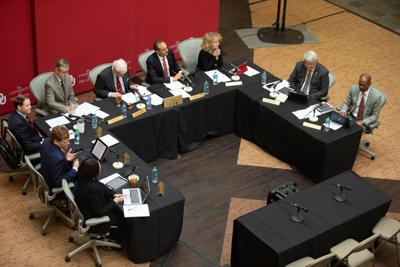

The OU Board of Regents approved a search committee for a new College of Law dean, an easement of North Flood Avenue near Max Westheimer Airport and extended sick leave benefits in its meeting Thursday afternoon.
Also on the agenda are purchases for Love’s Field’s scoreboard and its playing field.
Follow along for live updates:
5:11 p.m.
This meeting is adjourned.
5:10 p.m.
The board approved the 2023 fiscal year.
5:09 p.m.
OU Board of Regents approved an expansion for the Sam Viersen Gymnastics Center with an estimated budget of $15.9 million for improvements.
The board also approved the North Flood Avenue easement project, which includes temporary construction and right-of-way easements requested by the city of Norman to build a multimodal path along the west side of North Flood Avenue. The land borders Westheimer Airport.
A multimodal path is a pathway that allows for multiple types of transportation for travelers.
5:08 p.m.
OU Board of Regents approved the naming of a modernized men’s and women’s clubhouse and the full university golf training areas after longtime donor Jerry Ransom. Charlie Coe, legendary professional golfer and whose name is currently honored at the Charlie Coe Golf Center, will be honored inside the clubhouse and in the naming of its driveway, according to the agenda.
5:07 p.m.
OU Board of Regents approved the dean search for the College of Pharmacy dean and the Global OU Bylaws.
5:06 p.m.
The Board of Regents approved a search committee for the College of Law dean co-chaired by OU Vice President and General Counsel Armand Paliotta and Dodge Family College of Arts and Sciences Dean David Wrobel.
The current dean, Katheleen Guzman, announced her decision to step down at the end of the academic year in early October.
Along with Paliotta and Wrobel, College of Law professors Steven Gensler and Liesa Richter along with Kenneth E. McAfee Centennial Chair in Law Megan Shaner are on the search committee.
Department of Political Science Chair and professor Alisa Hicklin Fryar, Department of African and African American Studies professor Kalenda Eaton, Department of Modern Languages, Literatures and Linguistics Chair Nian Liu, College of Law's Dean of Student Engagement Jennifer Needham and former Assistant Dean for Students and staff member Stanley Evans along with Brady Trantham, content writer at the Office of Marketing and Communications, will also be members of the committee.
Second-year law candidate Catherine Hensley will be the student representative. Artoush Varshosaz, litigation lawyer at K&L Gates LLP in Dallas, Texas, will be the external community member on the committee.
5:05 p.m.
The board approved OU’s consent items. Included in these are a scoreboard purchase and a softball playing field purchase for the new softball stadium, Love’s Field. The scoreboard project is estimated to cost over $1.4 million, and the acquisition and installation for the softball playing field is estimated to total about $1,053,945.
Included in academic personnel changes, the regents approved a salary of $160,733 for 12 months for Kelvin White, who was appointed interim dean of the Honors College last month. White replaces former interim Dean Rich Hamerla, who stepped back to return to teaching. The Honors College has had three interim deans since 2017.
4:50 p.m.
OU President Joseph Harroz Jr. welcomed Tomas Diaz de la Rubia, vice president for research and partnerships, to give a presentation on research updates on campus.
Rubia said OU’s research strategy emerges from different challenges, including geopolitical instability, global technology development, environmental degradation, social injustice and global pandemics.
“How do we think about research? Because that's what this all comes from the planet today the world faces really dire, serious, grand challenges in the 21st century, and we know that we live in a geopolitical environment that is extremely difficult,” Rubia said.
Rubia said the university is focused on growth by investing roughly $2 million in seed grants that enable faculty to focus on research. This investment grew into $45.7 million in new external grants, according to his presentation. Rubia said 73% of the funds go back into supporting faculty, students and staff to keep growing research.
OU-Norman’s research expenditures have grown 50% from 2019 to 2022.
Awards to the university grew by 33% for sponsored awards and 53% for federal sponsored awards.
Considering accelerating anthropogenic climate change, Rubia said OU is helping the country and world adapt to this acceleration through data and research.
“If we're not able to tell with accuracy what's going to happen in the future, it is very difficult to think about (adapting) when you're always running behind,” Rubia said. “So this university has been for a long time very focused on the science of adaptation to the environment.”
Rubia presented GeoCarb, the world’s first geosynchronous greenhouse gas measuring satellite. Geocarb, led by Berrien Moore, dean of the College of Atmospheric & Geographic Sciences and director of the National Weather Center, is a $178 million collaboration between NASA, OU and Lockheed Martin to study the carbon cycle from geosynchronous orbit to advance climate science.
Rubia presented HORUS, an advanced weather radar funded by the National Oceanic and Atmospheric Administration’s National Severe Storms Laboratory. HORUS is an all-digital polarimetric phased array radar capable of obtaining data to help understand and predict severe weather.
Rubia said OU will be the first institution, funded by the National Science Foundation, to connect artificial intelligence and weather research to better understand severe weather and how to better prepare communities.
OU will also be launching a new Materials Science interdisciplinary Ph.D. program, according to Rubia.
4:45 p.m.
OU President Joseph Harroz Jr. recognized the improvement Regent Bob Ross spoke about regarding the Hudson College of Public Health.
“We have to, and we've known this for a while, that we have to be an academic health system that lifts the health of the state,” Harroz said.
Harroz also said the Oklahoma legislature is part of the reason OU’s Health Sciences Center is able to be successful.
4:39 p.m.
The board moves to discuss University of Oklahoma matters.
President Joseph Harroz Jr. recognized Rep. Mark McBride (R-Moore), calling him a “champion of higher education” and a “voice of reason.”
Harroz welcomed Student Government Association President elect Caden Glasscock and Vice President elect Cyrus Mortazavi. The pair will be sworn-in on Wednesday.
4:31 p.m.
The board moves to discuss Rogers State University matters. The board will pivot to OU following all RSU items.
4:28 p.m.
The board moves to discuss Cameron University matters, which include program changes and personnel items.
4:18 p.m.
Regent Bob Ross said grant funding increased 25.8% since 2022 for the Hudson College of Public Health.
4:12 p.m.
Regent Anita Holloway said OU’s Norman and Health Sciences campuses received “unqualified opinions” for their external audits of the past fiscal year. This rating, Holloway said, is the highest level of assurance the university can receive and is a clean rating.
In January 2024, the board will vote on increases and decreases to fees on both campuses, according to Holloway.
4:09 p.m.
Regent Eric Stevenson announced that in December the university will be rolling out a generative AI program so students and faculty can utilize artificial intelligence in the classroom starting in January.
4 p.m.
The meeting has started. The meeting starts with approval of the September meeting’s minutes and then will pivot to committee reports.
The board will discuss consent and action items for Cameron University and Rogers State University before pivoting to OU.
Regent Rick Nagel announced the university is restructuring University College, instead of having incoming students enter straight into their respective declared program.


