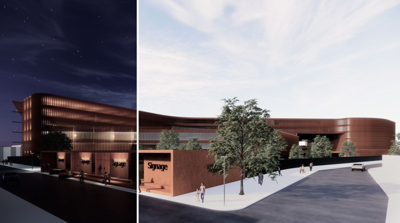

After a semester’s work, a class of 17 OU students at the Christopher C. Gibbs College of Architecture debuted their redesign of the Oklahoma County Detention Center Dec. 2, which includes elements they believe could be implemented in prison systems around the world.
The redesign project — titled “Reconstructing Incarceration” — focuses on alleviating the architectural issues within the jail that impact the mental health of incarcerated individuals who are awaiting trial. J.D. Zogg, the project lead, said students participating in the project learned about the incarceration system for three weeks at the start of the semester and spent six weeks designing the project.
The shape of the redesigned building is unique, as it avoids the x-shape design of the current jail by opting for a circular structure to make the rooms more “organic and habitable,” said Sager Alghanim, a student who worked on the project.
The inclusion of sunlight, space for activities and opportunities for interaction with other people decreases the chances of a person in jail to have a mental health episode or to become hostile while incarcerated.
The low-security room plan resembles a suite with four people in a pod, while the medium-security pod holds two people. The maximum security pods will hold one person to maintain security guidelines. Each space is equipped with a source of sunlight and a desk area that encourages a sense of rehabilitation and ownership so people may “occupy their minds” as they await trial, Alghanim said.
“The idea of being under constant supervision by a person in power ignites a ‘fight or flight’ type of environment,” the presentation shown at the debut event read. “A continuous feeling of anxiety makes people resort to actions they would not typically perform. Removing constant invasiveness will lead to more humane environments and fast development of autonomy.”
Space outside of the jail is incorporated in the redesign with plans to have one area as a visitation space and another exclusively for the use of incarcerated individuals. According to the presentation, these encourage “peace, rehabilitation, decreased hostility and health benefits” by incorporating green space and developing gardening and outdoor programs.
Alghanim said the redesigned visiting areas support the idea of having “freedom of movement” between those incarcerated and their families. It will allow them to walk around the entire visiting area instead of constricting visitations to one room.
Sustainability was also a focus of the project to “meet the needs of today without sacrificing the needs of tomorrow.” The project makes energy in the prison 48.5 percent more efficient and will save 5 million pounds of carbon dioxide through the use of clean energy and solar panels.
“We’re not trying to reinvent the wheel, but go with the wheel,” Alghanim said. “If you reinvent the wheel, then it’s really difficult to make change.”
The exhibit also included a painting titled “Endless Overcrowding” by Casey Meyer, a student who worked on this project. The work seeks to demonstrate the relationship between the current U.S. jail system and the Transatlantic Slave Trade in the 16th-19th centuries by comparing the methods of imprisonment between the two time periods.
A class of first grade students from Highland Park Elementary School contributed their visualizations of what a jail looks like to the exhibit. The drawings depicted bars on windows with sad figures standing behind them, while others illustrated colorful buildings with “jail” written across the front.
Marjorie Callahan, a professor at the school of Architecture, said Gaylord School of Journalism and Mass Communications Dean Ed Kelly and the School of Architecture Dean Hans Butzer approached her and asked if she could begin looking at the project. Callahan led a Dream Course on the topic in the fall of 2020.
Callahan said she’s been working with the Oklahoma Jail Trust, a committee charged with evaluating the conditions of the current jail, to increase awareness surrounding the way architecture can play a major role in social change.
“Architecture can sit at the table,” Callahan said. “It’s not just a social issue. That’s the big idea.”
On Nov. 29, the Oklahoma County Jail Trust voted unanimously to advance recommendations to build a new jail. This vote came after Oklahoma County lawmakers, including Rep. Jason Lowe and Rep. Ajay Pittman advocated for reform within the detention center in response to 10 deaths in the past year, including six in 2021.
“My hope is that together, we can institute positive change and make the Oklahoma County jail a safe and healthy environment for both inmates and detention officers,” Lowe said at a press conference.
During the semester, Zogg said his group was preparing for a presentation in Washington D.C. to the Federal State Department which ultimately gave the students “a lot of good feedback.” He said he hopes to reach a legislator to further the conversation with the Jail Trust Committee to try and relieve some of the overcrowding currently happening at the jail.
“It’s not necessarily just about the actual image of the building,” Zogg said. “It’s more about the principles that we’re doing bad things and principles that we’re missing that we need to work on.”


