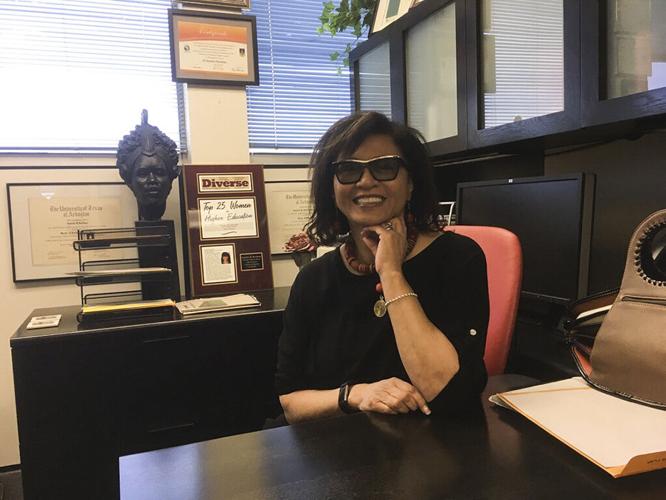

Sitting in her brightly lit office, her Outstanding Woman in Higher Education Award resting on the corner of her desk, Jeanette Davidson smiled as she reflected on her time at OU.
"I've got so many good things that have happened to me, and I've just had some really wonderful opportunities. It's been a great joy," Davidson said. "I'm very blessed."
After 26 years, Davidson, a professor in OU’s African and African American Studies Department, will leave OU in May to become the director of the Center for Societal Impact and a professor of instruction at the University of Texas this fall.
Those who know Davidson said the impact she will leave at OU is immeasurable.
"There are some people who really do make a difference, who really take the lives of others into consideration and do everything in their power to benefit other people," said Tammara Williams-Dias, an adjunct professor in the department of African and African American Studies and one of Davidson's mentees.
Davidson is one of those people, Williams-Dias said.
Originally from Scotland, Davidson moved to the U.S. with her husband shortly after getting married and earned her master's and doctoral degrees in social work from the University of Texas at Arlington.
Davidson taught at the University of North Texas and Columbia University before coming to OU in 1997, where she began teaching in the Department of Social Work before transitioning to African and African American Studies.
Unable to sell their house in Denton, Texas, Davidson and her husband made the two and a half hour drive to and from OU every day.
"I was really excited (to start at OU)," Davidson said with a laugh. "But I also remember thinking as I was driving up that first day, 'Oh, my goodness, it's a lot further than I thought it would be.'"
When then-OU President David Boren heard of the couple's commute and their dedication to students, he offered them resident faculty positions at Adams Center.
During their three years as faculty-in-residence, Davidson and her husband became notorious for hosting midnight breakfasts and creating opportunities for students to learn and build relationships.
"This will be my 26th year (at OU), and so I've got a lot of memories," Davidson said. "Of course, many of my memories are about students and I've just had some wonderful students."
One night in 2001, Davidson remembered walking past the cafeteria and hearing Scottish accents, an uncommon sound to hear more than 4,000 miles away from her home country.
She walked into the dining hall and learned OU was hosting study abroad students from Scotland. After getting to know them, the students and Davidson decided to host an event to celebrate Burns Supper, a Scottish celebration to commemorate the life of poet Robert Burns.
Bagpipes played, there was a large dinner complete with Haggis, the national dish of Scotland dating back to the 15th century, and almost everyone wore kilts, she said.
"Somebody had an extra kilt and gave it to my husband," Davidson said. "It was so much fun, kilts and bagpipes were everywhere."
Davidson said getting to bring her Scottish roots to Norman and experience it with both Scottish and local students is one of her fondest memories from her time at OU.
Davidson said the majority of her favorite memories at OU involve interacting and building relationships with students. Some of her former students still call her today.
"It doesn't get better than that," Davidson said. "You have beautiful relationships with students, and you can teach them and you can mentor them. … That's just a real honor for me and something that matters to me."
Vincent Winston, owner of GB Travels and a 2010 African and African American studies and public affairs and administration graduate, said he's fortunate he had Davidson as a professor.

Professor of African and African American Studies Jeanette Davidson in her office April 20.
"College can be a very tough place to navigate both academically and personally," Winston wrote in an email to OU Daily. "Not only did (Davidson) push me on the academic side, her deep commitment to education included the whole person. I felt seen, heard, understood, and supported in ways that absolutely helped me graduate and start my career."
While studying at OU, Winston ran for Student Government Association vice president alongside presidential candidate Amanda Holloway in 2008. He said Davidson encouraged him even when he had doubts and helped him cope with his imposter syndrome — the internal experience of believing that one is not as competent as others may perceive them to be — when he was elected.
"(She's always) willing to go the extra mile for her students," Winston wrote. "I can't overstate the support, care, and love that exudes from Dr. Davidson."
Beginning in 1998, until the start of the COVID-19 pandemic, Davidson occasionally taught at several military bases in Germany, Iceland, Belgium, England and Florida through OU's Advanced Programs out of the Department of Human Relations. Through this program, active and retired military, as well as military spouses, earn a master’s degree in human relations or international studies from OU.
"It was fun because I got to travel, but I also got to teach and have a whole view of the life of people that are serving in the U.S. military that I would never have had … (without) the university," Davidson said.
Davidson said she is proud OU offers the program, as some of the people stationed abroad wouldn't earn a degree otherwise.
"People who never even came to Oklahoma could get a degree from the University of Oklahoma," Davidson said. "It's amazing."
In 2002, Davidson became the inaugural director of the African and African American Studies Department, which was a provisional program at the time.
"(It was) hanging on by a shoestring," Davidson said. "It could have been cut at any point."
Within a year, OU made the department permanent, expanded its curriculum and increased faculty, Davidson said.
"There was huge growth in African and African American Studies and I'm proud of that. That was very important to me," Davidson said.
The African and African American Studies Department was one of the earliest departments to host campus-wide events and increase outreach to surrounding communities by inviting speakers and community members to the events as well, Davidson said.
She said she wanted the department to be a home for students and a place where they not only gain knowledge, but learn how to apply it.
"The original intent with Black Studies or African and African-American Studies is what we learn. We then need to utilize for the good of the community and the community at large," Davidson said.
Valerie Grim, president of the National Council for Black Studies, said what Davidson accomplished at OU was tremendous.
"She did a lot of it as a ‘one-woman show,’" Grim said. "She didn't have a big faculty, although she had affiliate faculty who could step in and help do something, but she was the anchor and I think she anchored that program very well."
Grim said when she visited Davidson at OU, everywhere they went on campus people knew Davidson and stopped to say "hello."
"She is a people's person. She's a community person. She's the kind of person that cares that a person feels connected," Grim said.
This, Grim said, is the embodiment of what Black Studies is about: inclusiveness and community.
"We are very concerned about humanity, and we are very concerned about inclusiveness,” Grim said. “We want a big tent. Anybody is welcome to be a part of our organization, and I think (Davidson) is a living example of that."
In addition to her roles at OU, Davidson serves as a member of the National Council for Black Studies board of directors, the Southwest Center for Human Relations in Education’s executive board, an affiliate faculty member of the Black Europe Summer School and a fellow of the Molefi Kete Asante Institute in Philadelphia.
Stephen Small, an affiliate faculty member of the Black Europe Summer School, wrote in an email to OU Daily stating he, along with his colleague Kwame Nimako, immediately invited Davidson to be a faculty member after hearing about her research, publications and her active involvement in Black Studies organizations.
"Some academics have narrow minds, but not Professor Davidson. She is an intellectual in the true and broadest sense of the word," Small wrote. "I have no doubt that her career and her life have brought insight, understanding and indeed empathy to the lives of thousands of her students, and even more readers of her writings."
After 15 years of serving as director of the African and African-American Studies Department, Davidson stepped down from the role in 2017 to return to teaching and to finish her book “Black Lives in Scotland: Telling Our Stories” and edit the second edition of the textbook "African American Studies."
Karlos Hill stepped into the role and served as department chair until June 2022 when Greg Graham took over the department.
"(Teaching is) a real honor for me and something that matters to me," Davidson said. "You want to see students reach their potential, and sometimes students come in and they don't actually see it in themselves, but I can see it."
In 2018, Davidson was selected by the publication Diverse: Issues in Higher Education as one of 25 outstanding women in higher education for her contributions and leadership in academia. The women were chosen for tackling challenges in higher education, exhibiting extraordinary leadership skills and making a difference in the community, according to OU's website.
As Davidson prepares to depart from OU and begin the next phase of her career, those who know her don’t doubt that she will continue to do incredible work.
As director of the University of Texas’ Center for Societal Impact, Davidson said she hopes to make a positive impact on society, looking at issues such as housing, mental health and disability. At the center, Davidson said they will be conducting research and shaping curriculum around these issues in order to engage faculty and students.
"I hope that everything she is dreaming becomes a reality because I sense what she's dreaming when I talk with her," Grim said. "She wants to make a better world.”
Davidson said she is grateful for the positive relationships and experiences she has had during her time at OU, and for the work she was able to do in the Department of African and African American Studies.
"I wish all my friends and colleagues well. I look forward to maintaining lifelong friendships with people I met at OU," Davidson said. "I am particularly thankful to have taught and mentored so many wonderful students, in African and African American Studies, in social work and human relations, at home and abroad. I hear from many of them from all over the country and all over the world which brings me great joy."
This story was edited by Karoline Leonard, Alexia Aston and Jazz Wolfe. Grace Rhodes and Nikkie Aisha copy edited this story.


