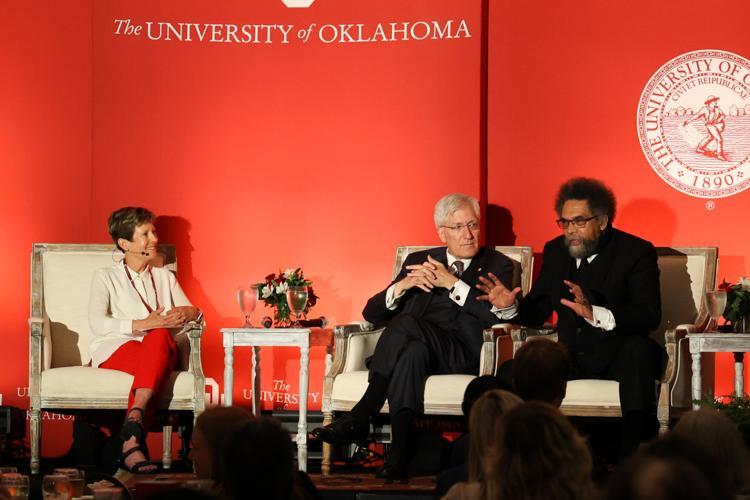
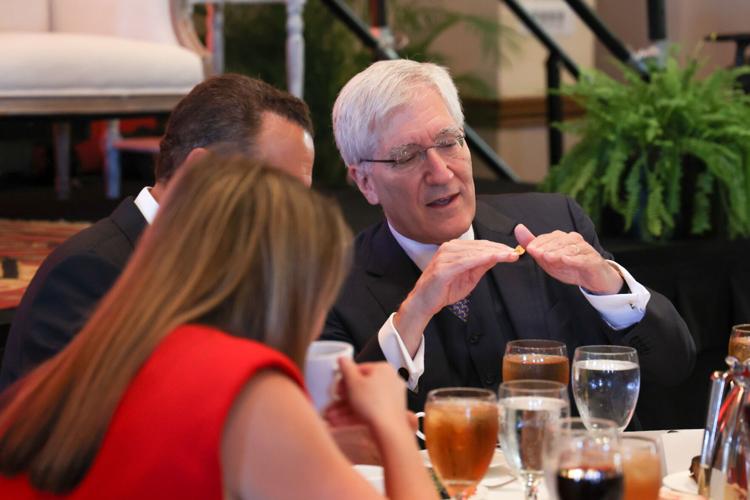
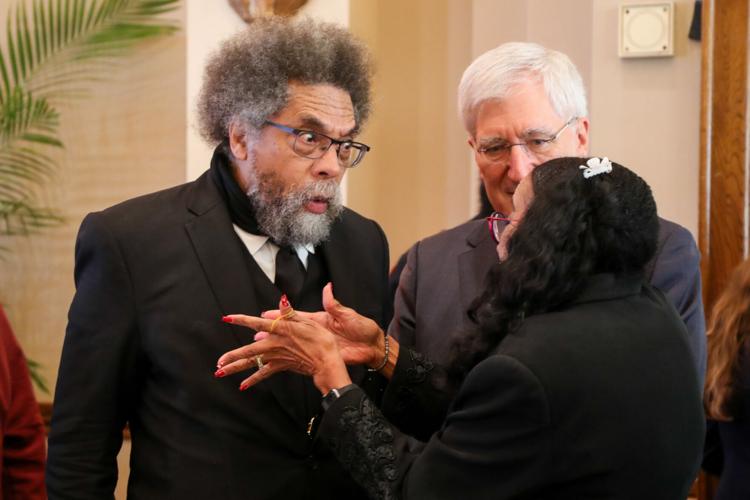
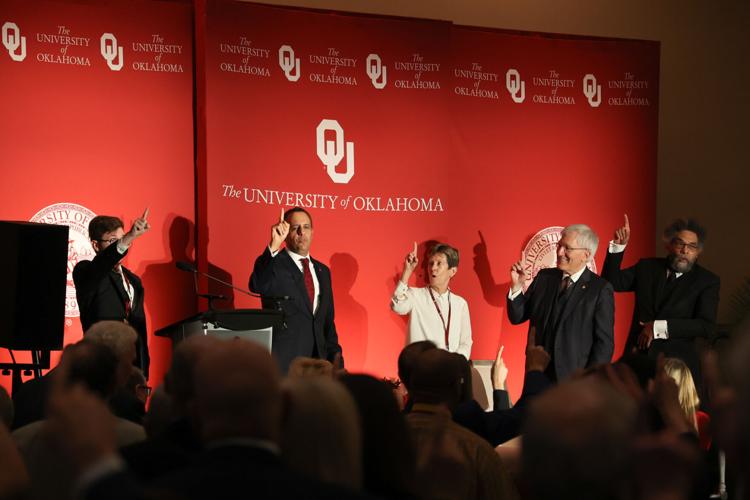
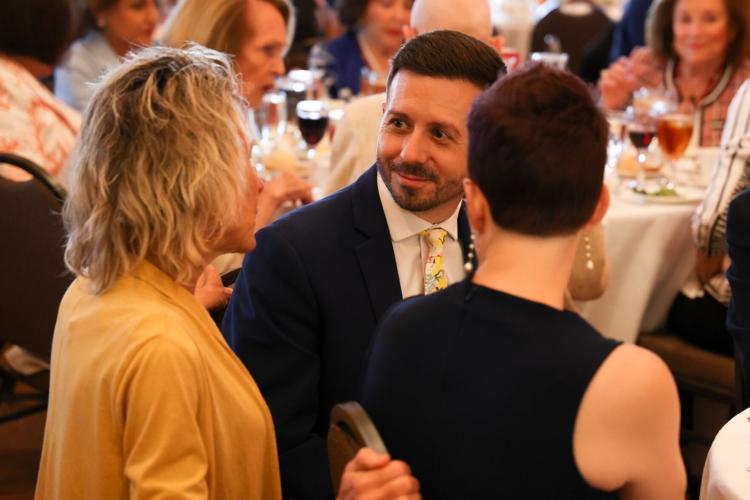
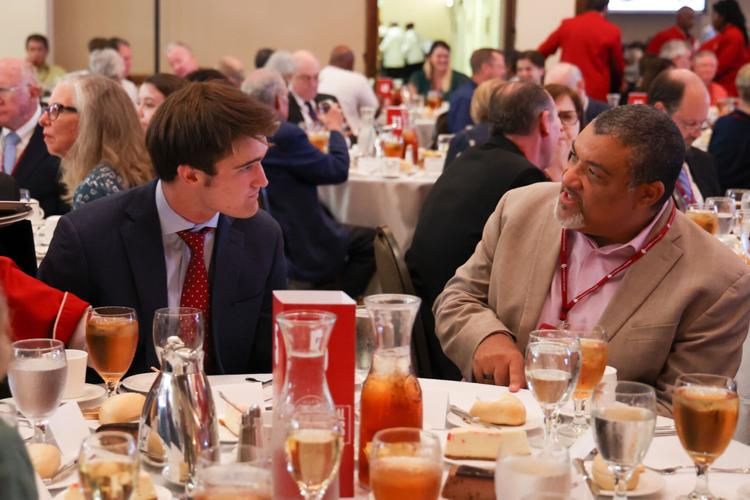
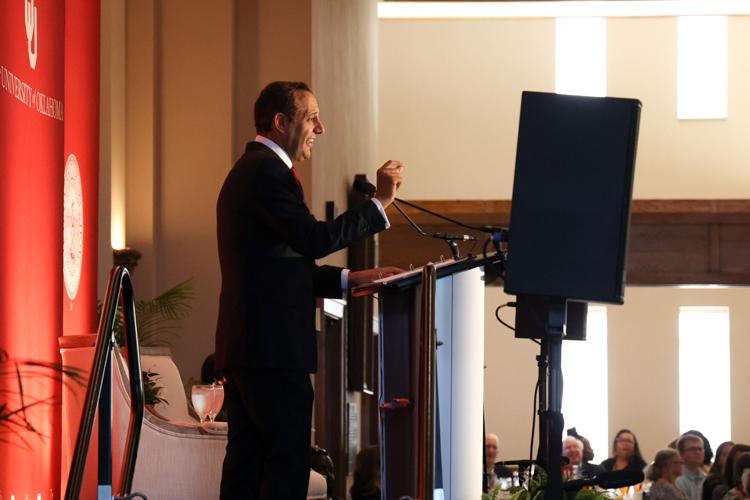


OU held the fall 2023 Presidential Speakers dinner with guest professors from Princeton University and Union Theological Seminary at the Molly Shi Boren Ballroom inside the Oklahoma Memorial Union on Thursday.
The dinner was formatted as a point and counterpoint discussion between guest professors Robert P. George of Princeton University and Cornel West of Union Theological Seminary revolving around points on opposite sides of the political spectrum. OU history professor Anne Hyde served as the moderator.
In a room full of food, drinks and chatting, the event counted approximately 700 guests composed of students, faculty and alumni who were eager to listen to the professors’ discussion.
According to a university press release, George is a professor, author and former judicial fellow at the United States Supreme Court. He received several recognitions over his career, including the U.S. Presidential Citizens Medal. He holds 22 honorary degrees and also served on the President’s Council on Bioethics.
West is the Dietrich Bonhoeffer chair at Union Theological Seminary. According to the release, he is passionate about communicating with the public in order to keep the legacy of Martin Luther King Jr. alive. He has written 20 books, including “Race Matters,” “Democracy Matters” and his memoir, “Brother West: Living and Loving Out Loud."
After introducing the members of the Board of Regents and guests of honor, President Joseph Harroz Jr. reflected on the changes of higher education across the country and how he’s working to give a quality education to students coming to OU.
“You have to be both affordable and excellent. If you're not both, students will not come there,” Harroz said. “You have to be a great, valuable institution, but you also have to make sure the American dream is alive in public higher education.”
Harroz’s comments on affordability come after the OU Board of Regents approved a 3% tuition raise in June of both in-state and out-of-state students.
As the discussion started, George and West reflected on how they met and their relationship over the years.
The pair met at Princeton University and became friendly acquaintances, George said, but it wasn’t until one day when West requested to interview him for a school publication that they established a closer relationship.
When asked about political disagreements with close relatives, West said love is not reducible to politics and that society is very polarized in themes like culture, gender and religious identity.
“You lose your democracy when you don't have citizens who are willing to speak their minds up and courageously say what is on their mind,” West said.
George said intellectual humility, the virtue of recognizing someone might be incorrect, is missing in today’s society and without it, democracy could collapse. He asked faculty members and parents in the audience to urge this virtue to students.
West said courage is being pushed to the margins of society and there aren’t enough people who can encourage generosity.
George and West both said they teach the students in their seminar class that they need to learn how to be more open and vulnerable with other human beings.
“Education itself is an eventual vision of moral and spiritual greatness and that's very important,” West said. “That's why me and (George) tell our students they come into this class to learn how to die. Love of Western philosophy is beneficial in preparation for death … to learn how to love in the form of death because you have got to be able to kill the cowardliness, the fear, the narcissism … at least for a while to be open enough and vulnerable enough to fall in love and become entangled with another human being.”
George said humans tend to wrap their emotions on their beliefs and need to learn how to manage disagreement. He said if people wrap their emotions too tightly, they can react to it in an arrogant manner and treat people who disagree as an enemy.
He said that while he and West often disagree, they discuss the point of each issue and trust each other's point of view, because he knows they are both seeking a common good.
“It's up to us to practice virtue, to exemplify virtue, to impart to our young men and women the virtue of understanding our disagreements as opportunities to try to get through to understand our interlocutors (and) our conversation partners. Not as enemies, but as friends,” George said.
After being asked how critical race theory is being restricted in Oklahoma by an audience member, West said he is committed to fight for justice and truth.
“Our students really deserve to hear what reasonable people of good will have thought and said about the big issues ... That's what it means to serve our students,” George said. “Our fundamental job is to serve our students, and that means that we have to give them the best arguments that have been advanced on all sides of questions and leave it to them to decide by the exercise of their own intelligence where they think the dream was.”
Paul Ryan, former Speaker of the U.S. House of Representatives, will speak at the spring 2024 Presidential Speaker Series and the theme will be “The State of American Politics.” The event will be at 6 p.m. on March 27 at the Molly Shi Boren Ballroom inside the Oklahoma Memorial Union.
This story was edited by Peggy Dodd, Taylor Jones and Alexia Aston. Cooper Marshall and Grace Rhodes copy edited this story.


