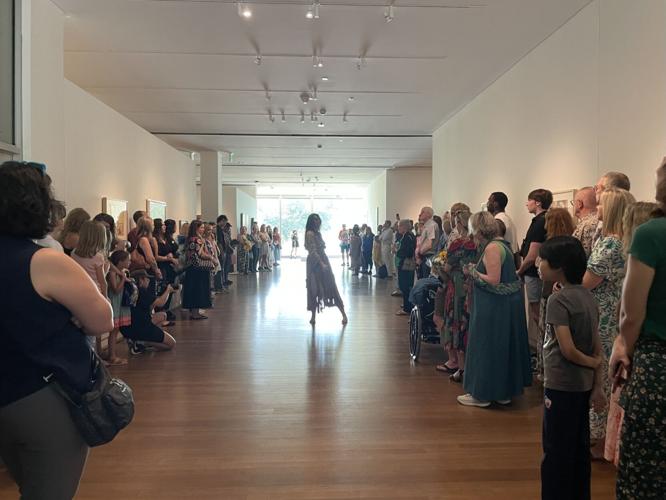

While preparing his piece for the OU School of Dance summer intensive, choreographer Raúl Tamez wanted to instill a complex narrative in the minds of the young dancers he taught.
Tamez, director of La Infinita Compañia in Mexico City, was invited to Norman to choreograph a contemporary dance piece for the School of Dance summer intensive, as a reaction to the Fred Jones Jr. Museum of Art temporary summer exhibition “Un/Natural Selections: Wildlife in Contemporary Art.”
The summer intensive program featured guest artists to teach choreography to dancers ages 14 to 20, aiming to provide comprehensive experience through high-level training, focusing on ballet technique and modern dance.
The program also coincided with the School of Dance’s bachelor of fine arts summer session, which allowed dancers to collaborate closely with OU students.
The “Un/Natural Selections: Wildlife in Contemporary Art” exhibition was organized by the National Museum of Wildlife Art and uses animal imagery to address humanity’s interconnectedness with the natural world.
On Saturday, the summer intensive program ended with a final performance featuring six pieces taught by guest choreographers ranging from modern ballet to hip hop and a 36-minute-long piece choreographed by Tamez, inspired by the Fred Jones exhibition and titled “Cielo Rojo,” or “Red Sky.”
Among the choreographers were Nick Mullikin, María Solera, Kara Wilkes, Roxanne Lyst and Michelle Rambo.
While the first five pieces were performed on the main stage of Holmberg Hall, “Cielo Rojo'' began in the lobby of the building, where guests were instructed to gather following a 15-minute intermission. As the performance continued, dancers led the guests outside the building and into the museum.
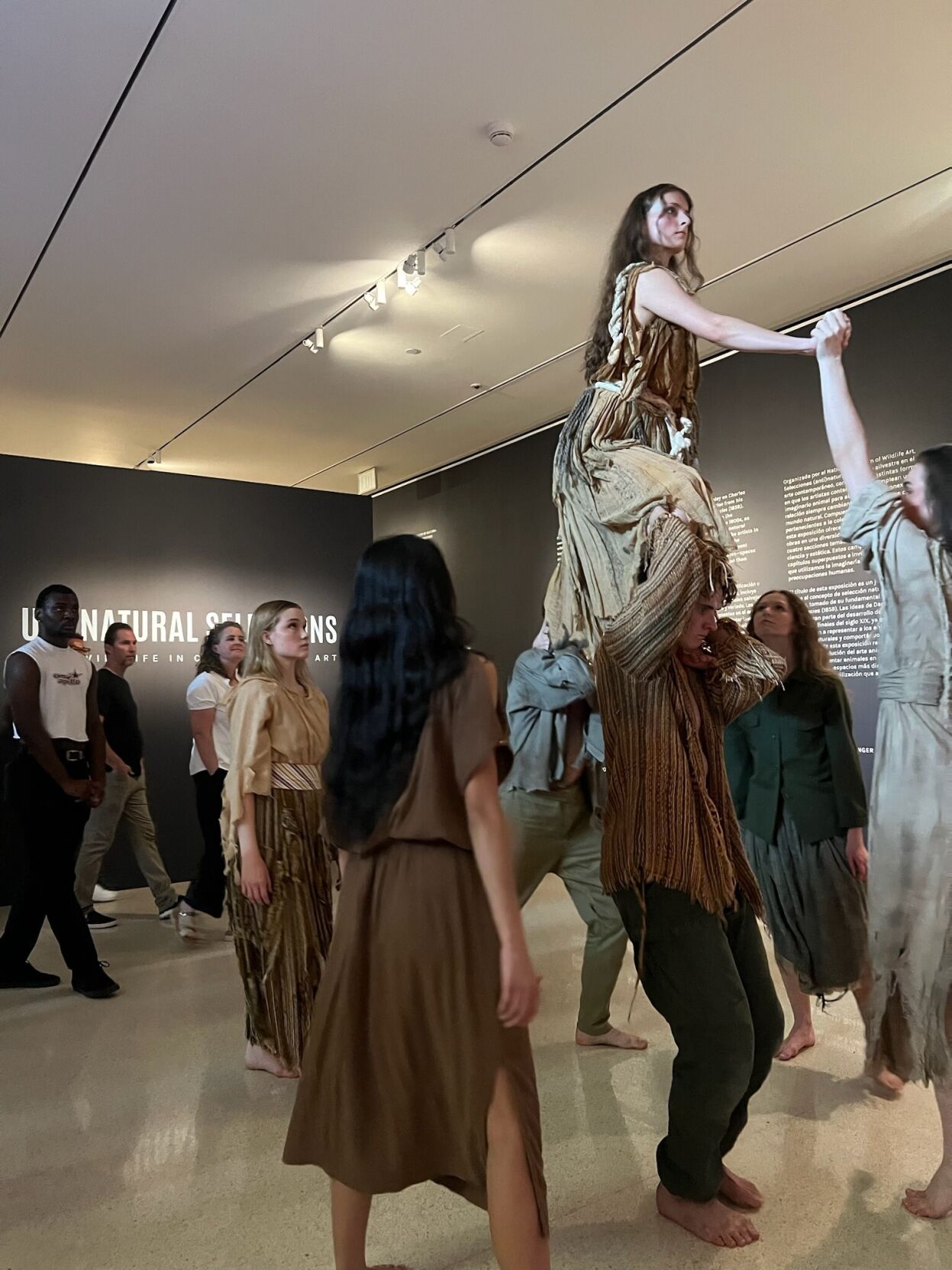
OU dancers performing "Cielo Rojo" at the Fred Jones Jr. Museum of Art on June 29, 2024.
Audience members were guided through the museum with the dancers only a few feet in front of them. The performance moved through the Un/Natural Selections exhibition and ended in a large studio on the lower level of the museum.
Music and design choices reflected the themes of the piece, which Tamez described as being the tension between life and death, the natural and unnatural.
Tamez said he found the exhibition also draws connections to Native American communities and symbols along with the wildlife and natural imagery it highlights.
“In Mexico, we have 63 official languages, and each of the languages represents, of course, an Indigenous community,” Tamez said. “We are talking about Indigenous communities that are in danger of (extinction) … it is very relevant if we consider that as part of our culture and the responsibility that we as a young generation have in order to give the importance that it has to those symbols.”
The final piece was immersive, with dancers leading the guests with their movements and emotions. Tamez said he aimed to surprise the audience with an unexpected performance.
“They will have to make decisions, and they will have to … find a good perspective of the scenes that they see and the fact that lots of unexpected scenarios will come,” Tamez said before the performance.
Tamez said he has found that the way people express emotions in the U.S. differs from how they do in Mexico, which proved challenging for him as a choreographer.
“In the United States, it's becoming more and more difficult for the people to have physical contact between them,” Tamez said. “It’s like if communicating through the body would be almost impossible or morally incorrect. And that's one of the things that is probably disconnecting us from our origins, from our roots.”
Similar to Tamez’s interpretation of the exhibition, incoming ballet and biology freshman D’Anise Chavez said she felt the dance piece showed how humanity has advanced but simultaneously created problems that prevent indigenous tribes from prospering.
She said performing “Cielo Rojo” allowed her to connect with her own cultural identity as it represented Juarez, Mexico, the city Chavez is from.
“I've never been able to connect to a piece about my culture, so that was really nice to be able to break out of my technical shell while also representing my culture in a way,” Chavez said.
While choreographing the piece, Tamez said he gave dancers references and tools to push them to connect with their emotions and move organically.
“We are absolutely absorbed by the internet and by the screens, and that's something that I detect as a foreign choreographer (and) a foreign artist in the United States,” Tamez said. “In Latin America, you can find a lot of connection with music, with eye contact, with touch, with moving the hips, connecting the feet on the ground. There is a lot of ritual. There's a lot of music in the streets, and that's something that is in danger of (extinction).”
Kathryn Hensley, an incoming ballet freshman from Atlanta who participated in the summer intensive program, said Tamez’s instruction took her out of her comfort zone as Tamez coached through improvisation techniques, such as using their voices and improvising as animals.
“I feel like I learned a lot from watching other people and how they interpreted his ideas versus how I did,” Hensley said. “I liked being able to do my own thing in a way that was also along the lines of where he wanted to go with his vision for the piece.”
As a ballet dancer, Hensley said she enjoyed getting to work on a less structured contemporary piece.
“It was very pushed out of my comfort zone, because normally, whenever I do a modern style or contemporary, it's very structured,” Hensley said. “I've never really performed (like) that in a way, and especially never with an audience so close, like you could see them.”
According to incoming ballet freshman Andrew Parson, Tamez’s attention to themes played a crucial role in his teaching style.
“We had to not just train or not just copy his movement and make it look good on us, but we had to understand the themes that he was giving us and figure out for ourselves how to express that through our movement,” Parson said.
Parson said he was drawn to the way “Cielo Rojo” portrays nature and wildlife and that the piece reminded him of the importance of preserving the ecosystem.
“Throughout the piece, there were a lot of people reenacting animals and embodying animals, and I think for me, that was my favorite part,” Parson said. “Not just trying to pretend to be an animal, but (understanding) that animals in nature are important to our world.”
Hensley, Parson and Chavez come from ballet backgrounds, so working with Tamez provided new and unique dance experiences.
“He had a very unique teaching style and movement style, which was something I had never experienced before,” Parson said. “I've really just been a classical ballet dancer, and while there's so much to that, there is so much more in the world of dance, and this summer really just opened my eyes to different cultures and different ways of movement.”
This story was edited by Ana Barboza and Taylor Jones. Riley McDaniel and Avery Avery copy edited this story.


