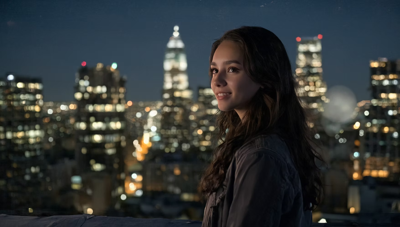

The introduction of AI actor Tilly Norwood to Hollywood this year has sparked concern among OU School of Drama students.
AI talent studio Xicoia, powered by AI production company Particle 6, created Norwood, marking AI’s integration into the acting and film industry.
When Particle 6 founder and CEO Eline Van Der Velden debuted Norwood and Xicoia at the Zurich Summit, part of the Zurich Film Festival, she faced backlash over the ethics of creating an AI actress.
OU acting major Isabella Kopec said she uses and enjoys other forms of AI but is uneasy about its potential to replace actors.
“I think that AI is so wonderful in so many different ways — like I can’t say I’ve never used ChatGPT before,” Kopec said. “But I think that with AI, it scares me to think that other humans would rather watch someone who doesn’t understand the human experience try to tell it for them.”
Kopec said her opinion stems from the fact that Norwood lacks lived experiences that human actors can pull from.
“I think that a robot can’t really capture the real feelings that we feel. Like an AI actress isn’t going to be able to know what it feels like on your first day of kindergarten, or like when your first pet dies,” Kopec said. “I think that we as humans are the only people who can understand what other people go through.”
Online, Norwood is treated like a real actress, with her Instagram including AI-generated photos of her cramming to finish an essay or taking nature pictures — creating the illusion of a real person.
The captions are written in first person as if Norwood wrote them, giving her a backstory as a broke university student.
Kopec said this personification bothers her as she believes Norwood should be presented as technology, not a human being.
“I think it should be treated as a technology,” Kopec said. “When it boils down to it, there’s no person there, I’m not gonna go and be able to meet her. She doesn’t have a past, I guess she has a future, but she doesn’t come from anything.”
Generative AI models trained on real-world actresses were used to create Norwood, which has fueled debate about her existence.
The Screen Actors Guild and the American Federation of Television and Radio Artists, said in a statement that Norwood “creates the problem of using stolen performances to put actors out of work, jeopardizing performer livelihoods and devaluing human artistry.”
Similar concerns with generative AI have been raised in the past during the 2023 Hollywood writer’s strike of Writer’s Guild of America, which SAG-AFTRA joined, based on issues of compensation, low residuals and regulation of AI in Hollywood.
This initial cry against AI also argued for creative rights, as WGA voted AI can’t and shouldn’t be a credited writer.
Kopec said Norwood’s creation is unethical and undermines the work of real actors.
“I just think that’s such a rip off, that’s taking other people’s unique talents and personalities and things that they’ve put so much time and effort into working on,” Kopec said. “I’m going to school for four years to get better. These other actors, I’m sure, did the same thing.”
Another concern for Kopec is how an AI actress, unlike her human counterparts, can have no imperfections.
“It just makes me get in my head, because it’s like, ‘Wow, I’m competing with the perfect person,’” Kopec said. “This person has been built to be beautiful and have the perfect body and basically be perfect at what they’re doing.”
Kopec said imperfections are what makes performances compelling.
“I think that the most interesting people to watch on stage or in film are people who aren’t perfect,” Kopec said. “That’s what viewers connect with the most.”
Several well-known actresses have discouraged companies from signing Norwood, including Oscar nominee Emily Blunt, who said on a Variety podcast after being shown the AI actress, “That is really, really scary. Come on, agencies, don’t do that. Please stop taking away our human connection.”
Despite the backlash, Kopec said she believes Norwood, and AI actors in general, could rise in popularity due to low cost and convenience.
“I honestly think it could go one of two ways,” Kopec said. “I think that people could realise that it is cheaper and easier and it could start taking off. I think if that were to happen, we would lose so many people.”
Another reason Kopec worries AI actors will be favored is because they don’t require the same working conditions or accommodations as human performers.
“They can work as long as they want to,” Kopec said. “I’m competing against this person who it’s like, ‘How do you compete with that?’ I think that it just gets so tricky because then it’s like, what are the union rules.”
Norwood has yet to be cast in any projects outside of “AI Commissioner," a short comedy sketch created entirely by AI and released by Particle 6.
This story was edited by Madisson Cameron. Parker Newman and Gretchen Schultz copy edited this story.


