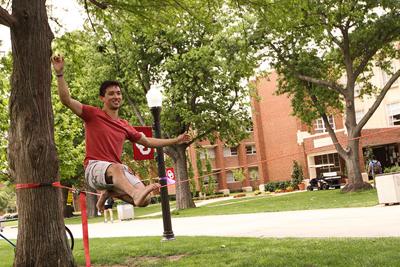

After spring break, Sandeep Ramesh, computer science senior, saw other students slacklining on the South Oval and felt prompted to join. Ramesh found a new community and stress reliever in the newfound activity.
“I’m just walking down the South Oval and I see this (slacklining) and just start wanting to walk it,” Ramesh said. “I just started getting into it because I used to get stressed out and needed something to take my mind off it.”
The other students Ramesh met while trying to slackline for the first time were very welcoming and encouraging with helping him understand how to do it correctly, Ramesh said. He is also glad most slacklining takes place on the South Oval because it gives him something to do in between classes.
Slacklining is the act of walking and balancing along a flat-like fabric, such as fiber or nylon, suspended from two different points. What makes slacklining different from tightrope walking is the materials used and in how the materials are set up. While tightrope walking involves a rope-like material suspended more tightly than a slackline, slacklines have more of a flat surface and are more flexible and loose.
Students have been slacklining on the South Oval for years. While it started as a small group, a large amount of students have been slacklining again on the South Oval the last few months.
An OU slacklining group called Sooner Slackliners includes about 130 members. The Facebook group is open for anyone to join and includes open updates from students within the group about who is slacklining and where. The past few years, the group has seen an uptick in the Facebook groups activity, said Nate Richbourg, chemical engineering junior and experienced slackliner.
A lot of the members have graduated or are going to, like Richbourg, said Rachel Yates, biology major.
Yates has been slacklining since she was a junior in high school. Now a sophomore at OU, she has begun to love the outdoor activity even more. Yates' involvement in the Sooner Slackliners makes the activity more enjoyable because she has more friends enjoying the same thing with her, she said.
Slacklining does take plenty of practice. Usually, an individual should practice multiple times a week in order to perfect his or her skills enough to call it a hobby. When Ramesh started after spring break, he wasn’t able to take even a few steps on the slackline, but now he has made significant progress, he said.
“It is a steep learning curve just because it uses muscles in your hips you don’t usually use,” Yates said. “Once you develop those it will get much easier.”
Richbourg, a more experienced member of the group, has been slacklining for years.
“I got into this as a break from climbing because that takes a lot of upper body strength and is a lot more exhausting,” Richbourg said. “It’s more balance and less muscle.”
While Richbourg has been climbing seriously for the past three years, he has been slacklining regularly this semester. Once he learned how to walk all the way across, he began to get more into it, coming out whenever he can and attracting others to do the same, he said.
“When I’m out here, people would walk and stare at me the whole time while I’m walking on this, up and down the South Oval. Eventually, some of those people would just, like, join me and stuck around,” Richbourg said.
Richbourg has also been trying his hand at a few slacklining tricks. Some of the tricks Richbourg has tried include doing spins or having two people walk toward each other at the same time on one slackline.
The trees on the South Oval in front of where Gittinger Hall used to be make for great support of the slackline, Richbourg said. The nice surrounding grass makes for a good cushion in case someone falls off. Another reason why the South Oval is a good place is because it's a space where everyone can hang out and even throw around a disc while slacklining, Richbourg said.
Richbourg’s slacklines cost him about $30 dollars from Amazon, which is very cheap, he said. He knows more people who are involved in Sooner Slackliners who own equipment that costs up to $800. Although Richbourg is not at that level yet, he looks forward to getting more expensive equipment in the future, he said.
Anyone can slackline if he or she continues to practice. Not everyone has the best balance, but he or she will develop his or her sense of it over time with practice. It's better not to give up over the first couple of failures, Richbourg said.
“The best thing about it is that I can study then slackline for a bit as a break,” Richbourg said. "The only down part of it is that I sometimes accidentally do it for three hours.”


