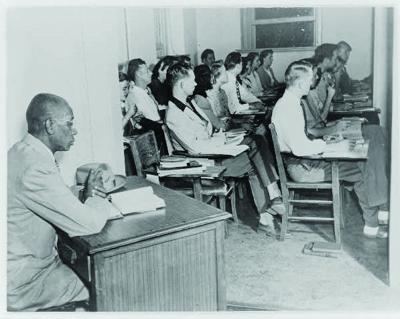
Our view: February is Black History Month and a great opportunity to talk about the history of race at OU.
Racism isn’t dead in America and neglecting to talk about race won’t make the problem go away. February is Black History Month and the perfect opportunity to engage in meaningful conversation about race in America. We believe speaking openly about racial issues is one of the best ways to address inequality, and what better place to start with than the University of Oklahoma. We encourage students to brush up on race at OU to remind them of our history, how far we’ve come and how far we have to go. Below are a few of the most important figures and events in the history of race at OU.
• McLaurin v. Oklahoma State Regents
George McLaurin endured years of court cases and unequal treatment in his pursuit of equality at OU. In fact, McLaurin was the first black student admitted to OU. McLaurin successfully sued OU for admittance in 1948 after he was denied admission to pursue a Doctor of Education degree. At the time, the state of Oklahoma was still segregated and schools were required to provide separate instruction for black and white students. Although it’s embarrassing and saddening, incorporating Jim Crow laws that essentially made segregation legal was the Oklahoma legislature’s first act after Oklahoma became a state.
OU admitted McLaurin, but he was not taught in the same setting as his white peers. He had to sit at a separate cafeteria table, had a designated desk in the library and was forced to sit at a desk outside the classroom during classes.
McLaurin continued his fight for equal treatment as he fought to make OU remove the separate facilities and allow him to interact with his fellow students. In 1950 the Supreme Court ruled in McLaurin v. Oklahoma State Regents that a public institution of higher learning could not provide different treatment to a student based solely on his or her race. The court ruled doing so was a violation of a student’s Fourteenth Amendment rights of equal protection.
McLaurin’s case proved to set the precedent for the Supreme Court’s landmark 1954 case, Brown v. Board of Education that desegregated schools across America.
• Ada Lois Sipuel Fisher
Sipuel is famous for integrating OU’s law school in 1949 after undergoing multiple lawsuits and countless acts of racism, much like McLaurin. Sipuel, an Oklahoma native, was the first black woman to attend an all-white southern law school. She originally applied to OU’s law school in 1946 and was denied admission based on race. Sipuel took the case to court and the Supreme Court ruled in 1948 that Oklahoma must provide equal instruction for black and white students.
However, integrating the law school wasn’t that simple. Instead of letting Sipuel attend classes at OU’s existing law school, OU created an entirely separate school, the Langston University School of Law at the state capitol, a situation that was separate but certainly not equal. Sipuel had to take further legal action to demonstrate OU’s failure to provide her with equal instruction, and in 1949 she was admitted to OU’s law school.
Even after successfully integrating OU’s law school, Sipuel was made to sit in a chair labeled “colored” during classes and eat lunch in a chained-off, guarded section of the cafeteria.
Sipuel is an integral figure in Oklahoma’s desegregation and helped our school become more inclusive. She went on to earn her law degree and was appointed to the University of Oklahoma Board of Regents in 1992.
• Unheard and the continuous quest for equality
Racial tensions are alive and well in America, and the lack of true equality is evident in cities across the country. Take a glance at recent headlines and you’ll see examples of racial strife from Ferguson, Missouri, to New York City to Cleveland, Ohio. We believe it is critical to talk about racial issues, get uncomfortable about the inequalities that still exist and work together to inspire change in our communities.
It’s 2015 and we still reflect on the strides toward equality made by African-American figures from the '40s and '50s. Fifty years from now it’s likely OU students will be talking about the actions taken by students who attend classes with us right now, like Unheard, a student group committed to bringing about change at OU.
Unheard members have organized a silent sit-in, had private meetings with OU President David Boren and held a rally on the South Oval to air their grievances about the lack of inclusion and representation of black culture at OU, all in the span of a few weeks. These students have made it clear the journey toward equality is a continuous process requiring open dialogue across the university. This Black History Month, and every month, we encourage students to engage in that dialogue and help make our university more accepting and diverse.


