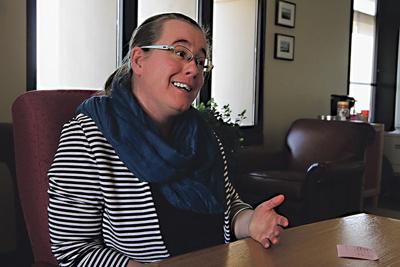

When Kirsten de Beurs joined her academic department in 2010, she was one of two female faculty members.
Today, she is one of seven.
The increase in diversity in her department was kick-started by a grant given to the OU Department of Geography and Environmental Sustainability from Oklahoma’s Established Program to Stimulate Competitive Research, which focuses on increasing institutions’ capacities to do competitive research and increase hiring diversity.
De Beurs became chair of the department in 2015, after several new female faculty members were hired.
In 2012, Renee McPherson, associate professor and university co-director of the South Central Climate Science Center, joined them, and soon she and a team of others received the EPSCoR grant that included funding for three new hires.
All of these hires ended up being women, bringing more of a gender balance to the department.
“Even though we’re not completely balanced just yet, it’s a lot better,” de Beurs said. “I think this is a collegial department that was very interested in kind of diversifying to begin with, but with help from EPSCoR ... I think we started paying extra attention to hiring minorities in our other searches.”
One of the main focuses the EPSCoR grant placed on the department was to try to hire a more diverse group of faculty members, de Beurs said. McPherson said that, throughout the process, the department members stopped and asked themselves if the pool of candidates was diverse enough before they moved on to the interview stage.
McPherson said there was one pool that they felt was not diverse enough, and they started over. The department applied this tactic to its other searches, even those not related to EPSCoR, making sure that everyone was treated in the same way.
The department hired two female assistant professors in 2014 through the grant and also made three hires not related to EPSCoR. One of those hires was a woman, assistant professor Rebecca Loraamm. The department most recently hired Mary Lawhon, assistant professor, through EPSCoR in 2017. Lawhon is the seventh woman to join the department’s faculty.
De Beurs said since she’s been on faculty, the department has increased the number of degree programs from two to six, and increased the amount of students in the department from around 50 to about 200. De Beurs said that, at the same time, the department has seen an increase in the number of female students, which rose from about 35 to 40 percent to about 50 to 55 percent.
“So is that because we have hired more women?” de Beurs said. “I don’t know — or is it because maybe women are more attracted to some of the degrees that we’re offering now, or is it a little bit of both? I suspect it’s all kind of tangled up in a way.”
Both de Beurs and McPherson said that they believe having more females on the faculty is good for female students. Female leaders can be someone they can look up to and have conversations they may not be comfortable having with a male, McPherson said.
“I remember back when I was a graduate student here at OU in the school of meteorology, and there were no female faculty members,” McPherson said. “So there was really not anybody that you felt like you could talk to, who you felt like understood, kind of, your psyche.”
McPherson said that when she was in the early stages of her career, she asked her boss if he thought her having children would hurt her career.
“He basically said, ‘Yes, you should wait for five or ten years, get your career established and then think about having a family,’” McPherson said. “Well, that’s not the type of advice that I think most women would give.”
McPherson said that she makes every effort to tell young women that if they want and are in the position to start families, they should not have to wait because of their jobs.
“My hope is that male and female faculty members are seeing that, because there are women role models out there like Dr. de Beurs, who has a family, and Dr. (Laurel) Smith, who has a child, they’re successful and have a family — that people don’t have to put that off, to choose their career or their family,” McPherson said.
Monica Mustain, a graduate research assistant who is working toward her master's of science in geography at OU, was previously a student at Illinois State University and New Mexico State University. Mustain said that being part of the OU Department of Geography and Environmental Sustainability has been a different experience because her previous departments were much more male-dominated.
“Personally, I’ve been applying for jobs a lot recently, and it has been important that — if companies post their top people in their company — it’s been important that there’s been a mix of male and female,” Mustain said.
Mustain said she has enjoyed working with all of the recent hires, male and female. She said they have brought a lot of energy to the department and work hard to make it the best it can be by doing good research and bringing in the best people.
“The evidence shows that a more diverse group of people working together ends up with better solutions to problems,” McPherson said. “If we’re good academicians, then we should follow what peer-reviewed research shows us.”
Correction: This story was updated March 15 at 10:45 a.m. to reflect the correct number of degree programs offered by the department.


