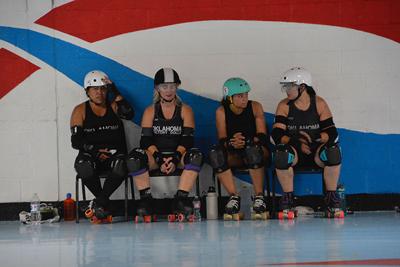
Lori Bautista comes home from her job at the Oklahoma State Department of Health and heads to Star Skate Norman with a bag full of gear. She sits at a table and begins to put on her roller skates and helmet, transforming into her alter-ego “Galaxy Inferno” as she skates onto the track.
Bautista is a member of the Oklahoma Victory Dolls Roller Derby team and has fallen in love with the sport of roller derby.
“When I’m on the track, I really love hitting people — I love hitting the crap out of them,” Bautista said. “It’s a mental and physical thing because it makes me mentally happy, and physically I’m in the best shape of my life.”
Bautista has been playing roller derby for over seven years and plays on the OKVD All-Star team and the Tornado Alley Roller Girls B team as a blocker. She is also the head of human resources for OKVD and has recently been elected vice president of the team in 2019.
OKVD is one of the more than 450 member and apprentice leagues represented by the Women’s Flat Track Derby Association, which is the international governing body of women’s flat track roller derby, according to the WFTDA website.
Flat track roller derby is a fast-paced contact team sport that requires speed, strategy and athleticism. The sport has grown rapidly since it evolved in 2001, especially because setting up a flat track can be done on any flat surface that can be skated on, such as skating rinks, basketball courts and parking lots, according to the WFTDA website.
The women in roller derby use nicknames to show that roller derby is their escape from their everyday lives and to allow them to embrace a tougher and edgier side of themselves. When players step into the rink, their “derby alter-ego takes over,” according to the WFTDA website.
When Bautista is not playing roller derby as “Galaxy Inferno,” she works for the state health department in the long-term care department as an administrative assistant.
Bautista said a lot of things she has learned in roller derby transfer over to her job, such as patience and teamwork. However, she does not hide the fact that she plays roller derby from her coworkers and is very open about her love of the sport.
“Most of the over 100 employees that work in my department know that I play roller derby,” Bautista said. “Especially when I started coming to work with bruises, and since they’re nurses, they would ask, ‘Are you okay? Do you need help?’ So I would say, ‘I play roller derby.’ So, they’re all supportive, and I’ve had people come and watch me that work with me.”
Bautista said she practices roller derby about three to four times a week and about two-and-a-half to three hours a day, which doesn’t include all of the working out that she does on the side.
Because of her dedication to roller derby, Bautista is a highly-valued member on OKVD and is known for being an extremely hard worker and a positive influence on the team.
“When I first met her, she was encouraging me to get back out to practice because I was sure I could not do the new recruit class, but she told me about how she broke her ankles (during her new recruit class) and how she came back from that, and I was so encouraged,” said Christina Merrell, a member of OKVD. “That definitely helped me stick with roller derby.”
Cheyenne Riggs, the team’s head of public relations, said Bautista always goes above and beyond whatever is asked of her and even takes on extra fundraising shifts, PR shifts and days at the gym.
“(Lori is) an incredible teammate and one of the best teammates we have here at OKVD,” Riggs said. “She is always positive and friendly and is always going above and beyond, not just on the track, but outside the track as the committee head for our HR department. She attends every tournament around the country that she can that we play in and is always there, always at practice and always working hard and smiling.”
Bautista said roller derby has not only given her a family and had a positive impact on her life but has also empowered her as a woman.
Roller derby is often seen as the full embodiment of feminism in the modern era because it’s an extremely challenging sport that has attracted a lot of women and pushes them in ways they may have never experienced, according to a study by Adele Pavlidis, a feminist scholar at Griffith University, and Simone Fullagar, a professor of physical culture, sport and health at the University of Bath.
“From the research I have done, what I have found is that roller derby provides a context for women to express parts of themselves that they otherwise can't,” Pavlidis said. “For example, some women revel in the ways derby enables them to express aggression and the possibility of hurting others, whereas in their day-to-day life they are usually in a caring role, such as a mother, nurse and so on.”
Riggs said a lot of women find roller derby in their mid- to late-20s as a way to stay in shape, but they end up finding a place to belong and a family of women who support them and learn valuable life lessons along the way.
“We have a saying in derby that ‘roller derby saved my soul,’ and I think for a lot of women that is true,” Riggs said. “There’s a lot that you can fail at in derby, and it’s really easy to fail at it, but in order to get good at it, you’ve got to try 100 times, and then on your 101st time you succeed. So, that’s a life lesson for anybody.”
Bautista said roller derby has given her an outlet to express herself and relieve frustrations in her everyday life, and does not plan on quitting or retiring anytime soon.
“It keeps me physically in shape and mentally in shape,” Bautista said. “It’s like moving chess when you’re out there, so it’s both physically and mentally challenging when you actually play. It has given me so much confidence both on the track and in my regular life.”


