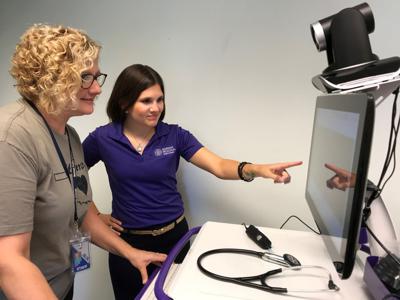

A student at Irving Middle School brushed her hair to the side as school nurse Ashley Carter used an otoscope to look inside her ear.
In front of them was a split computer screen with Kate Cook, Norman Regional Pediatric hospitalist, on one side and the inside of the student’s ear on the other.
Every day is different for Carter, as she sees students with everything from a sore throat to serious allergic reactions, but the unique technology at hand helps her diagnose students more effectively and keep them in school.
This new, high-tech “telehealth” program being piloted at Irving Middle School and Washington Elementary School is part of the unique partnership between Norman Regional Health System and Norman Public Schools, Cook said.
The Norman Regional Health System and Norman Regional Health Foundation have collectively donated around $4 million to Norman Public Schools to ensure each school has the resources it needs to provide quality health care for students, said Paula Price, Norman Regional vice president of strategy and growth.
Price said the health system began working with Norman Public Schools in 1996. However, when they noticed several students were not being reached through normal health screenings in 2007, they began working to ensure every school in Norman had a nurse.
“Our goal has always been to continue to have healthy children that are able to learn,” Price said. “So, they’re healthy and have the ability to learn what they need to to grow, learn and be healthy, productive adults.”
However, school nurses are typically funded by the schools themselves and many schools in Oklahoma without community partnerships don’t have the resources to have nurses on staff within the building, Price said.
“There’s just not enough funding to have school health nurses,” Price said. “In the rural areas, it’s very much needed, and it's all about funding. That’s why it was important to us in our community outreach to support children and their parents.”
Without a nurse on duty at schools, the responsibility often falls to secretaries and school administrators who are not as experienced in the medical field, potentially causing health issues for students with more serious medical conditions, Cook said.
“If you think about kids who have diabetes, seizure disorders, bad asthma or allergies, they really need to be recognized pretty quickly and addressed,” Cook said.
The telehealth program came from this desire to support Norman families a year ago. The health system approached Norman Public Schools and said, “Hey, we have an idea — we think we could actually extend some of the health services,” Price said.
Cook, who played a big role in getting the program started, is the main physician who virtually connects with the school nurses and students while remaining at Norman Regional Hospital.
When a school nurse sees a student with a condition that appears beneficial for a doctor to look at, the nurse then notifies the student’s parents and, upon their approval, conducts a virtual visit with Cook and sometimes the parents who can join in on a three-way video conference.
“It’s actually like being in the room,” Cook said. “I can see them, and I can move the camera around to see the things that I need to see, and it’s fun to develop that relationship with the nurses at the schools too.”
Since the telehealth program began, Cook has seen around 18 students, 75 percent of whom were able to return to class that day, she said.
At Washington Elementary School, the health assistant sees around 56 students a day, which “is a huge number of children coming in and out,” said Erin Barnhart, Norman Regional Health Foundation executive director.
Amid flu season, the ability to virtually address student medical concerns in schools plays a considerable role in limiting infectious exposure to healthy students, Cook said. When student attendance improves, the financial assistance schools receive from the state improves as well, she said.
“Part of the schools funding formula as far as the financial assistance they get from the state has to do with attendance and anything that we can do to improve student attendance is one, good for students and good for learning, but it also helps the schools financially to do that,” Cook said.
Having a nurse on hand at every school also increases attendance for students with special needs, as there are various treatments students need throughout the day, Price said.
“A lot of special needs children with health needs are in our schools, and I think a lot of people don’t realize that,” Price said. “Because they have a nurse there, they’re able to go to school and be social and integrate, that’s probably the most important part of that.”
The Norman Regional Health System hopes to further expand the telehealth program across Norman Public Schools, with tentative plans to integrate the system into Norman North High School by the end of spring, Cook said.
“We really see it expanding into other school districts, and I think it’s very important for schools to have community partners, so I think we’ll see more of it,” Price said.


