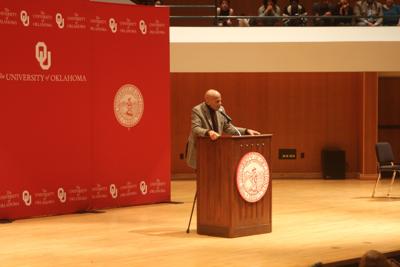

A renowned singer, actor and activist visited OU this week for an evening of discussion and reflection.
Harry Belafonte spoke 7 p.m. Feb. 8 in the Paul F. Sharp Concert Hall in OU's Catlett Music Center. OU President David Boren and professor Karlos Hill gave introductions at the public event.
"I am deeply moved that a campus such as this is still interested in what I have to say," Belafonte said.
Belafonte spoke extensively on his time as an actor and singer. His career began in acting; a singing career was the furthest thing from his mind. After a series of letdowns due to a lack of parts for black actors, he was encouraged by a colleague to try singing instead.
“There were no great plays on Broadway that depicted our culture. No one was hiring black actors to do anything,” Belafonte said.
It was not until he won a Tony Award in 1954 that he was finally able to work in film.
Belafonte said he was stunned at how well he was received as a singer. Above all else, through singing, he said he found a calling in activism.
“The turning point came when I began to sing songs concerning human and social development," Belafonte said. "Music carries a greater purpose than the melodies."
Belafonte became involved in the civil rights movement after getting a call from Martin Luther King Jr. From the time when he first heard King deliver a speech, Belafonte said he knew that it would be the beginning of a lifelong partnership and friendship.
“I knew that I wanted to be of his service for the rest of the days that we had together,” Belafonte said.
Belafonte's talk also stressed the importance of education. His parents were both immigrants from Jamaica and wanted him to get the education that they were not able to. Belafonte said knowledge is invaluable for him.
“Reading is a gift. Knowledge is a defense against oppression. Make it your business to know. In your knowledge resides liberation,” Belafonte said.
In a highlight of the night, Belafonte shared advice from his mother regarding social injustice. Belafonte's mother Melvine was a housekeeper and made sure to educate 7-year-old Belafonte on the perils of discrimination.
Belafonte also addressed current political and activist climates and said voting is one of the most valuable tools that society has in order to substantially make an impact.
“The vote is the one real key that determines whether or not the nation can become what we want it to be," Belafonte said. "Those who do not vote risk becoming a defamation to society.”
With optimism for the future, Belafonte praised the current protests and activist efforts of women.
“Women are plotting away and protesting in a nonviolent way," Belafonte said. "This tells me that the future is accounted for.”
The discussion ended after Belafonte responded to comments and questions. Belafonte received a number of standing ovations and left the stage with an enormous smile.
Correction: This story was changed at 12:08 p.m. Feb. 9 to reflect that Belafonte won a Tony Award in 1954, not 1959.


