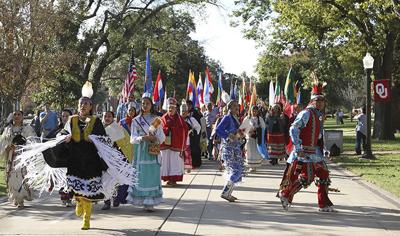

Festivities celebrating indigenous traditions and culture will take place on the South Oval Oct. 9 for OU’s third Indigenous Peoples’ Day.
The event will begin at 10 a.m. with opening remarks, although a teepee will be put up on the South Oval earlier in the morning. Opening remarks will be followed by cultural events and informational tables from 10:30 to 11:30 a.m., said Warren Queton, OU Tribal Liaison and Associate Director of University Community.
At noon, there will be a first-come, first-served luncheon where renowned native American author and poet Simon Ortiz will speak, Queton said. After lunch there will be singing, celebration and games of stickball played on the South Oval. The day will end with an evening celebration at the Jacobson House Native Art Center with various speakers.
The city of Norman will also join in the day’s celebrations for the first time since the Norman City Council voted last month to recognize the holiday.
“I think the city council recognizing Indigenous Peoples’ Day is a major step forward,” Queton said. “We’re going to have more people advocate and have cities recognize the existence of native people today. Native people don’t really have a day to celebrate, so we’re kind of moving forward and letting people know who we are.”
Various campus diversity organizations, including American Indian Student Life and Latino Student Life, are sponsoring the day’s events at OU. Queton said the Latinx Coalition and other campus Latino organizations will take part in the event since many Latino students are also indigenous.
“American Indians are not restricted to the northern hemisphere. They expand into Central and South America too,” Queton said. “So we’re tying this all together in our OU Indigenous Peoples’ Day celebration to recognize indigeneity in all forms.”
Queton said he is excited to celebrate with native students as well as other members of the OU community.
“The main point we want to drive home is that indigenous communities are still alive and thriving today — a lot of people overlook indigenous communities all over the world,” Queton said. “We have an identity that we want to pass on to our next generation.”


