
Brittany McKane, a Native American studies and anthropology junior, could see the bright red blood staining the attack dog’s mouth from where she stood 50 yards away. A policewoman unleashed the dog on a group of protesters after they ducked under a fence to stop bulldozers from digging up a sacred Native American burial site while constructing an oil pipeline.
This is what McKane witnessed when she recently visited the Oceti Sakowin Camp in Cannon Ball, North Dakota, to protest the Dakota Access Pipeline.
“That hurt me to see that because that’s the blood of our people. We bled on this land for so long. They’ve made us bleed. They’ve hurt us so much,” McKane said. “I don’t feel like there’s anywhere you could step where there isn’t indigenous blood that’s been spilled there.”
Thousands are now camped out with the goal of impeding construction on the pipeline, a $3.7 billion project that would carry approximately 470,000 barrels of oil each day from northernmost North Dakota to southern Illinois, an underground route traversing 1,170 miles, according to NBCNews.com.
In response to events occurring in North Dakota, the Many Nations Youth Council of Norman held a rally Nov. 5 to garner public support. MNYC member Kaimera Cornell said she also visited North Dakota for several days recently and was inspired by her experience.
“It opened my eyes up to what is happening right here in Norman,” Cornell said. “They’re (also) having the Plains Pipeline going on in Norman right now, so that’s another thing to be protesting. It just opened my eyes up to more issues that I wasn’t aware of before I went there.”
Plains All American Pipeline recently received a permit from the city of Norman to construct a pipeline that would run through east Cleveland County in its route from Cushing, Oklahoma, to Longview, Texas. Both it and the Dakota pipeline draw similar concerns from environmentalists and Native Americans, but the Dakota Access Pipeline has reached a much larger audience.
Thousands of people from around the world have been gathering in North Dakota since late summer to show solidarity with the Standing Rock Sioux Tribe. The tribe sued the U.S. Army Corps of Engineers for violating the National Historic Preservation Act by failing to properly consult the tribe before beginning construction of the pipeline on sacred burial sites. Since then, the federal court denied the tribe’s request to halt construction of the pipeline, although the Army Corps is currently reassessing the situation.
McKane said protesters are fighting for a host of various issues, including the protection of the environment and Native American culture. Environmentalists are concerned because of a potential pipeline malfunction that would contaminate the Missouri River.
“As native people, we’ve never been removed from the earth the way that other societies and cultures have. We’ve stayed connected through our medicines, our prayers and our songs, and we know the importance of it,” McKane said. “And so we know that you might be creating jobs, you might be making money, you might be helping the economy, but what good is all of that when you’ve ruined the earth? What good is that when you have no land to survive on, you have no water to drink? Once you’ve cut down every last tree, you can’t even make any more money.”
McKane wept as she spoke of the struggles of Native Americans who continue to protest despite police retaliation in the form of arrests and physical brutality.
“Those people are gathering for our ancestors to protect those sites, and they’re fighting for our children and our grandchildren so that they can have clean drinking water, so that they don’t have to fight these fights that we’re having to fight, so that they don’t have to be brutalized just to have a way of life, so that they don’t have to be attacked every time they want to make a stand for something, so that they can be seen as fully human in our society,” she said.
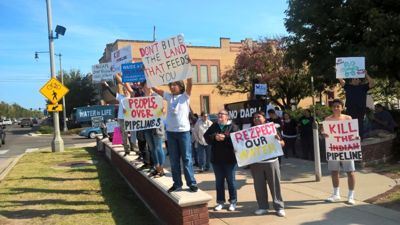
The protest in Norman Nov. 5 drew a group of more than 30 people who marched up and down Main Street chanting, singing and holding signs that read: “People over pipelines,” “Respect our water,” “Don’t bite the land that feeds you” and “Honk if you drink water.”
Blue Cloud, another member of the Many Nations Youth Council said he attended the protest to show his support.
“Voices, even if they’re quiet, they have to be there,” Cloud said. “All these people, you never know who we’re giving strength to. There could be somebody with the right connection on the street that would pass by and be like, ‘Man, you’re right, I do need to do something about that.’ So you never know who we might reach.”
The group attracted the attention of passersby in cars who rolled down windows and honked and waved in support of the protesters.
“That’s why they’re fighting, that’s why we’re fighting, that’s why we have these demonstrations, to let people know that we’re still here, and that we’re thriving people, and we need our land to survive, and we need people to recognize that,” McKane said.


