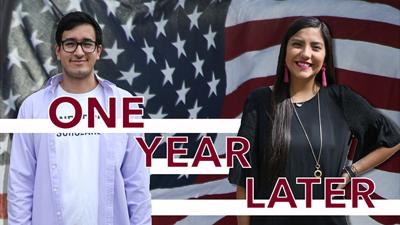

Carlos Rubio was driving down Interstate 44 to Norman from his home in Tulsa when he got a text from a concerned friend that prompted him to check the news.
What he saw made him feel as if his life were flashing before his eyes.
It was Sept. 5, 2017, and President Donald Trump’s administration had just announced the Deferred Action for Childhood Arrivals program, or DACA, would end. The program gives Rubio and nearly 700,000 other qualified young adults who were brought to the U.S. as undocumented children a renewable, two-year protection against the threat of deportation.
The weight of that announcement made the rest of that drive one Rubio will never forget.
“That was probably the heaviest car ride I think I’ve had between coming home and coming to school,” the industrial and systems engineering junior said. “I didn’t know the severity of it, I just knew that there was a threat potentially — it could harm me, it could harm my family, it could harm my sister, and then the students that go here.”
It’s been a little more than a year since that day, but many of the same doubts, fears and questions that overwhelmed Rubio and OU’s nearly 80 other DACA recipients last fall still linger. Since then, Congress has failed to pass a legislative solution and the issue has been taken up in court, where three district judges have issued injunctions that protect the program from termination.
The cases could work their way up to the Supreme Court or Congress could propose legislation on the program, said Nima Zecavati, OU’s immigration attorney. There are many competing factors that make it difficult to predict what exactly will happen to the program and when, he said.
“With the midterm elections coming up, there’s hopefully a good chance that there could be enough change to create some kind of legislation that finally passes through Congress,” Zecavati said. “My hope is that it doesn’t work its way up to the Supreme Court and that sometime between now and the end of June, which would be when the case would possibly go to the Supreme Court, Congress will finally be able to find some kind of permanent solution — that’s the hope.”
While legislators stall and courts battle over the issue, the young adults whose futures are on the table have been left in a state of limbo.
It’s a feeling Rubio describes as floating through space — moving through life and school with an ever-present question mark.
“With any student there’s going to be a degree of uncertainty but I think there’s an added degree to that when you’re undocumented,” Rubio said, “just because literally tomorrow (U.S. Attorney General) Jeff Sessions or the president could come out and say something, which will always be at the back of our heads.”
Another threat blossomed as recently as August, when a Texas lawsuit questioned the lawfulness of the 2012 DACA program itself. The court denied the request to end the program, but it caused a scare in the community as many, including Rubio and his younger sister, scrambled to renew their statuses and extend their protection as long as possible.
Vanessa Meraz, a DACA recipient and a political science and letters senior, applied for a renewal during the same frenzy last month and received her notice of acceptance on Sept. 5, the exact anniversary of the day the program had been rescinded. It was a bittersweet moment, she said.
“I understand the intricacies of immigration policy and understand that even if I’m safe, there are thousands of people in the U.S. right now that aren't,” Meraz said, “because they can’t apply for DACA in the first place.”
Meraz and Rubio are both protected by deferred action until the fall of 2020, but the impending court decisions and potential for legislation leave much unclear.
“There are many big question marks in the life of the Dreamer community, but a really big one is just like what tomorrow looks like — in general, but specifically with status,” Meraz said. “Because of the way that this year has looked, the next months could look a lot of different ways.”
Making plans is difficult when the program’s future is unclear, but that has not prevented the Dreamers, as DACA recipients are sometimes known, from doing so. Meraz plans to move to Washington, D.C. to do immigration policy research for a year before going to law school with the ultimate goal of becoming an immigration attorney. Rubio no longer wants to be an engineer but hopes to pursue education and work with kids.
DACA allows its recipients to apply for a work permit. Without it, these young people would have difficulty working in the U.S. in pursuit of their goals.
“Every day I think it weighs a little bit more,” Rubio said, “because I get closer and closer to the end of my collegiate career.”
Meraz, whose family immigrated to the U.S. from Mexico, said she and other Dreamers must keep moving forward with their goals. She said she refuses to let her parents’ sacrifice in bringing to her to this country go in vain.
“I think as a community we are risk-takers,” Meraz said. “We say, ‘Okay, we’re living in a limbo and in fear anyway, so let’s go for it.’ Although there’s a huge risk in going into the workforce when you could lose your job the next day, or going to school when you could not even use those degrees that you get, you still do it because that’s why our parents brought us here.”
A new OU administration has raised questions within this community about how the school will support them. Former OU President David Boren was an outspoken advocate for Dreamers. Last September, Boren issued a statement saying it would be “un-American and grossly unfair” to end DACA. Last month, he wrote a Tulsa World editorial in support of Dreamers.
The Dreamer community now looks to the new Gallogly administration with some uncertainty. Unfounded rumors of OU’s Project Threshold closing sparked concern in underrepresented communities on campus, including undocumented students.
Meraz said she thinks Gallogly values hard work and giving students a place on campus, which he mentioned at the emergency meeting regarding Project Threshold.
“If he can think of that when he thinks of the changes that he’s making that may impact our community, we’re going to be okay,” Meraz said. “Because that’s what it’s all about. We need a place where we can succeed just like any other student at OU. I think (Gallogly) believes in the OU family, he believes that every single student at OU is part of that family, so as long as he sticks to that, I think we’ll be solid.”
Gallogly said in a statement through Erin Yarbrough, interim vice president for public affairs, that there has been no policy change regarding undocumented students and that the president is “sympathetic” to these students.
Zecavati said the university is committed to helping its DACA students in any way possible. He said he plans to meet with Jane Irungu, interim associate vice president for university community, in the coming weeks to discuss ways to support these students.
The past year has shown the strength of the community surrounding DACA students, Meraz said. When the program was rescinded, it ignited a passion within her and others to fight for the program’s continuation and pressure legislators to find a solution that would create a pathway to citizenship.
“I think in this moment I am exhausted — I think that would be an accurate description after a year because we’re not where we want to be,” Meraz said. “But I still haven’t lost that desire to keep going. I’m very tired, but we can’t afford to be exhausted. We can’t afford to be tired or to give up, and we’re not going to.”


