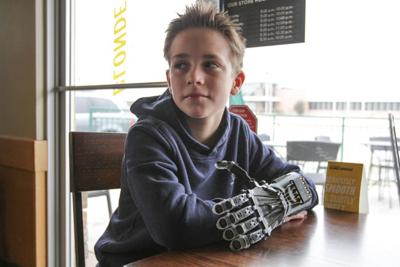
Day-to-day activities have always been more difficult for Austin Shumsky, who was born with an underdeveloped hand.
But thanks to OU’s biomedical engineering department, the Oklahoma City boy recently put on his first 3-D-printed hand, free of charge.
Twelve-year-old Austin Shumsky was born with Poland Syndrome, a condition that affects one side of the body, often times the hands or pectoral muscles. His left hand is significantly smaller than his right, and his fingers are fused together.
Jennifer Shumsky, Austin’s mother, first discovered the possibility of 3-D printing opportunities for her son when she stumbled across the blog of a girl from Nevada with the same condition as Austin who had a 3-D-printed hand from the University of Nevada, Las Vegas.
“I just sent a random email this summer to the engineering department ... telling them about Austin and his syndrome, and asked if it was a possibility of something that maybe some of their students might want to do,” Jennifer Shumsky said.
She was referred to Rachel Childers, an assistant professor of practice in the biomedical engineering department. Childers recruited Emily May and Amanda Phillips, two biomedical engineering juniors, to help with the project.
The hand was created by 3-D printing segments of a wrist part, palm part and fingers made out of polylactic acid, a type of plastic. The segments are printed separately and assembled using elastic and velcro, May and Phillips said.
The hand attaches to Austin Shumsky’s wrist like a glove, and the fingers move in an inward motion as he bends his wrist. It is most helpful with grabbing things, which was his greatest difficulty before the hand, Jennifer Shumsky said.
Between meeting with Austin and his mother, taking his measurements and working on the hand, the project took around two months, May said. May and Phillips gave him the prototype around Thanksgiving.
“It was so cool — he was so excited,” May said.
Because Austin will grow and the hand was a prototype, the biomedical engineering students are hoping to work on an improved product.
“Now we’re working on potentially creating our own design, now that he’s had his hand for a while and now we’ve seen what the kinks are with it and what needs to be adjusted,” May said.
Although this first prototype is black, Austin Shumsky is hoping for a cooler, themed hand eventually. May mentioned that he wanted an Iron Man-themed design.
“My friends and me were making a joke about getting a blue sticker ... that would be awesome,” Austin Shumsky said when talking about making his hand Iron Man-themed.
Austin Shumsky also loves soccer and the NBA 2K video game. His smaller hand has not stopped him from enjoying these things, and his new hand has just made everyday things like having a better grip easier, Jennifer Shumsky said.
3-D printing technology has been a revelation in prosthetics because it makes the process significantly cheaper, said the students and Jennifer Shumsky. OU has 3-D printers in spots around campus, including the library and the Innovation Hub.
“3-D printing has been such a godsend for prosthetics because it’s been so much cheaper, and you can do it anywhere where there’s a 3-D printer, which is most universities now,” Phillips said.
Jennifer Shumsky said she had never tried to get a prosthetic for Austin before this opportunity arose, mainly due to high expenses.
“For one, I’m just so grateful they were able to do anything for us to begin with,” Jennifer Shumsky said. “Because a prosthetic, I’m assuming, would be thousands of dollars.”


