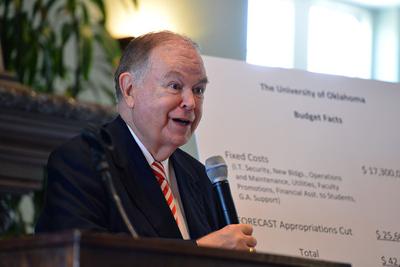
OU President David Boren recommended a 7 percent tuition increase for resident and nonresident students on Tuesday morning.
The decision comes in the wake of the university receiving roughly $20 million less in state appropriations than it did a year ago.
"The most critical budget crisis in history of OU ... will require a 7 percent increase in tuition and fees this year," Boren said.
This is the biggest tuition increase OU has approved since 2008 and the third largest hike in the last 10 years.
OU tuition increase history
| Fiscal Year | Resident percentage increase | Non-resident percentage increase | Resident cost per credit hour | Non-resident cost per credit hour |
|---|---|---|---|---|
| 2017 | 7 | 7 | $153.22 | $477.43 |
| 2016 | 4.8 | 4.8 | $143.20 | $446.20 |
| 2015 | 4.8 | 4.8 | $137.60 | $425.80 |
| 2014 | 0 | 2.9 | $131.90 | $406.30 |
| 2013 | 3 | 5 | $131.90 | $387.90 |
| 2012 | 5 | 5 | $128.30 | $365.10 |
| 2011 | 4.5 | 4.5 | $122.60 | $347.70 |
| 2010 | 0 | 0 | $117.90 | $332.70 |
| 2009 | 9.92 | 9.67 | $117.90 | $332.70 |
| 2008 | 8.5 | 9.95 | $108.70 | $303.80 |
Boren said OU faces a 17 percent budget deficit. He also said students will cover roughly 35 percent of the school's budget while state appropriations will front just 12 percent in 2017.
The OU Board of Regents approved the decision Tuesday morning.
Oklahoma State University's Board of Regents recently approved a 7 percent increase as well.
Boren also said OU is operating with $160 million less than it did in 2008 despite having more students. He said he submitted the increase "with regret" but that his hand was forced by the deficit.


