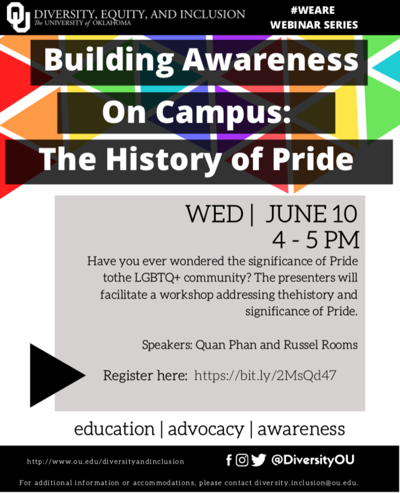

OU’s Office of Diversity, Equity and Inclusion hosted a Pride webinar Wednesday evening, providing historical context to the growth of the LGBTQ+ community and emphasizing its significance.
In the webinar, "Building Awareness on Campus: The History of Pride," Sage Mauldin, president of the LGTBQ+ Faculty, led discussions with speakers Quan Phan, OU’s program coordinator and advisor for LGBTQ+ Programs, and Russell Rooms, a family nurse practitioner and owner of Diversity Family Health.
Phan began by detailing the history of Pride from World War II — when the U.S. Army had strict standards preventing gay men from joining its ranks — to the Stonewall riots when LGBTQ+ community members gathered in response to a June 28, 1968, police raid at New York City’s Stonewall Inn.
History saw the LGBTQ+ community endure immense oppression, Phan said. Sodomy laws passed in the 1940s criminalized homosexuality, the American Psychiatric Association deemed homosexuality as a mental disorder in 1952, and the community continues to be subjects of harassment and persecution.
Activist groups lobbied against LGBTQ+ discrimination and fought to bring recognition to the community, Phan said. Organizations like the Mattachine Society — an early gay and lesbian rights group — and Daughters of Bilitis — the first lesbian civil and political rights organization in the U.S. — became figureheads of change by promoting the importance of acceptance.
As time went on, the LGBTQ+ movement transitioned from being an assimilationist movement that fought for the integration of the LGBTQ+ community into society, to a culturalist movement where members found their distinctive voices, Phan said.
Although Pride has become more of a celebration, Rooms said, discussing its history is extremely timely as the U.S. experiences similar fights from people who desire recognition and equality.
“We're talking about this in a time in our country and in our cities (when) we are seeing so much of the same fight for being heard,” Rooms said. “It's nothing new to the LGBTQ+ community, and I think that's why we see so many people joining in solidarity with the Black Lives Matter movement.”
Rooms also discussed the expanding terminologies in the LGBTQ+ community. He said it is important to recognize the difference between sexual orientation — how a person characterizes their physical and emotional attraction, or lack of attraction, to others — and gender identity — how individuals perceive themselves on a spectrum of masculinity, femininity or neither.
“Everybody has a sexual orientation and gender identity (which) lives on a spectrum,” Rooms said. “How people identify can change over time and many times we'll see the terminology vary. That's why we have this ongoing acronym that seems to grow as people find different ways to identify who they are based on their sexual orientation or their gender identity.”
Recognizing the uniqueness of individual journeys is key in understanding, Rooms said.
“I like to say that if you know one LGBTQ+ person, you know one LGBTQ+ person,” Rooms said. “Everybody's journey is different, whether it be based on sexuality … or whether it's based on gender identity.”
Although Pride month will not be the same as years past, Rooms said the LGBTQ+ community can still choose to celebrate one another and how far the community has come in the past 50 years.
“Even though it's just this month we bring that to the front … (it’s) important to remember that … the discrimination and rejection that created this community happens all year round,” Rooms said. “As LGBTQ people or allies of the LGBTQ people … we need to be able to speak up for those individuals when they can't themselves.”


