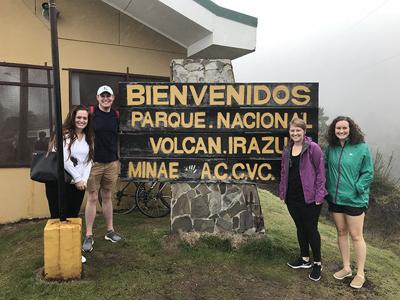

Over winter break, Jason Bollinger found himself washing his face in a Costa Rican river to receive a blessing from tribal indigenous leaders.
The river was at the heart of the issue that brought Bollinger, several other third-year law students and their professor to Costa Rica during the 2017 winter break. Considered sacred by the Terraba tribe, a population indigenous to the area, the river is under threat of destruction and invasion by a hydroelectric dam that locals are fighting to prevent.
Lacking in legal resources, the Terraba and Costa Rican government sought the help of others — namely the OU College of Law's International Human Rights Clinic because of its growing reputation. The program enables groups of students to conduct projects aimed at investigating and reporting human rights conditions and violations in international indigenous communities.
Lindsay Robertson, an OU law professor who started the program in 2009, said the clinic's mission is to provide information to the United Nations Human Rights Council. Students’ work is often cited at a convention in Geneva, Switzerland, each year where international leaders rely on information from many non-governmental organizations to determine whether a country is upholding its human rights obligations.
“I have worked in the U.N. system for some time, and one of the problems with getting information to them is that a lot of times groups with real human rights issues aren’t represented in the process because they don’t know about it, they don’t have the resources,” Robertson said. “So we thought, since one of our focus areas at the law school is indigenous peoples law, (and) another is international law, that we’d sort of combine those and start a clinic to act as an investigating and reporting agency for indigenous groups who were being ignored.”
Robertson said each U.N. Human Rights Council member country undergoes an assessment process known as the Universal Periodic Review every four years to determine whether it is upholding its human rights obligations. Robertson and Alvaro Baca, the clinic’s director, select countries for the student clinic to visit based on which countries are next up for review.
Now back in Oklahoma, Bollinger and his classmates have three months to draft an official report to be filed with the Costa Rican Supreme Court supporting the tribe’s right to gain personhood over the river as indigenous people.
The report, based off information collected through interviews with tribal leaders, is meant to garner support for the tribe, Bollinger said.
“We don’t have a say in it either way, but anything we can do can help,” Bollinger said. “It’s kind of like joining as a party to their lawsuit and giving free legal advice, free legal help, giving of our time — that’s basically what we’re doing.”
While some students delved into the Costa Rica project, another clinic group visited Uruguay to explore complicated issues of cultural identity and indigenous peoples’ rights.
Third-year law students Tara Jordan and Cara Miller said they learned a lot about the Charrúa tribe, which faces issues unique to its population. The Charrúa were believed to have been wiped out by a massive genocide, but recent educational initiatives in the country strive to gain recognition for descendants of surviving Charrúa whose identity has been erased.
“It’s really this movement to sort of reclaim their cultural identity,” Jordan said. “It’s different than a lot of the other countries in Latin America where the issues that they face are more like ... the indigenous people there don’t have access to clean drinking water or to safe stoves to cook on. Rather than it being a tangible issue that they’re facing, it’s more like they’re facing a lack of identity — the government doesn’t even recognize that they exist.”
The group will now draft a report to the U.N. outlining its factual findings and recommendations for addressing the issues faced by modern-day Charrúa members.
“I think it lends credibility, bottom line,” Jordan said. “I think having a document that’s a research document from a law school in the U.S. hopefully will lend credibility to the fact that they exist, they’re thriving, they’re really making strides in different areas like education, awareness, outreach, that sort of thing.”
Other groups in the past have seen the work done through this clinic achieve an impact on the communities they worked with, Robertson said. Students can watch the televised Universal Periodic Review gathering in Geneva, where their work is often cited by countries and used as a basis for questioning and analyzing human rights conditions worldwide.
“Our students get a sense immediately as it happens of the impact that their research has,” Robertson said. “Every report that we filed includes our findings of fact and recommendations, and every report that we’ve filed has been relied upon for the Human Rights Council for questions, findings of fact and for recommendations. We routinely have our students’ recommendations adopted by the U.N. Human Rights Council and passed on to the states.”
Beyond the impact of their work, the students said they gained a lot from the experience on a personal level as well. Miller said the experience was once-in-a-lifetime and makes her want to stay involved in the human rights or indigenous areas of legal work.
“This trip has definitely ignited something else — to see how people are and to see how people live and to see different cultures has ignited something in myself,” Miller said. “I want to continue to study it or be involved in some way, even if it's in America with different peoples.”


