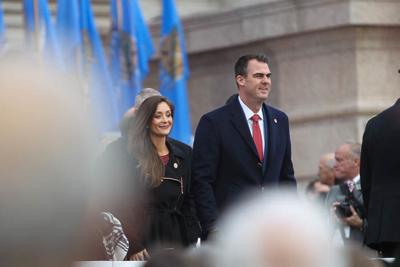

Amid claps, Oklahoma Gov. Kevin Stitt delivered his first annual State of the State address Feb. 4, outlining his budgetary goals for fiscal year 2020.
State officials, Oklahoma residents and the press crowded into the chambers of the Oklahoma House of Representatives during the first official day of the 2019 legislative session to listen as Stitt spoke on education funding, criminal justice reform, economic development and more. On each issue, Stitt had one goal in mind that echoed in each issue: “Make Oklahoma top 10.”
This was a statement Stitt repeated throughout his roughly 30-minute long speech, referring to his administration’s goal of pushing Oklahoma into the "top 10" in the nation in education, job growth, government accountability and fiscal responsibility, among other things.
“I’ve said it before: Oklahoma’s challenges are no different than any other state,” Stitt said. “And Oklahoma’s opportunities, I believe, are the best in the nation.”
Stitt expanded on ideas presented in his newly released proposed budget for fiscal year 2020, which begins July 1. One of the top highlights of the budget is a $1,200 increase in classroom teacher pay.
“Over the next few years, we will move the needle in outcomes. We will set high standards. We will enact reforms. We will invest in the classroom,” Stitt said. “But we must first continue our investment in the teachers because it’s not programs, curriculum or resources that students will remember. The magic happens between the student and the teachers in the classroom.”
Stitt also touched on his desire to reform the funding formula for education, to “take the handcuffs off” local communities and allow for the “reimagining of school districts.”
Criminal justice reform was also a main topic. Several items in the proposed budget are designated as critically needing extra funds, including $10 million to implement criminal justice reform, $1.5 million to the Women in Recovery program and $150,000 to the Oklahoma Pardon and Parole Board to hire additional staff, among other things.
“We are No. 1 in the nation for incarceration,” Stitt said. “To move the needle, it will require us to change the way we see the person who is in a cycle of incarceration for nonviolent crimes.”
The governor also emphasized his commitment to financial sustainability, pointing to a directive to pad the state’s Rainy Day Fund. It’s expected for the fund to have $874 million at the end of fiscal year 2019, so Stitt’s goal is for the Rainy Day Fund to hold $1.1 billion by the end of fiscal year 2020, according to the proposed budget.
There will also be a push for funding to audit the 12 state agencies that receive more than 90 percent of appropriated funds, according to the budget.
“Being conservative with our budget surplus today will protect Oklahoma from having to cut core services in the future,” Stitt said to a clapping audience.
Stitt also addressed a few other issues, namely the possibility of a Medicaid expansion. He said there needs to be caution when expanding health care spending, because he believes that federal funding sources might change in the future, leaving Oklahoma to cover the costs.
“While Medicaid expansion currently stops at a 90 percent federal match, we cannot assume that will remain this high forever,” Stitt said. “The estimated $150 million price tag today for Oklahoma to expand Medicaid could leave us down the road fronting more than $1 billion when the federal government pulls back on its commitment. They’ve done it before, and they’ll likely do it again.”
The proposed budget also calls for $20 million to be used in an “innovative grant program for which state agencies may apply to receive funds to digitally modernize their services,” according to information provided to the press. This would potentially include changes like digital driver’s licenses and updated online portals for paying taxes, among other things, Stitt said.
After the speech, Democratic party leaders addressed the press and gave their thoughts over Stitt’s comments.
House Minority Leader Emily Virgin, D-Norman, applauded the governor on his criminal justice reform measures, but questioned his comments on problems with expanding Medicaid.
“We were confused by his comments on healthcare,” Virgin said, referring back to previous comments made by the governor where he seemed more receptive to Medicaid expansion. “Today he seemed much more hesitant on this topic ... We hope that the governor hasn’t been affected by political pressure from his own party.”
The Oklahoma Policy Institute released a statement after the speech that also addressed Stitt’s comments on Medicaid expansion, saying the expansion has been adopted in “all but 14 states, and it has survived numerous court challenges and attempts at repeal.”
Senate Minority Leader Kay Floyd, D-Oklahoma City, touched on similar topics after the speech, but also responded to the lack of an increase in funding for higher education.
Currently, Stitt has higher education funding being held flat, giving the State Regents for Higher Education the same approximately $776 million in appropriations it received last year. The State Regents had asked for an increase of roughly 13 percent, or $101 million for fiscal year 2020.
“We’ve been concerned for higher education,” Floyd said. “Higher education has been cut by 26 percent over the last 10 years. So we’re not at a standstill with higher education — we’re 10 years behind. So higher ed needs to be part of the discussion in education.”
Overall, the proposed budget appropriates roughly $7.7 billion dollars to state agencies, which is approximately $183 million more in appropriations than the fiscal year 2019 budget. These increases are mainly found in the budgets for the Department of Education, the Oklahoma Health Care Authority, the Department of Human Services and the Department of Corrections, among a few others.
According to a December report from the Office of Management and Enterprise Services, the state government was projected to have $612.4 million more in spending for the legislative budget. But due to oil price volatility, this number is expected to fluctuate but will be set in stone by Feb. 20, said Secretary of Budget Mike Mazzei.
“We’ll have to look at those numbers and go from there,” Mazzei said.


