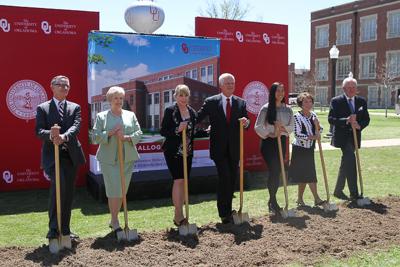

Gallogly College of Engineering's smallest school will soon be located in a 70,000 square foot building, and OU will name a large multipurpose space within it the "Valero Lecture Hall" after receiving a $1.5 million gift from Valero.
Gallogly Hall has been under construction since April and will house the Stephenson School of Biomedical Engineering and the college’s diversity and inclusion program. It will be ready for students by the fall of 2019, said Thomas Landers, dean of the Gallogly College of Engineering.
“Many companies who recruit our students want to make an investment in our programs and places that well prepared those students to graduate and go to work in their industry,” Landers said. “But I think it’s also recognized in the commercial sector that you have to establish your brand.”
Buildings funded by private donations are common — the majority of OU's academic and athletic buildings were funded, at least in part, by private donations, said Matt Epting, OU's press secretary.
Biomedical engineering is the fastest-growing field in engineering and requires laboratory space for undergraduates to get hands-on experience, Landers said.
“I believe that’s essential to an engineering education,” Landers said. “And we’ve adopted years ago, as a part of the strategy of this college, that we focus at the undergraduate level on experiential learning, where they do hands-on, team-based project work.”
Landers said Gallogly has had strong growth in enrollment and graduation numbers since 2005, so even though Devon Energy Hall and the ExxonMobil Lawrence G. Rawl Engineering Practice Facility have been constructed since then, additional growth demands additional space, especially for the school of biomedical engineering.
Alex Douglas is a biomedical engineering pre-med junior and will be in the inaugural class to graduate from the Stephenson School of Biomedical Engineering.
“Even though… I won’t be around when Gallogly Hall is finished, it’s still a representation of my time here,” Douglas said. “If I come back five years from now, I’ll be able to say ‘Wow, even though I wasn’t able to be a part of this building, I know this is still my legacy.’”
Currently, biomedical engineering students have laboratories on the fourth floor of the Carson Engineering Center, which is also home to other engineering disciplines, Douglas said.
Soon, Gallogly Hall will house the biomedical engineering students, as well as hosting freshman and sophomore biology and chemistry courses, Landers said.
There will also be a variety of features in the new building, including a terrace, a “living room” and a maker’s space, which is an area where people can create, with three zones, Landers said. One of these zones will be sealed so that living tissue can be worked on because the 3-D printers in the space are capable of printing tissue, he said.
“There are very specialized aspects of each zone of that lab, so they need space that’s dedicated to biomedical engineering and designed for the kinds of work that they’ll do both as a student and in the future as a practicing engineer,” Landers said.
Having laboratories specific to biomedical engineering majors and separate from those at the research campus will allow for more undergraduate research, Douglas said.
“I think (Gallogly Hall) kind of just solidifies the essence and the home of biomedical engineering, like being able to say, ‘That’s my building,’” he said. "Whenever Gallogly does get finished, that’s going to be a place where we can just physically have our own research and an area where people are doing the exact same thing as us and wanting to just help promote each other.”


