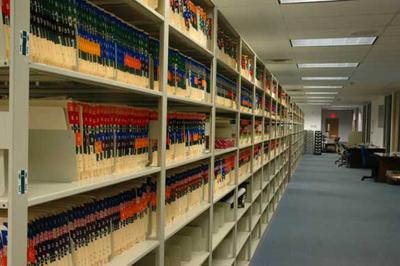

Devon Energy is funding a new well core viewing room inside the Oklahoma Geological Survey, headquartered at OU's main campus in Norman.
The survey’s new $302,000 room will be located in the Mewbourne College of Earth and Energy and will allow Devon Energy employees and researchers to view well cores.
The cores are vertical samples of the rocks beneath the Earth’s surface. They provide information about rock patterns for people interested in what lies below the Earth’s surface, including oil companies looking to drill, said Randy Keller, director of the Oklahoma Geological Survey.
The Survey’s core collection resembles a library, Keller said. However, the shelves, which are up to 20 feet high, hold rocks instead of books.
Researchers look at the cores in the well-core viewing room, which holds long tables and bright lights, Keller said.
Despite the abundance of cores, scheduling time to view the samples can be tricky. There is sometimes a three-week wait-list to view the cores, Keller said.
Keller said Devon Energy, which constitutes roughly 25 percent of the collection’s business, does not always want to wait for the weeks it would take to see a sample, Keller said.
“They want it when they want it,” Keller said.
Because of this, Devon Energy, the largest customer of the core collection, is paying for the new room.
“They’re completely funding it, down to every last penny,” Keller said.
Devon Energy is also willing to put forth the money to fund the construction of a new room inside an already existing room, Keller said.
The new viewing room will be primarily used by Devon Energy, Keller said. This will decrease the wait time for the current viewing room, which may benefit researchers, the collection’s second most frequent users, Keller said.
Keller said researchers from universities across the country frequently visit the well-core viewing room.
“They come here from all over, really,” Keller said.
Geology professor Gerilyn Soreghan co-hosted a workshop about the importance of well cores last year.
When it comes to rocks, access to vertical samples means access to information about the aging of the rocks, Soreghan said.
“Basically it’s like a tape recording of what’s going on in the Earth’s system,” Soreghan said.
The cores are continuous, so they provide better information about an area’s geological history than other samples might. Additionally, continuous samples have better chances of being accurately dated, Soreghan said.
By looking at the samples, researches can glean information, such as the sources of sediments and wind patterns over time, Soreghan said.
Because extracting cores can be expensive, sometimes oil companies will use other methods to see the rock layers below the Earth’s surface, using various sensors to make logs. However, these methods don’t give as much complete information as the cores.
“There’s a lot you can tell by doing logs, but you don’t have the rocks,” Soreghan said.
In addition, cores provide more complete information about rock formations than outcrops, which have sometimes been weathered for millions of years, Soreghan said. Outcrops can also be scarce in the Midwest, where the landscape is relatively flat.
“We could never get this data any other way,” Soreghan said.
Soreghan said she uses the well core viewing room at least once a year. She also brings her "Sedimentology and Stratigraphy" class to view the cores.
Soreghan said she’s had no trouble scheduling a time to use the viewing room. However, she reserves the room when she makes her syllabus, months before her class actually views the cores, she said.
Keller said the construction of the new room should allow the survey to better serve all of its customers.


