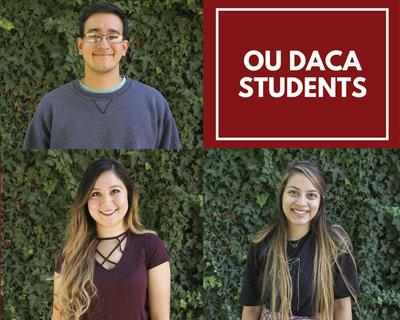
Carlos Rubio dreams of one day being an astronaut.
Diana Prieto wants to mentor foster children and juvenile detention youth.
Ruth Cruces hopes to be a pediatric oncologist and surgeon.
But the lofty aspirations of these three, and the 77 other OU students like them, may never become reality because of a minor detail they share in common: their place of birth.
On Sept. 5, the Trump administration announced its plan to end the Deferred Action for Childhood Arrivals program, or DACA, but with a six-month delay to allow Congress time to create a legislative solution. The program gives those who came to America as children the ability to obtain work permits, travel permits and temporary reprieve from deportation for two-year periods.
The program will be phased out so that current recipients will lose DACA benefits when their two-year status expires. While new applications are no longer being accepted, those whose DACA status expires between now and March 5 will be allowed to apply for renewal.
Rubio is a DACA recipient whose status expires in June 2019. For now, he can finish his college degree in industrial and systems engineering, but without a work permit upon graduation, his future is uncertain.
Still, he has no choice but to keep moving forward.
“I’m just going to keep grinding,” Rubio said. “Right now I’m just trying to keep my head up, grades, to be the student I want to be, continue to stay involved like I want to be involved and just focus on these next couple of years. Who knows what will happen when I graduate — I’ve got three good years left at a good university where there’s still a lot to do, so I just kind of have to keep my head up.”
Prieto’s work permit will expire in a year, at which point she will be unable to work to support herself.
“If I can’t hold a job, I can’t pay for my apartment and I can't pay for my school, so I would have to drop out,” Prieto said. “Basically, I wouldn't have anything without DACA.”
Prieto first heard the news while sitting in Cate Center about to meet friends for lunch. She cried, overwhelmed by sadness and anger.
“I have two choices: I can either be like, ‘Why am I doing this, why am I pursuing something I don’t even know if I can finish?’ and drop out,” Prieto said. “But then, what’s the purpose of me and others fighting for this cause if I’m not going to pursue my degree? So at this point, it’s uncertain, but I can’t just quit.”
DACA’s regulations require that applicants must have immigrated to the United States before turning 16, have no felonies and no more than three small misdemeanors and must have at least a high school diploma (or equivalent) or currently be in school, among other guidelines. Applicants must pay a $495 fee upon acceptance and with each renewal, in addition to disclosing their undocumented status to the government.
The program was created in 2012 by an executive order from then-President Barack Obama and has since faced backlash regarding its constitutionality and whether the executive branch has the right to make immigration policy, said Nima Zecavati, OU’s immigration attorney.
The official decision to end the program came after Trump received an ultimatum from attorneys general from various states. They threatened a lawsuit if he did not end the program by Sept. 5, Zecavati said.
Even with the looming cancellation, current DACA recipients have a small window of opportunity to get an extension. Approximately 800,000 people nationwide have DACA status, and close to 7,000 are in Oklahoma, Zecavati said.
“It looks like they did put some thought into it rather than just terminating the program and saying everybody with DACA doesn’t have DACA anymore,” Zecavati said. “It does put a little pressure on Congress to find a fix — and quickly.”
Zecavati said there have been multiple bills brought up in Congress to address underaged, undocumented immigrants, but they were never passed.
Many of those who receive opportunities through DACA, like Cruces, didn’t know they were undocumented until they were teenagers.
“I didn’t find out I was undocumented until I was a junior in high school. I was applying for scholarship, and that’s when I found out,” Cruces said. “And so that was this moment where everything flipped, and that’s when I started to realize more about the things that could happen. Like what if I get pulled over and it doesn’t go how it should go, and I get detained and deported? I mean, what would that mean for the rest of my family? For my parents?”
For students like Cruces who now face potential deportation when their DACA status expires, the threat of being sent to a country that is completely foreign to them clouds their vision of what America has always meant to them.
“I grew up singing 'The Star Spangled Banner' and saying the Pledge of Allegiance. These things are about freedom and America and hope,” Cruces said. “I might have a different birth country, but it isn’t my home. All I know is America.”
DACA students have received support from the OU community in the past few days. On the day of the decision, OU President David Boren issued a statement addressing OU’s undocumented students, expressing his full support of DACA students and acknowledging their leadership and place on campus.
"In my opinion, it would be un-American and grossly unfair to deprive these young people of the opportunity to continue to live in the United States, where they are making a significant contribution to this country,” Boren said in the statement.
The OU Student Government Association has created advocacy cards for students interested in petitioning state congressmen and senators to “act with compassion” to sign at various locations across campus on Sept. 7 and 8.
OU’s DACA students will also be able to attend forums to help guide them on what actions to take, Zecavati said, but the details of these forums have not been finalized.
With the executive branch ending DACA, it is now up to Congress to create workable legislation to protect young immigrants, Zecavati said.
“A lot of us in the immigration world were hopeful that as bad as the termination of DACA is, that it provides a catalyst for us to pass some kind of permanent fix to help the DREAMers,” Zecavati said.
On Sept. 6, attorneys general from 15 states and D.C. filed a lawsuit to stop the Trump administration from ending the program, the Washington Post reported.
Even with the next six months stretching out in uncertainty, Prieto said she there is action to be taken, such as calling legislators and senators to remind them of these problems.
“That’s what we can do,” Prieto said. “There’s a lot of things we can’t do, but I got tired of thinking of that, and now I just have to think about what I can do.”
Emma Keith contributed to this report.