
Every Wednesday evening a community of OU students gathers over snacks and coffee in the community room of the Anne and Henry Zarrow School of Social Work.
They check in on each other, say what’s on their minds and discuss the issue they have in common: they are students recovering from addiction.
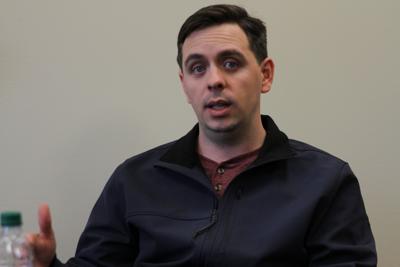
In its early stages in 2018, this group was small, comprised of a transfer student in recovery named Dustin Huckabe and a handful of others. But in just over a year, Students in Recovery has evolved from a grassroots group of a few dedicated students to a rapidly growing organization with reach beyond campus borders.
“Our meetings used to be me, maybe two other people and a box of pizza,” Huckabe said. “Now ... it's getting out of our hands, which is what we want.”
Students in Recovery formed in the fall of 2018 after Huckabe transferred to OU from Texas Tech University due to his wife, Emma Huckabe’s, job. At Texas Tech, Huckabe was part of the Center for Collegiate Recovery Communities, a support program for students recovering from addiction.
Texas Tech’s program provides scholarships, sober housing and support groups for recovering students. When Huckabe came to Norman, OU didn’t have the same resource, and he worried about finding a support system.
Huckabe’s initial goal was to create a space like Tech’s recovery program where recovering students could find connections with people who struggle with similar issues, he said.
Now, the group has a consistent attendance of about 15 members — some students in recovery and some support members. Since the group began it has raised $16,500 from donations, said Jennifer Dell, the organization’s adviser and undergraduate coordinator for the school of social work.
The group’s ultimate goal, according to their Thousands Strong page, is to raise $100,000 to hire full-time staff, visit other collegiate recovery programs and have a dedicated space on campus.
The group has also prompted the formation of an exploratory committee made up of representatives from Goddard Health Services, Students Affairs and Food and Housing to investigate addiction at OU and the effects of a collegiate recovery program, Huckabe said.
During its weekly meetings, the members of Students in Recovery use a 12-step program similar to Alcoholics Anonymous to form a support system for each other, said Neal Stetson, member of the group and biochemistry junior.
Stetson discovered Students in Recovery through a classmate.
“(Addiction) is one of the hardest ... mental disorders there are, because it's one of the few that can convince you that you don't have it,” Stetson said.
Stetson, now 37, dropped out of college when he was 18 due to drug use. Now at OU with Students in Recovery, he’s able to maintain his sobriety with the help of the community.
“Having a group of people to talk about my thoughts is essential to my recovery because it is ... easy for me to one minute be completely fine and okay with myself and with the world, and then in a day be in a completely different place,” Stetson said.
Stetson is one of the older members of the group, which is diverse in age, ranging from young adults to older, non-traditional students.
The group is not only for students in recovery. Advocates for those in recovery are also encouraged to join.
“It's been some of those allies that have helped really break the ground,” Dell said. “Now we're looking at that other layer of institutional support that's going to make this what it needs to be.”
Social work senior Jesse Andersen, while not in recovery himself, serves as an ally and advocate for recovering students in the group.
In July 2018, Andersen’s older brother, Brandon Dunagan, passed away after a decade of addiction and several years in prison at age 30.
“That really pushed me over the edge to be very passionate about social work and wanting to help people ... with substance abuse problems, mental health ... especially in the criminal justice system,” Andersen said.
Andersen joined Students in Recovery after Huckabe invited him to a meeting last spring. The group was much smaller then, mainly comprised of advocates like Andersen. Now, with more members, there’s a community on campus for people struggling like Andersen’s brother did.
“I don't want people to go through the same things I went through and that my brother went through,” Andersen said. “So many other people on campus have their needs met through different organizations or different resources. Why can't these people have their needs met on campus?”
Beyond building campus community, Students in Recovery has partnered with other recovery organizations in Oklahoma City and Norman. The most recent outreach effort of the group was with Mission Academy High School — a sober high school in Oklahoma City from Teen Recovery Solutions.
Students in Recovery tabled at the high school’s fourth annual Run for Recovery in February, which raised money for recovering teens and their families, according to the organization’s website.
Huckabe wanted to partner with Mission High School to show high schoolers in recovery that sobriety in college is possible and to encourage the members of Students in Recovery to give back to their community.
“In my previous life ... I took a lot of things from my community,” Huckabe said. “So one of the coolest things about our student organization so far and about what we want to do is being able to give back ... being able to have a sense of pride in the community in which we live.”
Showing recovering high school students support systems in higher education is a valuable experience, said JD Fennell, executive director of Teen Recovery Solutions — the nonprofit behind Mission Academy High School — and a recovering addict himself.
“One thing I know for sure is you cannot get sober and stay sober on your own,” Fennell said. “You must surround yourself with other people who are doing the same thing you're trying to do.”
Some of the group’s upcoming community outreach activities include events like Dogs and Dogs on March 30 where Students in Recovery members will hand out hot dogs on the South Oval and have service animals for students to hang out with. The goal is to connect students with Students in Recovery who may not know about it, Huckabe said.
Despite the progress already made in the organization’s short existence, Huckabe says they’re just beginning.
“We've come a long way in the past year and a half ... and I think we're approaching the starting line,” Huckabe said. “I think the work begins once we have this program that surrounds these students.”
Update: This story was updated at 7:30 p.m. March 12 to reflect the correct spelling of Emma Huckabe's name.


