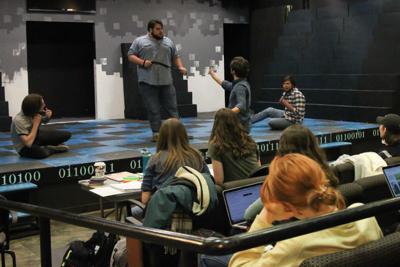
A small ensemble of OU drama students are set to perform a theater adaptation of a German novel starting Nov. 13.
OU’s production of “The Trial” illustrates the death of privacy in the modern era as people are surveyed more and more online, said Joe Alberti, the show’s director and a Weitzenhoffer endowed assistant professor of voice and speech. In 2018, before the production process, cast members did a staged reading of the text and have been reading through and practicing the show ever since.
Based on the 1925 German novel “Der Prozess” by Franz Kafka, “The Trial” was first adapted into a play by Steven Berkoff and performed in 1970 at the Oval House in London. The performance led to multiple adaptations, according to Berkoff’s website.
Alberti worked with Genoa Davidson, a voice and dialect coach in Norman, and Robert Lemon, an OU associate professor of German literature, to translate and adapt the novel into a play.
“The Trial” tells the story of Joseph K., who is arrested by anonymous authorities for reasons unknown to him. As K. eventually goes to trial, the show depicts how bureaucracy's power over people has increased in the past century from the totalitarian government Kafka described in the original text to the ever-surveying government we know today, Alberti said.
Alberti said Lemon originally came to him about a year and a half ago, wanting to translate the German novel into English and turn it into a play. Lemon started translating the novel in the summer of 2018 with the intention of altering the text to fit a more modern context.
“We decided to set the play in the very near future, about five years from now,” Alberti said. “The protagonist is now a high-profile player in a Google kind of organization where knowledge regarding people’s individual selves is being used and sold as marketing info.”
This adaptation of the play incorporates 21st-century technologies, such as a TV screen on the back of the stage, artificial intelligence and even Amazon Alexa devices. Lemon said all of this technology is included to depict how the government is always watching people.
“Everyone has the equivalent of Siri or Alexa, connecting them to an online network,” Lemon said. “This means characters like Joseph K. are constantly under surveillance and can’t travel anywhere without being watched.”
Because the production is an original adaptation, actors were provided with ample creative control within rehearsals. Will Warner, a drama sophomore who plays an attorney named Dr. Grace, said this production was unlike anything he had ever done before.
“What’s cool about the production is that it’s always been very fluid, which you don’t normally see,” Warner said. “In most cases, the script is god and you have to say every line precisely, but with this, we get to decide if something does or doesn’t work.”
It is rare for original full-length plays like OU’s adaptation of “The Trial” to come out of colleges without a playwriting program. Warner said in that way, this production was special, as once the idea was conceived, students were immediately involved.
“Dr. Alberti has put a lot of faith in student input and creativity, which can be pretty scary since it is his professional work,” Warner said. “I think he has been very kind to let us all be involved.”
The essence of the play can be summed up with the term “surveillance capitalism,” Warner said.
Coined by Harvard professor Shoshana Zuboff, surveillance capitalism is a corporate collection of people’s online data gathered to shape online markets by pushing political agendas or advertising certain products, according to The Harvard Gazette.
“We brought in this idea of surveillance capitalism based on a book called ‘The Age of Surveillance Capitalism’ (by Zuboff),” Alberti said. “We wanted to look further into how our information is being taken and used often without our awareness.”
Warner said “The Trial” is meant to show what the world could be like five to 10 years down the line, when data harvesting and surveillance capitalism are general practice.
“With surveillance capitalism, already we’re seeing our minds being changed in a slow, gradual shift,” Warner said. “Especially for my generation, none of us remember being in a time where we weren’t monitored by the government. I think a lot of us take it for granted, thinking it’s all OK, when in reality I would say it’s not.”
Alberti said he hopes to generate an experience about surveillance capitalism that challenges audiences to consider Kafka’s prediction of a totalitarian government and how it relates to restrictions imposed by the U.S. government today.
“We hope to open audience members' eyes by emphasizing how our personal lives are becoming public in many ways,” Alberti said.
“The Trial” will start at 7:30 p.m. Nov. 12, with additional performances at 7:30 p.m. Nov. 13–16 and at 3 p.m. Nov. 17 in the E. Frank Gilson Lab Theatre, 640 Parrington Oval.
Tickets are $8 for adults and $6 with a student ID. They are available by phone and at the OU Fine Arts Box Office.