
During his weekly update, OU’s Chief COVID Officer Dr. Dale Bratzler said OU's transition to online classes after Thanksgiving is meant to reduce the concerns of the OU community on COVID-19 transmission.
According to an OU Medicine live stream, Bratzler said OU does not want to potentially increase the risk of COVID-19 from bringing OU students back to campus after Thanksgiving, especially those who are traveling to other states with higher incidences of COVID-19 and fewer mask mandates or masking enforcement than in Norman.
Bratzler said he would not be surprised if the OU community sees an “uptick” in the number of COVID-19 cases a couple of weeks after Thanksgiving.
“We actually see very low transmission of the virus in Norman at this time since Norman has had a mask mandate for a long time,” Bratzler said. “All of us expect family gatherings that (might) actually result in an increased number of cases.”
Bratzler said he encourages OU students who are returning home for Thanksgiving to get a free COVID-19 test before traveling in order to avoid the exposure to their families.
“We've encouraged our students who are going home for Thanksgiving to come and get a free test before they go and not to take COVID-19 home to their families,” Bratzler said.
Bratzler said Oklahoma has recorded 95,000 COVID-19 cases since testing began, with an average of 1,000 cases per day. During the last week, Oklahoma confirmed 7,000 new cases and 44 deaths.
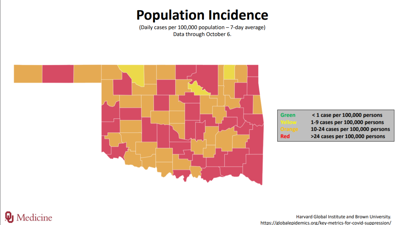
According to Bratzler, COVID-19 is currently moving into the rural Oklahoma communities, although Tulsa County, Cleveland County and Oklahoma County continue reporting the majority of COVID-19 cases every day.
Bratzler said COVID-19 is mostly spreading in young people from 15 to 24 and from 25 to 38 in Oklahoma, yet patients over 55 are suffering the consequences — the group makes up 93 percent of the deaths in the state.
“It’s really important that we continue to inspire young people to wear masks and to practice social distancing, even though they don't get as ill,” Bratzler said. “They're the ones who eventually are likely to be spreading this disease to the older population who's dying from the disease.”
Bratzler said Oklahoma still has hospital bed capacity, yet there are nurse staffing limitations. If there is an early flu season this year, hospitals will need to come up with contingency plans for surge capacity, although that might result in patient care delays.
“Typically if (patients) are not very ill, (they) have an average hospital length-of-stay of about four days according to the health department, but that ranges anywhere from one to 15 days per person,” Bratzler said. “It's important to recognize if you're sick enough to end up in a hospital, mostly if you have complications and a higher risk of death from the disease.”
According to Bratzler, preventing hospital shutdowns during COVID-19 and influenza season means finding additional health care workers to attend to patients in need of additional surge capacity. Bratzler said wearing a mask to “slow the spread of (COVID-19) and of influenza” and getting a flu shot would ease pressure on hospitals.
“There's bed capacity in Oklahoma, but it may mean if we get more cases, the patients may even get moved out of (their) own community,” Bratzler said. “COVID-19 patients are not going to be moved out into smaller regional facilities in case of capacity issues.”
Lastly, Bratzler said the university uses the data collected from the OU Student Health Center and from how much COVID-19 is found in wastewater from the buildings to inform the number of COVID-19 cases in Cleveland County. He said that “although there were some increasing cases (in Cleveland County), that has been steadily coming down.”


