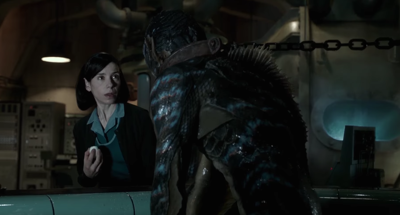
“The Shape of Water” is a mesmerizing love story that draws in audiences of all genre preferences, with the promise of a fairytale that’s unique and unexplored.
The film, directed by Guillermo del Toro, explores a love story between Elisa Esposito, a mute janitor in a government testing facility, and an amphibian man amid a government scandal that threatens America’s national security.
The movie is nominated for Best Picture at the 2018 Academy Awards. It also snagged nominations for Best Actress, Best Actor in a Supporting Role, Best Actress in a Supporting Role, Best Cinematography, Best Costume Design, Best Directing, Best Film Editing, Best Music (Original Score), Best Production Design, Best Sound Editing, Best Sound Mixing and Best Writing (Original Screenplay).
The film opens with a montage of Elisa’s routine and her mundane, quiet life. Her only friends are her roommate, Giles, played by Richard Jenkins, and her coworker, Zelda, played by Octavia Spencer.
Elisa’s life is quickly interrupted when she and Zelda are instructed to clean the facility where the amphibian man is being held and tortured. The creature and Elisa quickly make a connection, sparking a relationship that silently blooms as she teaches him sign language and finds ways to sneak into his facility to feed him.
When the government program ultimately decides to terminate the amphibian man, Elisa makes the decision to save him, enlisting the help of her friends to get him out of the facility.
The story's evolving romance gives a human element to the amphibian man, and the end of the film hints that Elisa’s muteness is a sign she has been an amphibian creature herself.
Del Toro’s storytelling throughout the film is sprinkled with his technique — the use of sign language from Esposito’s side of the story, unique camera angles and a dark yet colorful overtone that gives the film a “Pan’s Labyrinth” feel.
Still, its unique blend of fantasy and reality might be a little too forward for modern audiences to fully appreciate. The movie’s storyline crosses some social boundaries that seemingly hinder audiences from connecting on a personal level.
While the film is set in a classic American setting and the characters are real and vulnerable, the romance sparks a controversy that surrounds the idea of beastiality. Even if Esposito is meant to have been amphibious herself, her onscreen romance with an amphibian man is awkward, at best, to watch.
The movie is daunting and dark. It has a fairytale familiarity but carries itself as an individual in the cinematic world.
Given the fairytale essence of the film, there is a question of how stories have evolved in our society. Mary Anna Evans, assistant professor of professional writing, gave her input on fairytales in our own evolving culture.
"I think fairy tales evolve with the times," Evans said. "The trappings of them change, but the basis of the story stay pretty constant."
The idea of romance between a person and a monster also plays deeper into exploring who we are as a society.
"A lot of monster movies are helping us grapple with our dark sides. They help us take a look at the parts of ourselves that scare us," Evans said. "I think giving monsters emotions makes them more relatable. If a monster is a mirror of yourself, it only makes sense to give it a story arc.”
Whether or not audiences are ready to stomach the cross-species romance that unfolds on screen, del Toro’s take on an adult-centered fairytale has earned it some well-deserved credibility and a chance at Oscar success.


