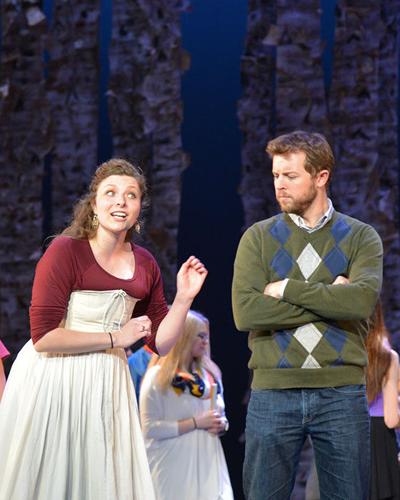

Audiences can expect to relive the experience of falling in love through Tchaikovsky’s opera, “Eugene Onegin,” while becoming entranced in an array of melodies.
The beloved Nutcracker composer, Tchaikovsky, is back at OU, this time with his three-act opera, “Eugene Onegin.” The Russian composer adapted the opera from Alexander Pushkin’s poetic novel of the same name.
Jonathan Shames, the show's artistic director, said the opera tells the story of Tatyana, a young girl who falls in love with Eugene Onegin. The opera is a tragedy because Onegin, a wealthy Russian aristocrat decides he wants nothing to do with Tatyana.
“(Onegin) is the very kind of character you see in Russian literature a lot, an alienated personality or man who has no inner substance," Shames said. "Pushkin was the first one to put this personality in literature.”
Onegin is a hands-on production, fully staged and costumed with the OU symphony, OU opera chorus and 21 dancers from OU’s dance department.
“Eugene Onegin” is a lavish production, Shames said.
“Certain composers express things in different ways but (Tchaikovsky’s) special gift is melody," he said. "He has a real great gift for dance and the movement of music."
Tchaikovsky’s personal feelings and interpretation of Pushkins' novel are evident in the opera. The melodies and harmonies give enormous emotional information, Shames said.
“I think Tchaikovsky really identified with this character," Shames said. "In particular he identified with the heroine. The audience will hear the most gorgeous music, very soulful, very intimate and very painful because it a very tragic story.”
Alex Bolerjack, one of the actors who plays Eugene Onegin (the four leads are double cast), said Onegin is a very unique personality, and he used BBC's Sherlock Holmes and Mr. Darcy from “Pride and Prejudice” as influences.
“During rehearsals when I want to be bubbly and excited, I just chew on my thoughts, and when you’re chewing on your thoughts it can (be) incredibly dangerous because it creates an inner dialogue," Bolerjack said. "But that’s been a lot of fun for me.”
Onegin has a lot of self-disdain, boredom and detachment issues throughout the opera, and any redeeming quality he has comes too late, Bolerjack said.
“When he is forced to wrap his head and his heart around what he thinks is love for the first time, he cannot fathom being apart from her," he said. "I think the redeeming quality is not actually explored.”
Melissa Delgado, who plays lead character Olga, said transitioning into the role of Olga was easy because she relates to Olga's happy frame of mind.
“(Olga) is bubbly, very happy, kind of ditzy. She lives in her own world," Delgado said. "She thinks that people should live in a constant state of happiness.”
One challenge Delgado faced was staying engaged with her character while singing the music, she said.
“Whenever I am focusing on the music and whenever I am counting I get this dead look in my eyes," she said. "One of the coaches was like, ‘yeah, you get the dead fish eyes.’”
The characters in “Eugene Onegin” have qualities that all people express at one point in their lives, she said.
“As far as Onegin comes, he seems to have this hole in his life that he just can’t fill, and there are points in our lives where some people can even relate to that,” Delgado said.
Everything in “Eugene Onegin” is sung in English, which makes the opera less intimidating for those who are unfamiliar with it, she said.
Whether it is 19th century Russia or 21st century America, “Eugene Onegin” contains contemporary themes, Shames said.
“Tatyana does this thing where she writes a letter to Onegin instead of talking to him and she thinks ‘oh god what an idiot I was’," he said. "I think anyone who writes an email and presses send feels that way.”
Shames ultimately hopes that audiences are enraptured with the entirety of “Eugene Onegin,” he said.
“I want them to feel something of what I’m feeling from this music," he said. "I hope they hear it and are affected by it some way.”


