


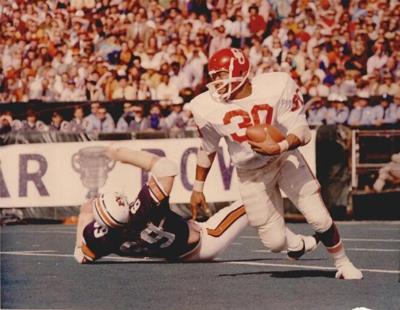
Joe Wylie still believes his punt was good enough.
The Oklahoma punter’s hang time allowed OU’s defenders ample opportunity to swarm the returner. But the Sooners weren’t dealing with a typical returner. They were up against Nebraska’s Johnny Rodgers, who 50 years later still holds the all-time record for kick- and punt-return touchdowns with nine and seven, respectively. The future Heisman winner once famously said he refused to ever call for a fair catch.
Rodgers, who returned the punt from his own 28-yard line, was met instantly by five OU defenders. But Rodgers shredded a tackle, planted his outside foot, cut upfield and wove through Oklahoma’s defense before scoring the first touchdown of 1971’s Game of the Century between the No. 1 Cornhuskers and No. 2 Sooners.
#HeismanMoment | 1972Johnny Rodgers, Nebraska“Game of the Century” punt return in 1971 #1 vs. #2 pic.twitter.com/V1KcE432GI
— Pick Six Previews (@PickSixPreviews) December 13, 2019
Rodgers’ return was the greatest play during college football’s most-anticipated game to that point. The contest featured a sold-out Owen Field crowd of 61,826 fans on Thanksgiving Day and was broadcasted on ABC to a then-record 55 million viewers.
“If it wasn’t the best run he ever made, it was awfully close,” Wylie, who played for the Sooners from 1970-72, told The Daily. “To me, it’s the best punt run I’ve ever seen, and in a critical situation.”

Oklahoma punter and running back Joe Wylie in 1972.
Although the OU-Nebraska rivalry that returns Saturday to commemorate the 50th anniversary of the Game of the Century doesn’t hold the same significance, Rodgers’ punt return still resonates in college football. He was one of many — the teams had a combined 17 of 22 All-Big Eight players that season — that contributed to the famous matchup between Nebraska’s top-ranked defense and OU’s top-ranked offense.
Rodgers’ success on that stage also played a role in limiting the glory of Greg Pruitt, one of the greatest Sooners to never win a Heisman or a national championship.
“Greg might be the Heisman winner”
Nebraska running back Jeff Kinney, the school’s all-time leading rusher who scored four touchdowns, including the game-winner, that day in Norman said he didn’t realize the play had happened because the offense was in the huddle preparing to take the field.
Then the crowd reaction let him know something significant had occurred.
“He was always that guy who could break something big,” Kinney said. “Johnny could score on a punt return, he could score on a kickoff. He could score on a short pass. Johnny was just a threat.”
Wylie said despite what video shows, he managed to get a hand on the 1972 Heisman winner, and Rodgers escaped that, too. But the first Sooner to get to Rodgers was Pruitt, the running back who also played special teams.
Pruitt ran for 1,760 yards that season, good for second in the nation, despite rushing just 196 times, which ranked 41st. He led the nation with nine yards per attempt, and scored 18 touchdowns, en route to a third-place finish for the Heisman in 1971 behind Auburn quarterback Pat Sullivan and Cornell running back Ed Marinaro, who had only 121 more rushing yards than Pruitt despite carrying the ball 160 more times.
Perhaps Pruitt would’ve ended his college career with the award if he hadn’t missed that tackle and the Sooners had beaten the Huskers. Had they done so, they would’ve likely finished ranked No. 1 and won the national championship. A year later, an ankle injury plagued Pruitt in the Nebraska rematch, and he finished the 1972 season a Heisman runner-up behind none other than Rodgers.
“I personally think if Greg had just stopped there and grabbed him, which he could’ve because he was close enough, he wouldn’t have gotten faked out,” Wylie said. “If he just grabbed him we might not be having this conversation right now and Greg might be the Heisman winner. To maybe have lost the Heisman Trophy because you couldn’t make a tackle is just terrible.”
‘He wanted to get him so bad’
Wylie recalled that Pruitt and Rodgers would talk “fairly often” during the season. In 1987, Pruitt told The Daily Oklahoman that he and Rodgers used to speak almost every day over the phone. The friendly rivalry continued throughout the Heisman race.
“Two weeks ago Pruitt, the speedy little Sooner senior, came out of the Kansas game with a badly twisted left ankle,” Pat Putnam wrote in a Sports Illustrated article after the 1972 rematch. “And suddenly his chances for the Heisman Trophy depended not so much on how well he did against Nebraska but on how well Oklahoma did against Johnny Rodgers.”
Rodgers is the namesake for “The Jet Award,” which debuted in 2012 and is given to the nation’s top return specialist. The trophy displays himself running away from a diving Pruitt. Joe Washington, OU’s second all-time leading rusher who arrived in 1972 and filled in for Pruitt while he was hurt that season, remembers watching the play on TV.
Heisman Winners, Mike Garett, Herschel Walker, Mike Rozier, Johnny Rodgers, Eric Crouch at the Jet Award Gala! pic.twitter.com/YKFm0mPb5P
— Johnny Rodgers (@heisman38) April 13, 2021
“Greg was trying to make that play, but he went at it too vigorously,” said Washington, Pruitt’s close friend. “He wanted to get him so bad, and Rodgers kind of bounced off him and the rest is history.”
Washington was a senior in Port Arthur, Texas, during the Game of the Century, and still hadn’t decided where he would attend college the following fall. Although he had already ruled out Nebraska, the Sooners’ and Cornhuskers’ matchup was vital for his future commitment.
“It really was an important game for me to decide where I was going,” Washington said. “But watching that game, and watching Johnny Rodgers and Greg Pruitt play, had me thinking where I would most fit in with the type of player I am and what I want to do.”
Washington mentioned a selling point for later joining the Sooners the next season was the hype surrounding the matchup. With a week off entering the game due to Thanksgiving, it gave the college football world more time to anticipate the highly-touted affair.
“If you come to Oklahoma, you have the opportunity to play on television,” Washington said. “You can be an All-American and have a chance to win the Heisman. (The game) didn’t need any hype, because it was No. 1 versus No. 2 and you got two Heisman Trophy candidates in the game, that’s a big deal.
Fifty years later, the OU-Nebraska rivalry returns Saturday, although the Cornhuskers’ dominance has diminished, and the wishbone has disappeared from offenses. Nebraska is arguably Oklahoma’s most-important rival of the past, as the two schools hold 12 combined national championships and 75 of the Big Eight’s 103 all-time conference championships.
“I think most college football fans have seen (Rodgers’ return) over and over for years and years,” said OU coach Lincoln Riley, who was born over 11 years after the Game of the Century. “I’ve seen it scrolling through social media this week. … I don’t care what era, what teams — take out the circumstances, you’re talking about a phenomenal, phenomenal player, one of the many that played in that game that would’ve been elite in any era, any time.
“It’s one of those plays that catch your eye."


