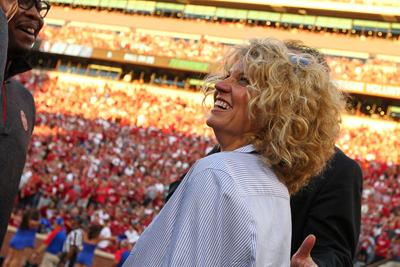

It was a freezing fall day in Norman, Oklahoma, in 1995, and Sherri Coale, the women’s basketball coach for the Norman High School Lady Tigers, found herself inside a stuffy basketball gym, packed with too many bodies for one coach to realistically handle.
One of Coale’s players, a senior named Stacy Hansmeyer, was commanding national attention thanks to her season averages of 17 points and nine rebounds per contest. Coaches from all across the country were coming to Norman to see just what it was the forward had to offer.
One coach in particular walked through the doors of the gym and stuck out like a sore thumb.
The lapels of his suit jacket were turned up to shield his face from the random snowstorm that was pounding Norman, and he was wearing loafers without socks. Geno Auriemma, the head coach for the University of Connecticut Huskies women’s basketball team, was in town to recruit Hansmeyer.
He left with a new name on his mind: Coale.
“I had a chance to watch a full practice, and I came away thinking that it was as close to a college program practice as I had ever seen in high school,” Auriemma said. “This level was certainly not the level you normally see at a high school girl’s program.”
Auriemma settled in and observed, praising Coale as a teacher by drawing a distinction between teaching her players the game and just coaching them.
In that moment, Coale said, a friendship was born.
“I’ll never forget the day that he came to watch (Hansmeyer) because it was snowing sideways, and it was like this snowstorm out of the blue in Oklahoma, like all of the sudden it just descended upon us and the wind was blowing,” Coale said, starting to laugh. “He’s got the lapels of his jacket up walking into the gym, and he’s like, ‘What is going on?’ I was like, ‘Who wears shoes with no socks, what are you doing?’”
The basketball coach at Norman High School had met one of the giants of her sport — UConn was fresh off the 1995 National Championship — mocked his attire and made a lasting impression.
Struggles at OU
Elsewhere in Norman, OU’s women’s basketball team was struggling. Five years removed from an eight-day shutdown of the program, the Sooners had experienced sparse success with Gary Hudson (39-45 in three seasons) and Burl Plunkett (WNIT appearance).
After Plunkett retired following the 1995 season, the Sooners were looking for a spark to their program.
Back at Norman High School, Coale was leading her team into the playoffs. The Lady Tigers had lost only once all season, and Coale was focused on a state title.
“I remember walking through the teacher’s lounge to get my mail out of the central mailbox, and a couple of guys in the lounge said, ‘Hey, Oklahoma women’s basketball, the job is open.’ I said, 'What?' And they said the job was open, and I was busy trying to win a state championship,” Coale said. “I was like, ‘That’s fantastic, or maybe it’s not fantastic, I don’t know, but I’ve got a state championship to win’ ... so the fact that this job was open was like way down the priority list for me.”
Coale’s Lady Tigers rolled through the playoffs and dominated third-ranked Sapulpa in the Class 6A State Championship game, beating them 73-35. After that game, some started to pitch Coale on the idea of going after the Sooners’ vacant coaching position.
“A group of community folks came to me and said, ‘We want you to apply for this job.’ I said, ‘Are you crazy? I’ve never been a college coach. I don’t have any background there,' and they said, 'We think you should just apply,'” Coale said. “Eventually I called (then-associate athletic director) Marita (Hynes), and she said that collegiate experience was not a prerequisite, that they were going to hire the best person that they could hire.”
Coale was in the right place at the right time, doing the right thing.
New opportunities
Coale was likely on the outside looking in for the Sooners’ vacancy — Hynes admits she was skeptical of hiring a high school coach for the job.
But she kept getting calls from people around the state talking about the upstart coach at Norman High School.
Then, Hynes got a particularly memorable call — from Auriemma.
Auriemma said Coale was doing things at a high school level that some college coaches don’t do, that she was teaching her players the fundamentals of the game and they were retaining those fundamentals. When Hansmeyer committed to Auriemma’s Huskies, he raved about how sound of a player she was.
When it was time for her interview, Coale lived up to the hype.
She walked in for her interview equipped with a written portfolio she handed to each of the seven members on the selection committee. It wasn’t a resume but a plan. There were no timelines, but Coale spelled out exactly how she was going to rebuild the program from the ground up.
“Sherri came in and told us what she could do for OU women’s basketball and presented a written plan,” Hynes said. “After we interviewed her, we all just kind of sat back and thought, ‘Man, we could all put on tennis shoes right now and go play for her,’ because she was so passionate about the job.
“I knew it was going to take a lot of energy and passion to turn that program around. She had it, and she convinced the selection committee that she had it. Donnie Duncan was our athletic director at that time, and I had one more interview to do, and I did it very late on a Friday night. Donnie called me at 6:30 a.m. on a Saturday morning and said, ‘Who do you want to hire?’
“‘I want to hire Sherri Coale,” she replied.
Building a foundation
Coale got right to work, but success didn’t come quickly. First, a foundation for the program needed to be constructed.
“People were saying that OU didn’t really care about its women’s basketball team, so they hired a high school coach,” said Jan Ross, a longtime assistant coach under Coale. “I think she heard those things, but she didn’t believe them and didn’t let it change anything she did. She didn’t need any motivation. Her motivation was to make this place great, not to get back at anybody that said anything.”
Turning Oklahoma into a great program started with seemingly the simplest of things.
“I remember in the middle of January in the first year, celebrating the fact that we went through a two-hour practice,” Coale said, remembering her first season at OU, a 5-22 campaign and the worst record Coale ever endured. “The little private victories came way before the public ones. It took us until January to really figure out how to be engaged and be intense and be productive for two hours at a practice period.
“There was a culture that we were creating — a way we were going to be, a way we were going to behave, a way we were going to treat people — and everything had to be established. Everything had to be built from a foundation.”
Joe Castiglione, the Sooners’ current director of athletics, hadn’t yet taken over – he wouldn’t until 1998 – but he could see through the trees from the outside.
“If anybody stopped to pay attention to the foundation and the way she was building the foundation, they would see that the program was being positioned for tremendous success way down the road,” Castiglione said. “She was recruiting players that were buying in to the vision she had for the program.”
The frustration came in year two, when Coale finished 8-19, her second straight losing record.
“That second year she was so frustrated, she had had some good recruits come in, and still we’re not having a very successful season, and she’d be sitting down in the tunnel after a game and be, you know, kind of crying,” Hynes said. “It was hard, it was hard for her, and I thought she might give up on it, but she didn’t. We would have long talks after games and things, and I kept just encouraging her to take it one step at a time."
Castiglione's plan
Castiglione officially took over in 1998, right before Coale began her third season. He doesn’t remember their first official meeting, but he clearly remembers the ice breaker that took place that July.
The team was hosting a preseason tipoff event, and Coale had planned a skit for the team to perform. The premise behind the show was that the returning players would be welcoming the new ones in; it was a quirky way to build team chemistry in advance of the season. At the last moment, Coale pulled Castiglione onto the stage to be a part of it.
“They used a spoof of 'The Brady Bunch' in the skit to try and metaphorically make this point, so they had different people playing the different characters in 'The Brady Bunch,'” Castiglione said. “You know how at the beginning of the show, there are nine boxes and they just have the faces in all the boxes? They made this little prop, and they had nine boxes, and they asked me to be a part of the skit, so I was Mike Brady and Sherri was Carol. When the music started I thought, ‘What have I gotten myself into?’”
Coale said the skit proved to her that Castiglione was committed and was “all in” with her and her program.
“He didn’t have to do that, looking back on it,” she said. “It was funny at the time — it’s even funnier looking back on it now — and we did the squares where you open them up, and it was hysterical, and he played right along.”
Later that year, Coale returned the favor, showing Castiglione she had faith in him. He was looking to renovate the men’s and women’s basketball facilities. When he arrived on campus, the women’s locker room was up a flight of stairs.
Castiglione took Coale and then-men’s basketball coach Kelvin Sampson to visit key donors and ask for a small donation to get the renovations off the ground. Castiglione had one surprise, though.
“Joe (Castiglione) waited until Coach Sampson and he and I got until about halfway from Norman to Ardmore to tell us that we were actually going to thank them for having us, but we were not going to make them ask, we were going to tell them ‘no thank you’ for the gift because we were going to come back and ask them for another gift later,” Coale remembered. “What Joe was doing was teaching us about the power of vision. His idea for our basketball complex was not a couple hundred thousand dollars worth of renovations. It was a $16.8 million facility, which is what we have here (now).”
That facility that Castiglione pushed for was one of the first of its kind. At that time, not many universities had individual facilities for their men’s and women’s teams.
Coale was on board with the new plan, and Castiglione was blown away by the amount of trust she was placing in him. Coale saw it as the ultimate sign of support and respect.
Near the mountaintop
In her third season, Coale’s Sooners won 15 games and punched a ticket to the Women's National Invitation Tournament. The next year, Coale went 25-8 and took the program to the Sweet 16. By 2002, Coale had the Sooners playing for a national title against Auriemma and the Huskies. Coale’s teams have made the NCAA tournament every single season since. She’s won 20 games or more 13 times since the turn of the century.
Coale has now been a part of the women’s basketball program for nearly half of its existence — she’s preparing for her 21st season — and to her contemporaries, she’s had as big an impact on her sport as Auriemma, a man who has won more national championships than any other coach in collegiate basketball history.
“One of her strengths is this cross between her own selflessness and an insatiable desire to learn,” Castiglione said. “Taking what she learns and mentoring those around her, with her staff, and obviously the culture that she creates with each team. That’s a year-to-year commitment. You can’t just do it once, and it carries on and on and on. You have to do things differently each year.”
Ross said Coale still has the same goals as when she to took the job.
She wants to teach; she wants to be a mentor.
“Her passion is to grow young women, not just basketball players but grow young women. She does that by growing herself,” Ross said. “She’s always staying up on stuff and new ways to teach and paying attention to what they need. She’s just amazing at being able to teach young people and at the same time learn herself.”


