




The state remained in shock as OU President Joseph Harroz Jr. prepared to address the Board of Regents — and by extension, Sooners fans and the college football world at large.
In a moment in which many felt demoralized, the often embattled but ever optimistic leader used an unexpected word: invigorated. He made clear OU wouldn’t be afraid to open its wallet in filling its head football coach vacancy and that donors were excited by Athletic Director Joe Castiglione’s endeavor to replace Lincoln Riley. The Sooners’ head coach since 2017, Riley had rocked the college football world four days earlier by accepting the head coaching job at Southern California on Nov. 28.
That donor enthusiasm Harroz mentioned was documented two days later when oil billionaire and OU alumnus Tim Headington was photographed stepping out of a car with athletic department leaders and into a South Carolina lake house to secure OU’s new head man. Hours later, Oklahoma named Brent Venables its next coach.
The former Sooners defensive coordinator returned from a 10-year stint at Clemson, where he was the highest paid assistant coach nationally at $2.5 million annually. Despite being a first-time head coach, Venables will make $7 million annually in total compensation to helm Oklahoma in 2022 and beyond. His starting pay is more than Riley ever made at OU, despite the latter garnering the largest fully guaranteed contract for a first time head coach upon being hired in 2017.
College football’s evolution as a business continues at a breakneck pace, more so amid conference realignment and coaching transitions, both of which OU has been a central player in during the past five years. The trend in skyrocketing coach salaries, in particular, illustrates that a sport once laden with pageantry is now consumed by paying top dollar for a perceived advantage in maintaining successful football programs on the field and at the bank.
The Daily analyzed key points and more than a century of data from OU Board of Regents records and then put them before experts on the business of college football to help explain and bring context to OU’s escalating head coach salaries, how they align with college football at large and where it might lead next.
While it feels new in some ways, Oklahoma has been at the forefront of such changes since President George Lynn Cross famously declared in 1951 his desire for “a university the football team can be proud of.” In years to come, the Sooners will remain atop the shifting college football landscape as they prepare to enter the Southeastern Conference by 2025. Recent spending reiterates pride — especially in college football’s top echelons — comes at a steep cost.

Biff Jones in 1937.
‘Biff ’ Jones, the superstar effect and winner’s curse
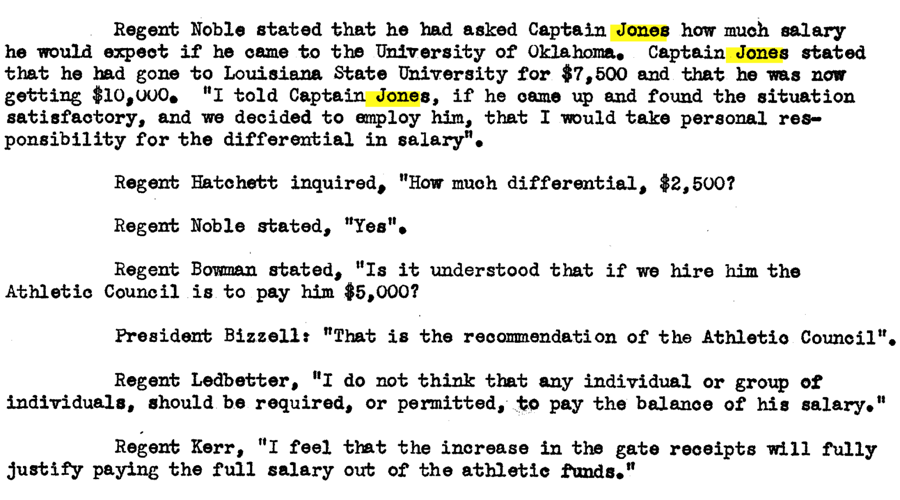
Following the resignation of coach Lewie Hardage in 1934, OU Regent Lloyd Noble embarked for Baton Rouge on his own ticket to find a new football coach. He visited Capt. Lawrence McCeney “Biff ” Jones, a World War I veteran who’d coached his alma mater, the U.S. Military Academy at West Point and, most recently, LSU.
Jones helped the Tigers tie for first in the Southern Conference in 1932, but he resigned after the 1934 season, supposedly due to a disagreement with Louisiana Sen. Huey P. Long, a longtime supporter of the program.
Jones was skeptical of OU but eventually agreed to coach the Sooners. He commanded a historic value of $7,500 — the most of any Oklahoma coach to that date.
Bennie Owen, who is credited with kickstarting Oklahoma football in earnest and whose likeness now stands in bronze just beyond the field that bears his name, produced a 122-54-16 record as the Sooners’ coach from 1905-26. However, his salary peaked at less than half of Jones’, and only after he gave up coaching to become athletic director.
At first, the athletic council recommended $5,000 for Jones, and Noble offered to pay the difference. Instead, regents settled on accounting for the difference from projected increased ticket sales.
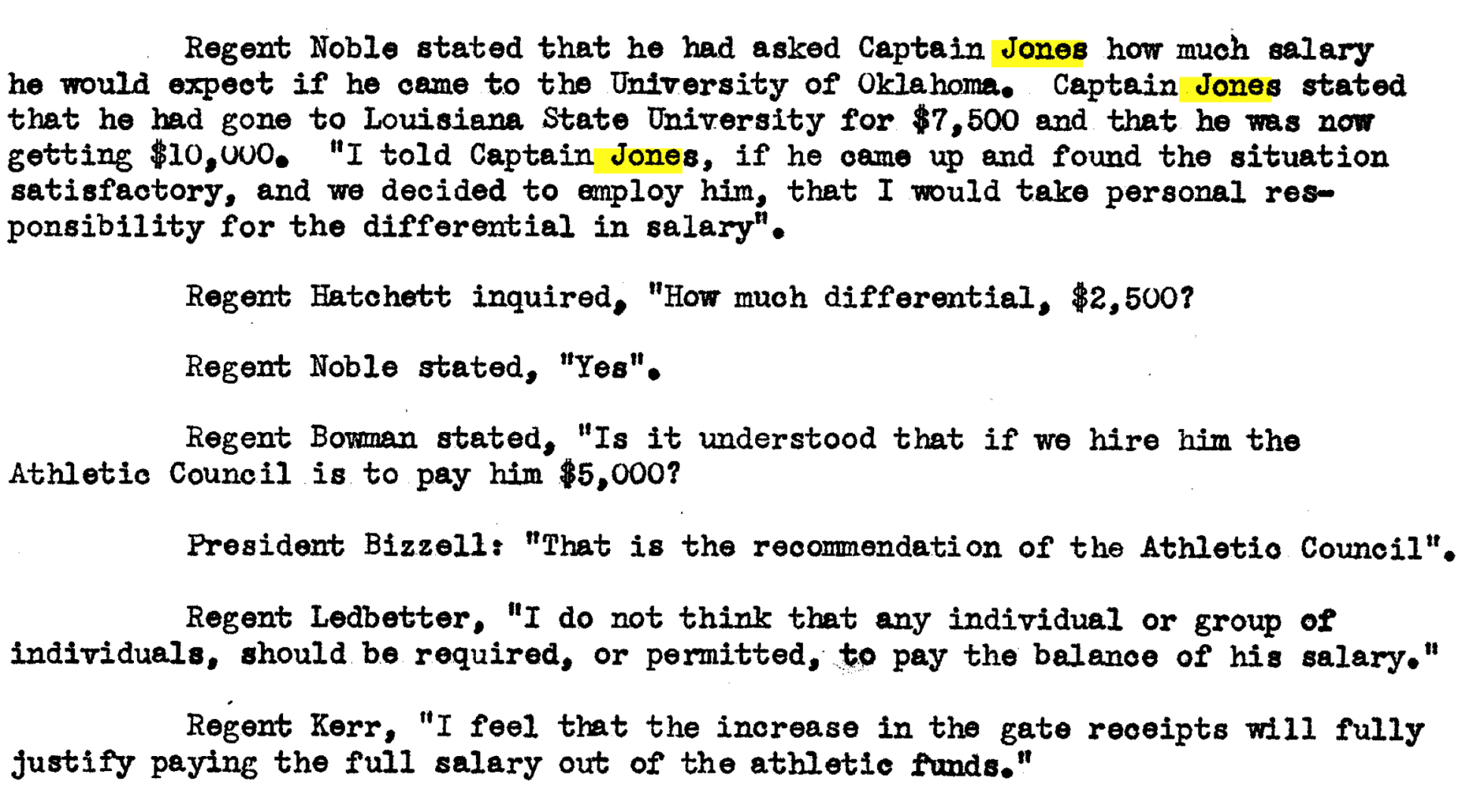
Regents minutes from 1935 regarding Oklahoma's hiring of football coach Biff Jones, courtesy of SHAREOK Repository.
OU was willing to pay more than ever for the perceived best option — a phenomenon Michael Leeds, an economics professor at Temple University, calls the superstar effect.
“If you have two coaches, one of whom is just slightly better than the other, you’re going to see the compensation potential for that slightly better coach blown up way beyond any difference in ability,” Leeds said. “You would think a slightly better coach would have a slightly higher salary (and) a much better coach has a much better salary. But, in fact, once you get to a certain level, those small differences in ability lead to huge differences in compensation.”
“The example I always give my students is, suppose — God forbid — you have a brain tumor. And you’re looking at a brain surgeon, and one of them has a 95 percent success rate, and another one has a 97 percent success rate. Who are you going to go to? Even if the person with a 95 percent success rate says, ‘I’ll charge you a little bit less,’ you’re still going to go to the better one.”
Unlike brain surgery, OU’s acquisition of Jones was a more short-term solution. The university hired him despite word from the War Department that he could be away from his military duties for only two more years, at most.
Right on schedule, Jones left OU after the 1936 season, having coached the Sooners to just a 9-6-3 record in the least-memorable stop of his 14-year career. Promptly, he retired from the military in 1937 and became head coach of the rival Nebraska Cornhuskers. Jones later returned to the Army to fight in World War II and was inducted into the College Football Hall of Fame in 1954.
In the case of Jones, the superstar effect led to another phenomenon: the winner’s curse. Enamored with the belief that Jones could provide unparalleled success, Noble and OU put all their chips on the table but walked away with less than expected. It wasn’t the last time the Sooners would overpay on a coach.
“What often happens is that the winning bid is well above the actual value of the thing being bid on,” Leeds said. “This is why you see cities overspending on (the) Olympics, why you see free agents in sports often overpaid, and it’s potentially one reason why you see, again, salaries being driven sky high for successful football coaches.”
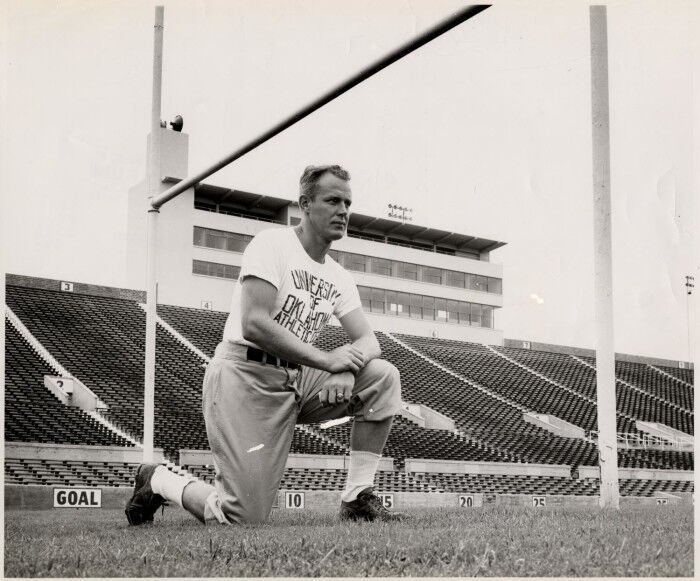
Bud Wilkinson in 1950.
Wilkinson, financial pioneer
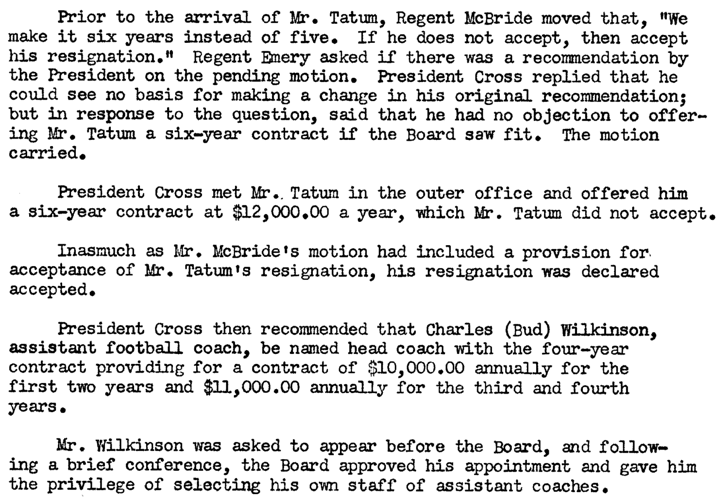
Ten years later, Jim Tatum topped Jones’ start value with an $8,000 salary in 1946, but after one season, he was wooed by an offer from Maryland and resigned. Attempting to retain Tatum for the 1947 season, the board offered him five- and six-year deals worth $12,000, but he sought a 10-year deal for the same value.
“If the objective is to be the (winner) of football games at any cost, the only factor to be considered in selecting or retaining a head coach is his ability to win games,” Cross said in a 1947 meeting, with words that foreshadowed the current nature of college football. “His methods of winning are not to be scrutinized too closely. His relations to his associates in other sports, and to the members of the faculty, will not be of great concern as long as he is winning.
“If, on the other hand, football in the university is to be a part of an educational and public relations program in a more genuine sense, many factors must be considered in the selection or retention of a head coach. His integrity, loyalty and personality must be taken into consideration in addition to his ability to win football games. His relations to his associates and the faculty become of paramount importance. Therefore, his salary and the other features of his contract must be considered in the light of the university’s general problem. His influence as a man upon the members of his squad becomes of importance. His ability to view the sport in its proper perspective must be considered.”
Faced with finding the balance of academic and athletic importance, the regents accepted Tatum’s resignation. It would be 75 years before another coach, Riley, left Norman to take another collegiate job. The same day the regents accepted Tatum’s resignation, they promoted one of his assistants, Charles Burnham “Bud” Wilkinson. Adjusted for inflation, Wilkinson’s initial $10,000 salary equates to $129,278 in 2021.
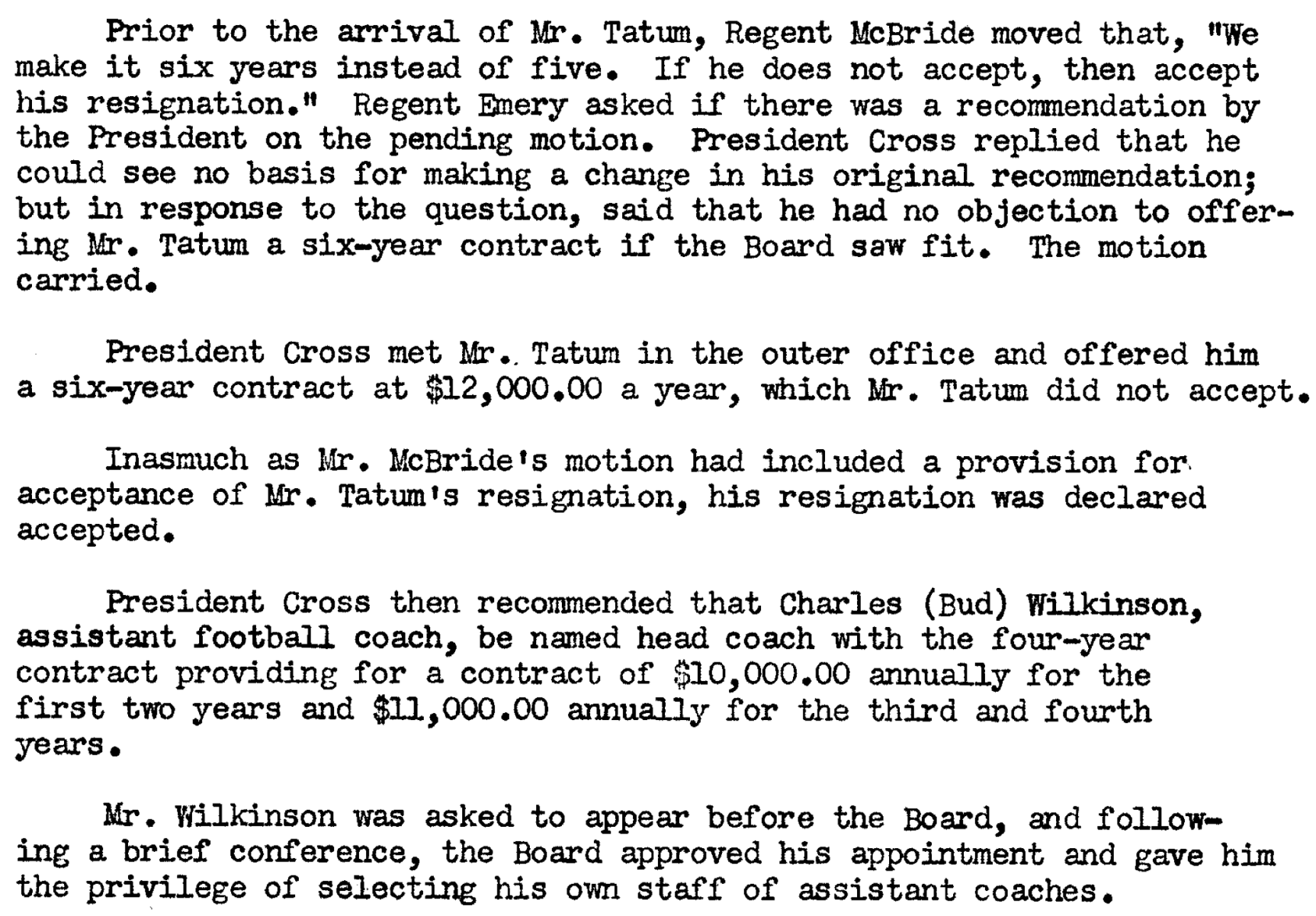
Regents minutes from 1947 regarding OU's hiring of football coach Bud Wilkinson, courtesy of the SHAREOK Repository.
Previously an assistant at Syracuse, Minnesota and the Navy Pre-Flight school at Iowa, Wilkinson became one of the greatest Oklahoma coaches and perhaps one of the last who kept the relative financial values of both educational and athletic successes in equilibrium.
He compiled a 145-29-4 record while winning the 1950, ’55 and ’56 national championships in his 17 seasons helming the Sooners. His 47-game winning streak from 1953-57 remains an NCAA Division I record.
On top of building the machine that is OU football, Wilkinson was a financial innovator. Ahead of the 1953 season, he became the first college coach with a TV show, pioneering a type of programming and line of revenue still used as supplementary pay in Norman and abroad today.
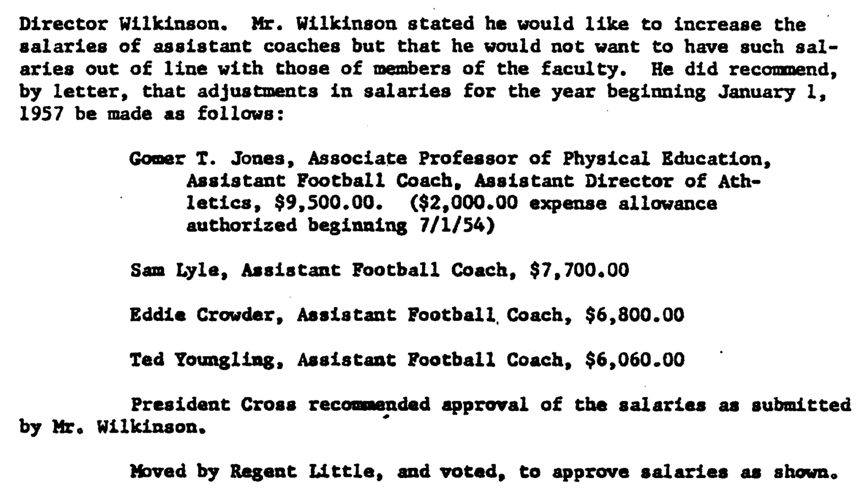
In 1956, Wilkinson became the first Sooners coach to garner annuities, setting himself up for retirement. One year later, he raised his assistant coaches’ salaries but said that assistants’ pay shouldn’t be out of line with that of professors.
His egalitarian perspective aligned with Cross’ assertion that the football program should serve the university's educational means and perhaps made Wilkinson one of the last of the old guard connecting the playing field to the classroom.
“These days, to make the kind of money that even an assistant coach or an offensive or defensive coordinator is making,” Leeds said, “you practically have to be a Nobel Prize winner.”
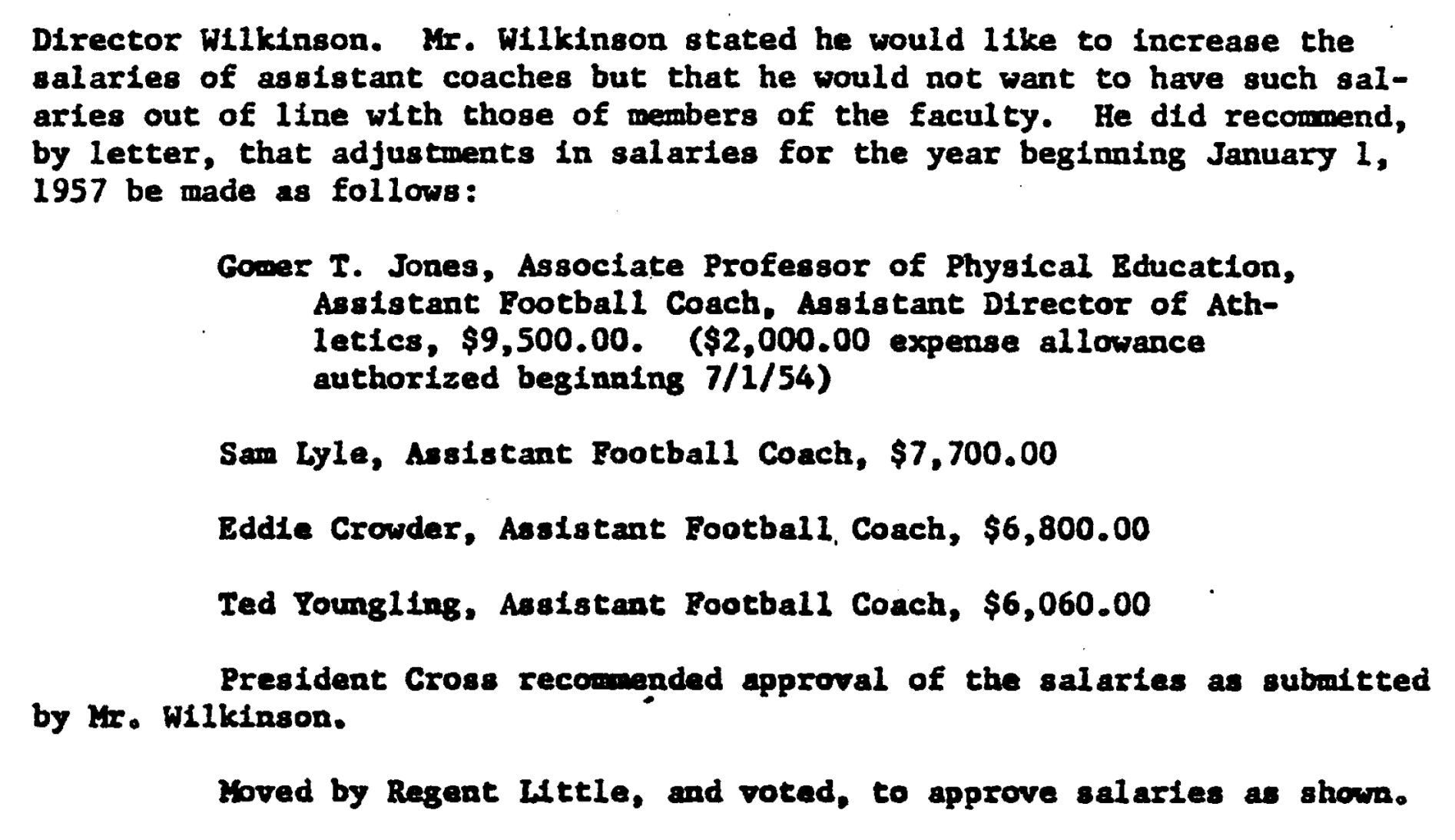
Regents minutes from 1956 where OU football coach Bud Wilkinson raised his assistants' pay, courtesy of the SHAREOK Repository.
While Wilkinson was modest in many ways, he was also among the first of college football’s celebrity coaches. Wilkinson, for example, was friends with President John F. Kennedy, who appointed him as executive director of the President’s Council on Physical Fitness in 1961.
When Wilkinson took a leave of absence to kickstart the program, he surrendered $7,000 back to the university, subtracting from the career high salary of $27,000 he attained in 1959, which equals $257,007 in 2021 money.
After the 1963 season that coincided with Kennedy’s assassination, Wilkinson resigned as coach and athletic director to enter politics. His final salary was $22,000 — $201,147 in 2021 — less than his peak but more than twice the then-record figure at which he began. Wilkinson’s remarkable career landed him a hall of fame nod in 1969 and a statue outside Gaylord Family-Oklahoma Memorial Stadium.

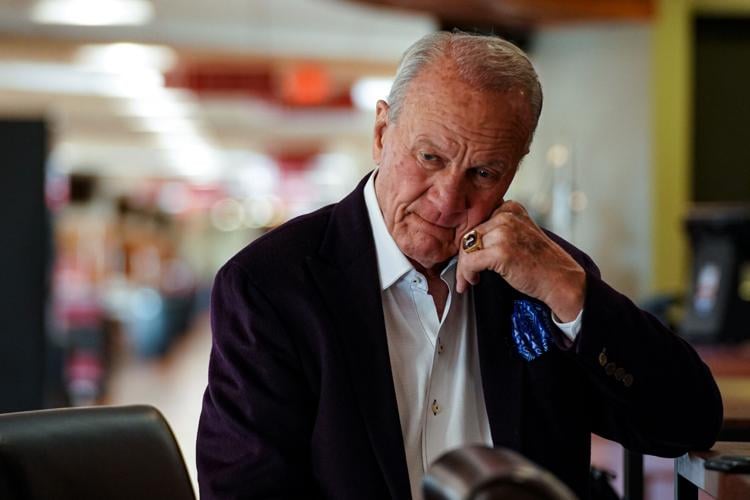
Former OU football head coach Barry Switzer ponders at a press conference on Nov. 29.
Switzer, the king with no ransom
One of OU’s former coaches remains known in program lore as “The King,” but Barry Switzer never received the fortune befitting his title.
Rodney Fort, a professor of sports management at the University of Michigan, recently surveyed The Daily’s data, specifically focusing on raises based on performance.
He noted OU’s historical tendency to initially pay low on coaches, granting them raises only after they proved themselves. However, one figure inexplicably bucked the trend of receiving massive raises for his successes, leaving Fort perplexed.
“Tell me what the hell went on with Switzer,” Fort said.
Switzer was the Sooners’ offensive coordinator from 1966-72 and head coach from 1973-88. A 2001 College Football Hall of Fame inductee, he’s OU’s second-winningest coach at 157-29-4 and holds national championship rings from 1974, ‘75 and ‘85.
Twenty-five years after retiring, Switzer still lives in Norman and is the fixture of hype videos and alumni events, but as Fort noticed, his salary never reflected the caliber of his legend. He succeeded Chuck Fairbanks making $27,000 — $174,923 in 2021 — starting at $9,500 less initially than his predecessor.
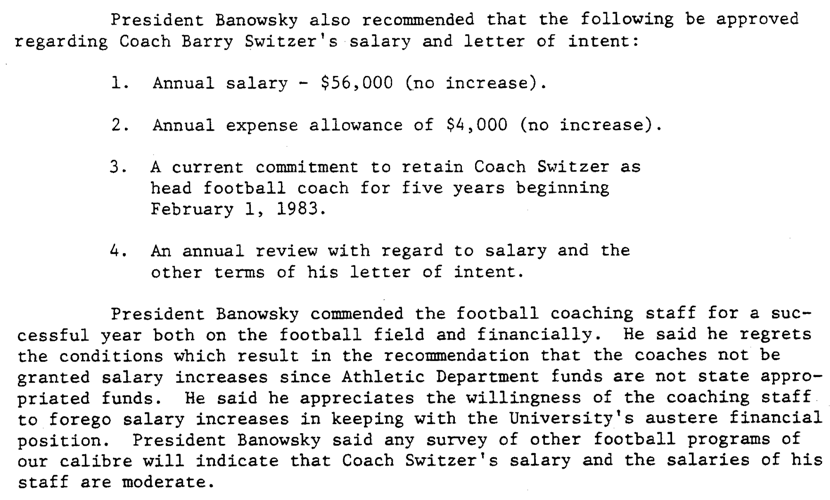
Switzer’s highs on the field happened to coincide with economic challenges off it. His heyday came during a nation-wide 1970s oil crisis under President Jimmy Carter’s administration, which depressed the value of his earnings, and the early 1980s collapse of Penn Square Bank in Oklahoma, which constrained the university and its boosters’ ability to increase his compensation. Regents minutes from January 1983 reflect just that.
“President (William) Banowsky commended the football coaching staff for a successful year both on the football field and financially,” read the hand-typed record. “He said he regrets the conditions which result in the recommendation that the coaches not be granted salary increases since Athletic Department funds are not state appropriated funds.
"He said he appreciates the willingness of the coaching staff to forego salary increases in keeping with the university’s austere financial position. President Banowsky said any survey of other football programs of our caliber will indicate that Coach Switzer’s salary and the salaries of his staff are moderate.”
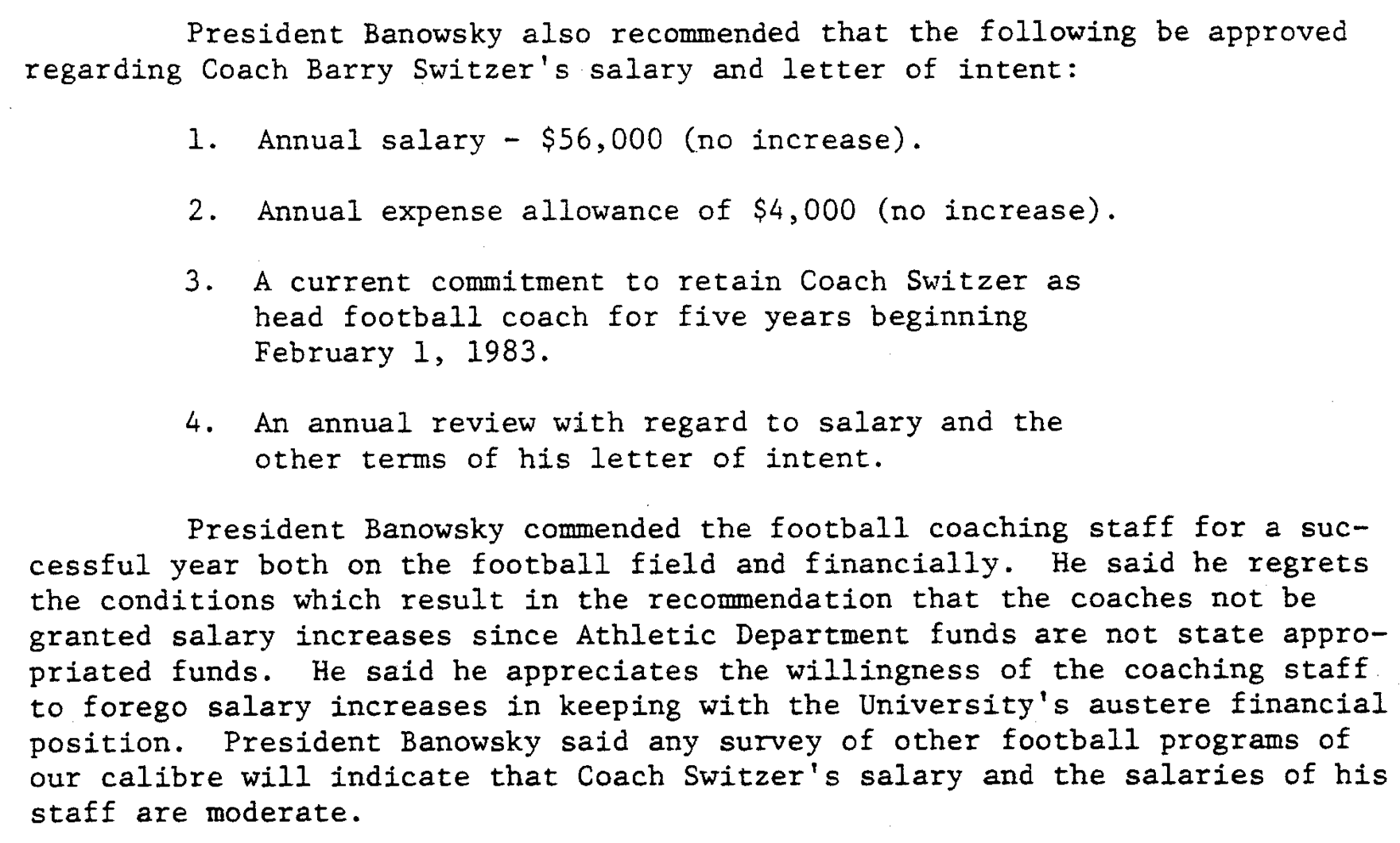
Regents minutes from 1983 that reflect OU's inability to adequately compensate football coach Barry Switzer due to economic hardships, courtesy of the SHAREOK Repository.
It all left Switzer without receiving raises as steeply as his predecessors had, or his successors would. Switzer’s salary didn’t peak until 1986 when he made $75,000 — or $190,375 in 2021 — just three years before he retired and after his third and final national championship.
“By all estimations,” Fort said, “he was as good a coach if not better than Wilkinson was. He went to 13 of 16 bowl games, three national championships, back-to-back in ’74-’75. ... Unless somebody was coming up with between 50,000 and 70,000 bucks a year, he never made as much as Fairbanks did.”
Switzer told the Tulsa World in 2017 that to boost his earnings, he schucked advertising for four different television programs. A five-minute radio segment for Chrysler every morning paid him more than he made from coaching.
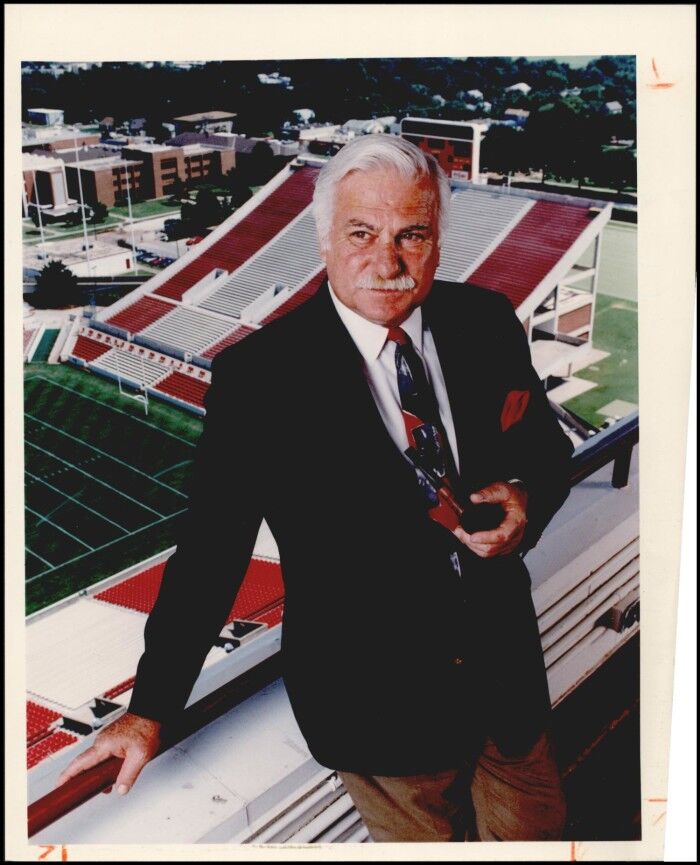
Howard Schnellenberger in 1995.
Schnellenberger snags superdeal
At the same time OU wasn’t paying Switzer a king’s ransom, it was working to put itself in a position of greater financial stability for as long as it remained a top-tier program on the field. The OU Board of Regents, along with the University of Georgia Athletic Association, sued and beat the NCAA over television rights in 1984.
Previously, college sports’ governing body had limited teams’ television appearances, arguing it protected live attendance. In 1977, several large universities formed the College Football Association, which was threatened by NCAA sanctions in 1981 when it negotiated its own television deal.
That led to OU and Georgia’s lawsuit, which they won 7-2 in the U.S. Supreme Court, stripping the NCAA of television control and divesting it to individual conferences. While that appeared to have helped Switzer at the end of his reign, it more so helped his successors, starting with Gary Gibbs.
Another former Sooners assistant promoted from within to the top, Gibbs consistently failed to beat the Sooners’ chief rivals, going a combined 2-10 against Texas and Nebraska across six seasons. Despite that, he topped his former boss at a high of $115,000 in annual salary, or $215,391 in 2021. The coach after Gibbs would shatter that thanks to conference realignment, much like Venables now commands premium pay as OU prepares for its SEC transition.
Enter Howard Schnellenberger, whose lengthy career across college football and the NFL saw him win the 1986 national championship at Miami before 10 seasons at Louisville, where he resurrected his hometown program ahead of its transition to Conference USA. He parted from the program in 1994 because he felt the Cardinals’ new conference wasn’t conducive to national championship contention.
Similarly, since Riley’s departure from OU, circulating rumors insinuate he wasn’t thrilled with the Sooners’ impending SEC move, which could complicate the path to the College Football Playoff.
The outlook for Schnellenberger was greener at Oklahoma, as the Big Eight Conference became the Big 12 with the additions of Texas, Texas A&M, Texas Tech and Baylor, and would be ready for play in 1996. Schnellenberger signed on in 1995 for $500,000, nearly five times Gibbs’ peak, boosted by increased television revenue and shrewd negotiating.
“His agent knew that the Big 12 was going to make a whole lot more money and that Oklahoma was going to get more than an equal share, or whatever that increase was going to be,” Fort said. “And this is also — relative to Switzer — after the NCAA decision. So both Gibbs and Schnellenberger also had the benefit of conference contracts, so those values shot up.”
Upon arriving in Norman, Schnellenberger declared people would “write books and make movies” about his tenure, and he coined the nickname Sooner Nation to describe OU’s fanbase as he traveled the state to reinvigorate support.
Schnellenberger also said he didn’t care about the history of Sooner football, alienated his players with criticism after their loss in the 1994 Copper Bowl, and boasted his teams would make people forget about Wilkinson and Switzer. Instead, OU went 5-5-1, lost to Oklahoma State for the first time in 20 years and posted a losing record in conference play for the second time since World War II.
At season’s end, Schnellenberger resigned and spent three years as a bond salesman before resurfacing at Florida Atlantic in 1998, never competing in the revamped Big 12 that garnered him the largest contract in OU history at the time. The Sooner Nation nickname sticks to this day and is most fans’ only fond memory of Schnellenberger.
“We went through (three years) at Michigan with Rich Rodriguez,” Fort joked of the coach who led the worst season in Wolverines history in 2008 and committed NCAA violations before being dismissed in 2010. “By my observation, I can’t be the only person who’s sort of wondering what the hell they were doing with Schnellenberger.”

Former OU head coach and current Fox Sports college football analyst Bob Stoops during the Fox Sports Big Noon Kickoff broadcast in Norman on Nov. 20.
BCS boom bankrolls ‘Big Game Bob’
Another era in the evolution of coaching salaries began in 1998 with the creation of the Bowl Championship Series.
The precursor to the current College Football Playoff, it created five bowl matchups for the top 10 teams in the country and pitted the top two in a national championship game. Television partnerships with ABC, FOX and ESPN made these postseason games incredibly lucrative. For example, in one of its early seasons, the BCS created a total payout of over $75 million. In its final season of 2013-14, it created a total payout of $227 million.
In 1999, OU hired Florida defensive coordinator Bob Stoops as its head coach after going 12-21 in three years under John Blake, one of the worst periods in program history. Even as a first-time head coach, Stoops’ starting salary topped Schnellenberger’s at $650,000, which in 2021 equates to the school’s first football coach contract of over $1 million.
“Big Game Bob'' resurrected the Sooners, winning the 2000 national championship in his second year, en route to becoming OU’s winningest coach by record at 191-48 across 17 seasons. Thanks to eight raises during his career, when finished, he was making money consistent with the modernization of college football, employed at over $5 million.
“Stoops is a proven commodity, most recently in the modern context,” Fort said. “He’s not going to do it any better than winning the national championship. And so I sort of look at all of that increase over time as a part of the value that athletes are creating for the University of Oklahoma.”
Despite larger-than-life charisma and pay that reflected it, Stoops has maintained in recent months that neither he, nor any coach before him, is what makes OU football — rather, the players define the program.
In 2017, Stoops handed the reins to his offensive coordinator, the up-and-coming Riley. Consistent with OU’s precedent, Riley’s start value was a little over $3 million, but he proved himself quickly, earning a raise to over $6 million by his departure.
According to Leeds, these enormous contracts are no longer so much the product of performance as they are the revenue available thanks to conference television contracts and the CFP, the latter's payout first promulgated by the BCS.
Look no further than Stoops for additional evidence. After Riley left, OU was able to pay its former coach a one-time $325,000 stipend to return as interim for one game.
“Their pay really isn’t necessarily related to anything they do,” Leeds said. “They get paid because the money is there, because athletic departments are just soaking up all this TV money, especially in the Power Five conferences, and they aren’t paying their labor force.
“The coaches are capturing all these rents. Not rent in the sense of what you pay for an apartment, but in effect, extra money that’s unrelated in some ways to the value of your performance.”

New OU football head coach Brent Venables during his introductory inside the Everest Training Center on Dec. 6.
Where things stand, where they’re going
As the experts hinted, if the coaches aren’t driving their own value, the players certainly are. The past century plus of college football has been about the escalation of coaching salaries, but athlete pay is on its own rising trajectory.
New name, image and likeness powers for college athletes took effect last July, allowing players to monetize their performance beyond university scholarships. Oklahoma was right at the heart, again, with preseason Heisman Trophy favorite Spencer Rattler becoming the first star of NIL.
Before losing the starting quarterback job to freshman phenom Caleb Williams midseason, Rattler was projected to earn $800,000 in social media revenue alone, endorsement deals with Fowler Auto and other companies notwithstanding.
After transferring to USC and reuniting with Riley in February, Williams has become an NIL sensation himself, garnering a signed memorabilia deal through the Trojans’ fan shop and an endorsement agreement with Beats by Dre headphones. He is also partial owner of the grooming brand Faculty.
At NIL’s outset, OU created a program called The Foundry to help educate athletes about their financial opportunities. It took another step toward the inevitable in December when it announced the Sooner Success Academic Award, which will directly pay players a maximum of $5,980 a year based on scholastic achievement.
Announcing the 𝙎𝙤𝙤𝙣𝙚𝙧 𝙎𝙪𝙘𝙘𝙚𝙨𝙨 𝘼𝙘𝙖𝙙𝙚𝙢𝙞𝙘 𝘼𝙬𝙖𝙧𝙙, OU's plan to make financial awards to student-athletes as a result of the Supreme Court's decision in the Alston vs. NCAA case last June.➡️ https://t.co/LJBIypzmgF | #BoomerSooner pic.twitter.com/fKbitUK8RK
— Oklahoma Sooners (@OU_Athletics) December 20, 2021
“That is the next shoe that’s eventually going to drop,” Leeds said. “You’re going to see players being paid directly by the university.”
Venables has opened the bank as he fills out his new coaching staff, paying offensive coordinator Jeff Lebby $5.7 million — the highest salary of any offensive coordinator at a public university — and defensive coordinator Ted Roof $3.4 million. Venables also revamped the entire defensive coaching staff with new hires, and has seemingly been granted an unending cashflow for adding analysts and support staffers as he gears up for the SEC transition.
Furthermore, Venables and Castiglione took an unprecedented step when they released a statement upon the transfer departure of Williams.
Statement from Joe Castiglione and Brent Venables on today’s announcement by Caleb Williams: pic.twitter.com/qGHlDqIDp2
— Oklahoma Football (@OU_Football) January 3, 2022
“Caleb Williams enjoyed an exciting and impactful first season at the University of Oklahoma, and we will continue to be engaged with him and his family on a comprehensive plan for his development as a student and quarterback, including a path to graduation and strategic leveraging of NIL opportunities,” they said.
“While we believe OU provides Caleb the best opportunity to develop as a player and realize his goals for college and beyond, we respect his right to explore his options following key staff changes here.”
Fort, who observes the increase in coaching salaries as an index of the value players create for those who recruit and develop them, sees numbers continuing to rise for years to come.
“Everybody laughs at the third layer of gold plating on the bathroom faucets inside the football facility,” Fort said with a chuckle, “but we know why it’s being spent. It’s being spent to entice athletes.”
While most of college football’s academic ties have been severed by championship chases and money moves, athletic success still correlates to broader university benefits in one way.
Referencing Cross’ quote about university pride, Leeds explained that after Boston College quarterback Doug Flutie upset powerhouse Miami with a last-ditch hail mary in 1984, enrollment exploded to the point that newly minted BC students were sleeping in hallways due to dormitory shortages.
This has since been dubbed the Flutie Effect. Akin to Wilkinson’s embodiment in the OU context, it’s the last of the old guard between the past and present age of the sport, linking degrees to touchdowns and helping build a university the football team can be proud of.
“What you see is not just more students, but the schools can be more selective, so they actually improve the profile of the student body,” Leeds said. “So, you do see some spillovers (there), but you don’t see a lot of (football) money flowing into other aspects of the university.”


