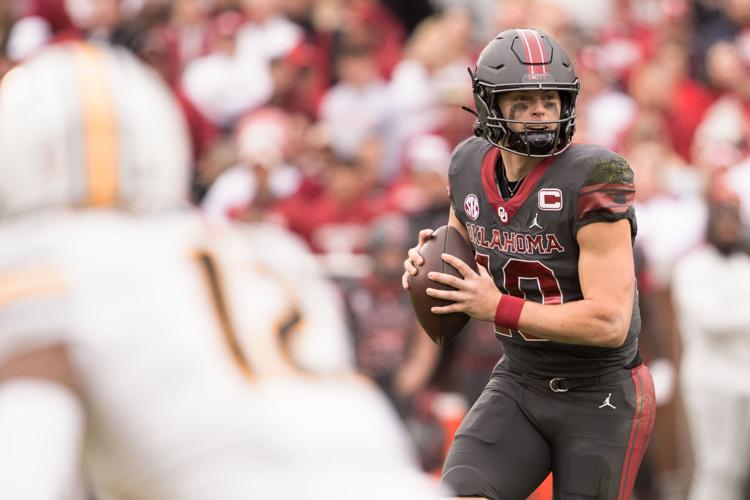
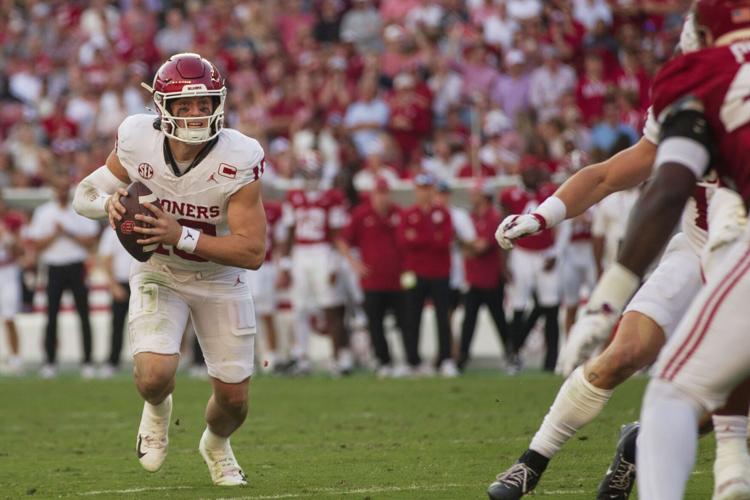


John Mateer, under the Friday night lights, in front of 83,550 fans at Gaylord Family-Oklahoma Memorial Stadium, had OU leading with about a minute to go in the opening half of the College Football Playoff.
Then he zipped the ball right to an Alabama defender in a momentum-losing pick-six.
Mateer and the Sooners frequently talked about being “hard to kill” during the second half of the 2025 season, and they backed it up, having a 19% chance at a playoff appearance with four games left in the regular season before making it. But after a hot first quarter in the CFP, the quarterback made a costly play that put an end to their dreams of a national championship.
“It's pretty bad,” Mateer said after the season-ending loss. “You watch the tape; it was obvious. … Hate that it’s over. That’s all I’m thinking about right now.”
Unequivocally, Mateer wants to win. He wants to give the Sooners a real shot at contending for their first national championship since 2000, and he has potential to be in the running for the Heisman Trophy at the end of 2026 after leading the betting odds early in the 2025 season. But he needs to step up for that to be possible.
Mateer had a terrific high school career at Little Elm, smashing program records despite playing against bigger schools. He had a successful 2024 season at Washington State, ranking top 15 in the nation in passing touchdowns at a program that has never won a national championship. Now, it is time for him to perform to the standard of a program with the most wins in college football since 1946.
Should Mateer step up in 2026, he would follow the trend of previous great transfer quarterbacks like Baker Mayfield, Kyler Murray and Dillon Gabriel. Mayfield went from 3,700 passing yards and 36 passing touchdowns to 3,965 and 40 passing touchdowns in his first two years as a Sooner, while Murray jumped from 359 passing yards and three passing touchdowns to 4,361 passing yards and 42 passing touchdowns. Gabriel elevated 3,168 passing yards and 25 passing touchdowns in his first year at Oklahoma to 3,660 passing yards and 30 passing touchdowns in his second. None of them won a national championship, but Mayfield and Murray each won the Heisman after reaching the semifinals of a then-four-team playoff.
“The first year, you may be wide-eyed, and things are going 100 miles an hour,” former OU quarterback Paul Thompson said. “But every year, the game slows down. You get more mature.”
Mateer has a chance to do what neither of those three did: claim the grand prize. He’ll have a defense behind him that was No. 6 in the nation in 2025; Mayfield and Murray’s defenses ranked worse than 60th in their semifinal seasons in 2017-18. In the last five years, the national champion teams have had top-10 ranking defenses.
Mateer could combine a dominant defense with a top-flight offense, which would increase the likelihood of a national title, Heisman Trophy or better NFL prospects. But for that to happen, he needs the throwing mechanics and maturity to perform under pressure.
“As a kid, you grow up and you dream of being in that situation, so I try to stay where my feet are,” Mateer said at SEC Media Days. “But sometimes, you realize the opportunity that you're given, and … there's nothing like it.”
Mechanics: Building back better

Redshirt junior quarterback John Mateer during the game against Missouri Nov. 22.
Mateer awkwardly side-armed a throw during a low-scoring win over Missouri late last season, an uneasy sight when he studies the film.
Though he felt uncomfortable watching the game back, the throwing motion simply stayed in line with a trend in 2025. The side arm is a habit he already had before last year, according to Mateer. Following his return to the field 17 days after an early-season thumb injury, the habit worsened.
"It's a pattern that I already had: (my arm) drops, …” Mateer said at SEC Media Days. “It kept going because I had no strength in the ball. … You watch it, and the elbow dropped a little bit to be able to come across (because of the thumb). There's a clip against Mizzou, and it’s, like, direct on, it's a fade, and I cringe. … I had to compensate. I had to adapt.”
Mateer revamped his throwing mechanics during the offseason with the help of Chris Hess, a biomechanics specialist who has worked with Josh Allen, long-time quarterback trainer Mike Keith and OU quarterbacks coach John Kuceyeski. Hess gathered data on the quarterback’s arm path, release point and ground connection, and Keith constructed a plan around it. Kuceyeski worked on Mateer’s throwing during his time at the OU practice facilities.
“Now, it's keeping it tighter, …” Mateer said at SEC Media Days. “The elbow, it's raised back to pretty even.”
Kuceyeski said in March that the complex process meant a gradual shift.
“It's not the easiest, and everybody wants you to go from here to here (quickly),” Kuceyeski said. “And that's not going to happen; everything is gradual. So if we can just start to get the arm angle here more consistently, that's going to be great.”
It starts from his base, according to Kuceyeski. Mateer spent extensive time not only working on his arm positioning but also how his feet operate as a quarterback.
“The biggest thing is his foundation, his platform, growing from a great platform, having consistency in his drops in his pockets, and he dedicated himself to that, …” Kuceyeski said. “Obviously, it's the one time of year you can really work the kinesthetic bottom half and just really drill it. … The feet and the arm angle (are) really the two operational quarterback play things we really worked on.”
Kuceyeski has worked with Mateer since January 2023 while at Washington State, and the two often make goals in the offseason. The quarterbacks coach has always been impressed with his goals and determination to reach them.
“That's been the greatest thing with him, is, he just continues to get better, …” Kuceyeski said. “He's grown up a lot. He's grown up a lot, obviously, as a human as well. I'm just really proud of (how) he's very process driven. It's always going to be a process, and that’s what's going to give him success.”
Mateer’s high school baseball coach Matt Harbin, who he keeps in contact with, said this reflects a continuation of an attitude Mateer has had since he was younger. Harbin watched Mateer develop from a freshman varsity starter to a record-breaking leader in his upperclassman years, all on an underdog team. Then he watched him lead Washington State to success, often an underdog in its own right.
Now, as Mateer looks to win national success, he has taken his offseason approach to another level.
“Once you get done and everything gets healthy, well now it's, ‘OK, now I know I got to work because I've seen what my floor is, and I've got to raise that floor to raise my ceiling,’” Harbin said. “That's really how he's always approached things. He never shied away from his mistakes. Some guys will only focus on the successes and the good results. He's never been that guy that only focuses on that. And I think that's what people are starting to see.”
Maturity: Systematizing success
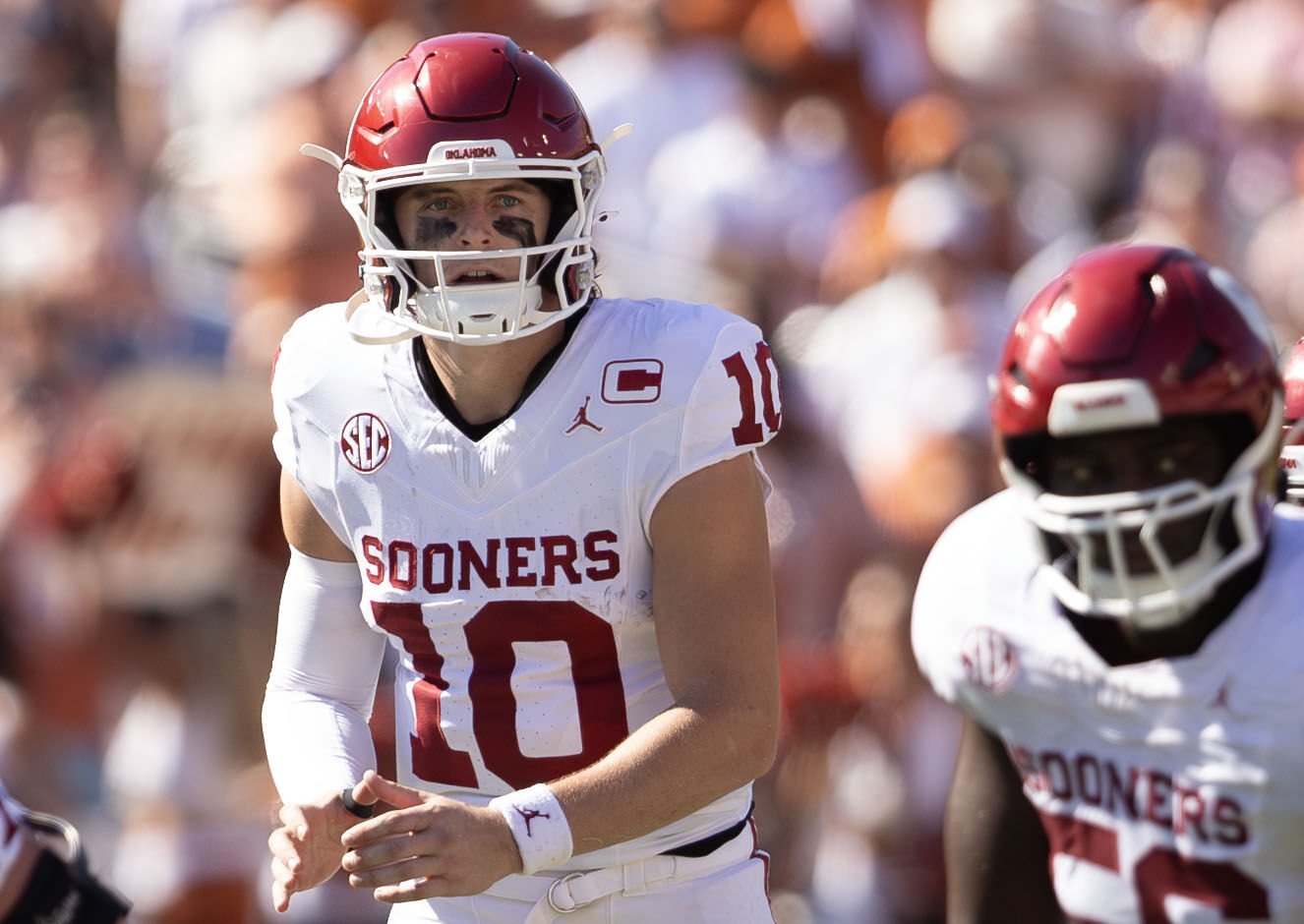
Redshirt junior quarterback John Mateer during the game against Texas on Oct. 11.
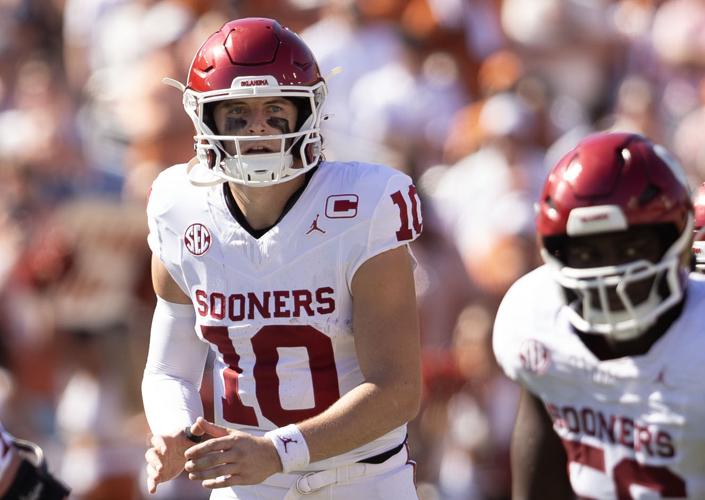
Mateer still thinks back to when he first returned from injury in a loss to Texas in the Red River Rivalry, in which OU failed to find the end zone.
It was an ugly showing from the whole team, especially Mateer, who barely surpassed 200 passing yards and threw three interceptions. His injury was an obstacle then and throughout following games, but he does not give in to the talk that he returned too soon.
“I'm glad I did it because it showed me that you can fight through a lot, even though I obviously was not 100%,” Mateer said at SEC Media Days. “It was a very difficult thing to do, but I'm glad I did it. Even though I failed, I'm glad I put myself in a vulnerable position because I've learned so much.”
Mateer matured through the challenges of last season, recognizing his needs for better throwing habits and ability to settle into offensive systems. He admits he previously would get too excited with trying for explosive, game-altering plays.
“Making plays is a lot of fun, so you kind of want those to happen, which is true,” Mateer said at SEC Media Days. “But staying on schedule, learning how to win the game is a big one, watching more film and learning scheme-on-scheme.”
Back in his days leading underdogs, he often needed to make big plays to help his teams have chances of winning, but playing for the Sooners is different. Unlike before, he has a defense that will keep the team in challenging games by itself, something even his star OU predecessors lacked. It has prompted him to systemize success.
“Most of his career, … we were down early and he had to create a big play. You had to have those big momentums that everybody sees, the break for 25 yards or, you know, throw deep downfield,” Harbin said. “I think winning a football game is more about managing every drive and keeping every drive and staying away from the three and outs, and especially when you have a lead. It's more clock management and still progressing and not getting too passive that you're always giving the ball back and giving them more chances to have their big moments. You can't teach that.”
Mateer has had to learn to adapt to playing with a lead, something that has required a different mentality from the quarterback.
“For probably the first time in his career, they had leads in a lot of the quarters instead of trailing, and so it's a different mindset, …” Harbin said. “He's talking about … being that complete first quarter-to-fourth-quarter guy that manages the game as they continue to score and control the clock.”
In the offseason, Mateer has worked on forming better habits and leaning into systems to help him not feel like “things are going 100 miles an hour” come fall. And since Mateer is a team leader, as he has worked to mature, he has pushed others to as well.
“I've definitely raised my intensity,” Mateer said at SEC Media Days. “We need to be better. I need to be better, and for that to happen, we all need to be better. … When the mental errors come around, you let them hear it a little bit. But there is a fine line, and I think I'm only able to do that because when they succeed, I try to do my best and give them their praise.”
Thompson, who led the Sooners’ offense in 2006, noticed a shift in Mateer this summer. After all of the swings of 2025, with big individual and team aspirations as well as pro prospects on the line, Mateer seems determined to meet the moment.
"Last season ate him up, not only from, obviously, having to miss (a game) and not coming back and, in his own words, not even performing up to the best of his capabilities," Thompson said. "My short time around him a (few) weeks ago, you could see the hunger, you could see the determination, you could see that he was going to put in the work. ... He's got a lot of fight in him."
This story was edited by Joshua Franklin and Charlie DiVincenzo. Kennedy Johnson, Tori Pham and Larkin Bock copy edited this story.


