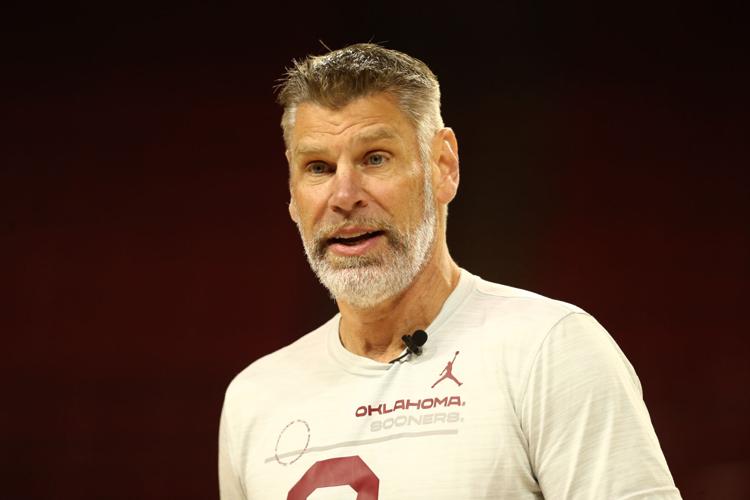
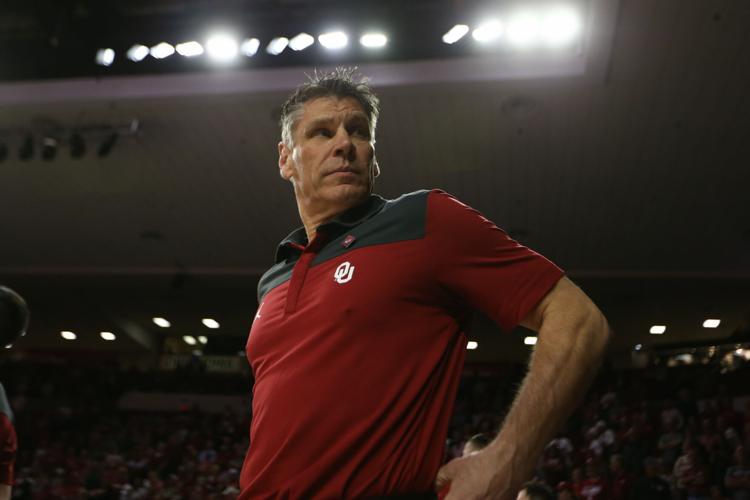


Head coach Porter Moser during practice on Oct. 21.
It was 95-degrees in Florence, Italy, when 6-foot-8, 235-pound Ben Averkamp found himself huddled inside an elevator with a group of his Loyola-Chicago teammates 10 years ago.
Moments earlier, freshman forward Matt O’Leary had stopped the elevator and forced his way in, but the journey lasted only a half-flight up. Averkamp, O’Leary and their teammates were stuck in the non-air conditioned box for nearly 25 minutes before a technician lowered them safely back to the lobby.
Then-Loyola-Chicago coach Porter Moser chuckled when he heard of the group’s conundrum. He had hoped for moments like that — fostering lasting memories that builds team chemistry — when he planned the Ramblers’ 13-day foreign tour in Italy.
Fast forward a decade, and Moser, now Oklahoma’s head coach has traveled on four foreign tours, dating back to the first he took as a senior walk-on guard in summer 1989 with Creighton coach Tony Barone. There, Moser learned the importance of testing a team’s mettle, but also the bonds a team trip can forge.
Moser was known as the ‘vocal’ and ‘energetic’ leader who helped sustain Barone’s culture on the Bluejays. Coming off a Missouri Valley Conference championship and an appearance in the 1989 NCAA Tournament, Moser led the charge to explore Italy, hoping to build on the success from the season before.
Although OU’s head coach always had a knack for leading with a firm culture and foundation, he finds himself stuck in a box — much like his Loyola players 10 years ago in Italy.
Due to the recent developments of the NCAA Transfer Portal, which grants players the right to transfer with little limit, Moser is facing the reality of potential roster churn every offseason, impacting the longevity of his cultural foundation with the Sooners ahead of their season opener against Sam Houston State on Nov. 7 in Norman.
Entering his second season, Moser welcomed four transfers and four freshmen, while losing guards Elijah Harkless, Umoja Gibson, Alston Mason, forward Akol Mawein and center Rick Issanza to the portal during the offseason. Moser, in turn, utilized the foundation of returners and reinforcements from the portal to revamp the roster.
🎤 𝑪𝒆𝒏𝒕𝒆𝒓 𝑺𝒕𝒂𝒈𝒆 🎤Fun with the fam and a few of our closest friends 🙌 pic.twitter.com/L4dIAfC9o8
— Oklahoma Basketball (@OU_MBBall) November 2, 2022
With the lessons learned from past jobs, Moser must battle the destabilized college basketball environment with the strengths of his program culture. In year 32 of his coaching career, Moser has been forced to adapt, with hopes of sustaining his culture moving forward like he did during his tenure with Loyola-Chicago and Arkansas-Little Rock.
“My first thought on the transfer portal, it's a reality,” Moser said. “I think you have to balance it with your program. I think for me, I signed some high school guys I really liked, and we added some transfer portal pieces. It's a reality. It's here. But I think you have to have a balance with it and you still have to try to recruit to who you are and your style.”
Moser has used foreign trips to quickly acclimate his teams’ newest recruits and transfers in his second season. This last summer was no different, as Oklahoma took a 10-day trip to Spain and France, helping bond the Sooners’ newcomers with overseas chemistry ahead of Moser’s second season.
Thinking about our time in Spain 😀La Sagrada Familia → https://t.co/LCdQz2S6gCCamp Nou → https://t.co/Mqef4hnqjF pic.twitter.com/DZIEENFpfB
— Oklahoma Basketball (@OU_MBBall) August 15, 2022
🎥 𝑽𝒍𝒐𝒈𝒈𝒊𝒏𝒈 𝒘𝒊𝒕𝒉 𝑳𝒐𝒔: Paris Edition pic.twitter.com/kN5FdQYLej
— Oklahoma Basketball (@OU_MBBall) August 11, 2022
He brought in senior guard Grant Sherfield (Nevada), junior guard Joe Bamisile (George Washington) and sophomore forwards Yaya Keita (Missouri) and Sam Godwin (Wofford) to replenish depth. Bamisile and Sherfield headline the bunch as a pair of top-level scorers that averaged 16.3 and 19.1 points per game, respectively.
The Sooners also welcome freshman guards Milos Uzan and Otega Oweh — both four-star recruits— plus Benny Schröder and Luke Northweather.
Moser’s trip was the first step in finding the ‘balance’ he’s looking for in season two.
“I think foreign trips, in general, can be very beneficial experiences,” Averkamp said. “Hanging out with your coaches and teammates out of a different setting is always enjoyable because you get to kind of see a little bit more about who they are.”

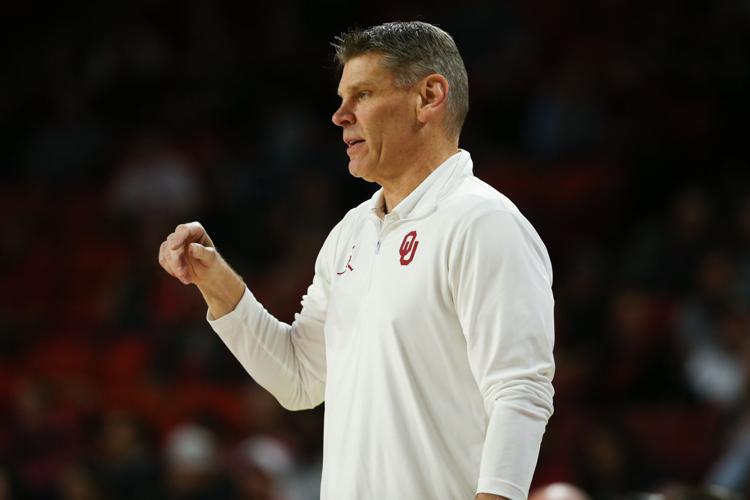
Head Coach Porter Moser during the second round NIT game against St. Bonaventure on March 20.
Building trust
The orange that lined the stands was almost as loud as the crowd inside Gallagher-Iba Arena when Moser, a first-year head coach at Arkansas-Little Rock and senior guard Alan Barksdale walked to the locker room on Dec. 19, 2000.
The Trojans trailed Oklahoma State by six points at halftime and Barksdale, who finished the season with a career-high 44.9% mark from 3-point range, was held to a game-low three points after being double teamed by the Cowboys every possession.
Taking a seat in the locker room, Moser broached Barksdale with an honest assessment of his performance.
“Look, Alan, whatever we're doing, it's not working,” Moser said. “We got to figure out something different. … The only way that we can make an adjustment is we’re gonna have to put you at the top of the key. We're gonna have to run you off the point.”
Moser wanted Barksdale to anticipate the double team, so the guard, UALR’s single-season record holder for 3-pointers (95), could set up his teammates in space or shoot from 3-point range before the coverage converged. Following that plan, Barksdale finished with 20 points, despite the Trojans losing 70-60 to OSU in overtime.
Barksdale’s eagerness to accept Moser’s plan was a testament to the first-year head coach’s ability to garner his players’ trust. The Trojans were 4-24 the season before Moser took over and he led them to an 18-11 record — the quickest turnaround for a program in Sun Belt Conference history.
The Trojans, on paper, were vastly overmatched. Coach Eddie Sutton had led Oklahoma State to eight NCAA Tournament appearances before the 2000-2001 season. Still, Moser’s foundation and culture instilled a belief within his players, and it helped Barksdale adjust against Oklahoma State.
“When I think about all of the coaches that I've been around, Porter has a true gift for understanding and relating to his players,” Barksdale said. “And then in turn, converting that into an on-the-floor gameplan, he's great in the game as well.”
After former Arkansas-Little Rock head coach Sidney Moncrief was fired, Moser, a three-year UALR assistant, was promoted. The first thing he did was communicate expectations.
He asked every player what they wanted to achieve, and then he laid out a pact between himself and the athlete. Moser provided an expectation for the effort necessary to reach those goals, and the player would then agree to Moser’s contract.
“He’s had it from day one,” Barksdale said. “It wasn't just like he figured it out halfway through. The perfect fit for him is when he has 100% buy-in from his team. Then, when you cross that over with his preparation, passion and knowledge, that’s an excellent recipe for success.”
Barksdale thinks Grant Sherfield is an example of how Moser wants to build through the new NCAA landscape. Oklahoma’s coach will be able to add players that are talented and fit his system, but will also weed out players that won’t meet his standards.
“He has consistency and he’s gonna attract people who have the same culture,” Barksdale said. “He has an honest, forthright and straightforward approach and method. Unfortunately because of that, guys are going to transfer because it's going to weed out the ‘me’ guys, But what it will attract is the guys who are committed.”
After establishing expectations, Moser pushed players to meet his standard. While the head coach built a family atmosphere off the floor — inviting players to his house for barbecues and doing team-building activities created by his wife, Megan — the work in practice built the team culture.
Then-senior forward Stan Blackmon finished the 1999-2000 season averaging a career high 15.9 points and 7.4 rebounds. After Moser was hired, the head coach told him “you don’t play hard enough,” which left Blackmon muddled following a career year offensively.
After working under Moser’s system for a season, working relentlessly in practice, the senior forward averaged 3.5 points and 0.4 blocks more than the previous year.
“He’s gonna hold you accountable,” Blackmon said. “I see what he was talking about now… But it just depends on your personality and how you take things. You can't take it personally. It's just a challenge. So I think he challenged everybody individually, as well as a team, and I think that was the difference for our success.”
Moser’s system didn’t just build trust among his players in Little Rock, it was also up to the assistant coaches to maintain the buy-in. Former Trojans assistant Steve Shields’ relationship with Moser was founded on trust when Moser first received the UALR job.
Shields, an assistant at McLennan Community College, became acquainted with Moser when he was an assistant at Texas A&M under Barone from 1990-93. Almost a decade later, Shields was on the road recruiting when he received a call.
Moncrief was let go and Moser thought he was up for the UALR job, so he offered Shields a spot on the bench. The caveat: he wasn’t offered the position yet.
“He always called me ‘Bucket’ and he said, ‘Bucket, if I get this job in Little Rock Arkansas, would you consider coming here with me?” Shields said. “I remember telling him ‘you're not getting that job.’ because Moncief’s staff won four games previously, but he thought he got it.”
After about two weeks, Shields' phone rang again and Moser said, “Bucket, I got the job.”
Shields immediately resigned from his position with McLennan, and left Waco — where he and his family had lived since 1976 — for Arkansas.
“For me to move away from there was a leap of faith for a guy who had never called a time out,” Shields said. “I just believed in the man. He's an enthusiastic, energetic, positive thinking guru who's infectious to the people around him. I remember we came in and nobody was gonna outwork him. Nobody was gonna have more enthusiasm, more energy than Porter.”
Twenty-two years and three coaching jobs later, the ways Moser cultivated trust at Little Rock are comparable to how he’s doing so in his second-year at Oklahoma. It’ll be significant to earn players’ commitment and keep them bought in to continue building a winning foundation.
Barksdale, who is friends with current OU guard Grant Sherfield and his father, Antoine, thinks Moser is forming the same relationship with Sherfield that he had with him 22 seasons ago. After transferring from Nevada, Sherfield will be a pivotal offensive weapon for Oklahoma in his final college season.
𝑭𝒆𝒆𝒅 𝑯𝒊𝒎 🍴@gsherfield5 with the last three buckets for the Sooners! He has 14 points 🔥📺 ESPN+ | https://t.co/N4C4KP4unA pic.twitter.com/lLvI6CiOHp
— Oklahoma Basketball (@OU_MBBall) October 26, 2022
Like Barksdale, Sherfield is a scoring guard that can create at all levels, but he was also sold on Moser as a person and a coach. Senior forward Jalen Hill hosted the 6-foot-3, 183-pounder’s visit to campus, and Sherfield immediately felt the welcoming energy, instilled in Moser’s first season at Oklahoma. The Nevada transfer described Moser as the most energetic coach he has ever seen.
“We both wanted to win, so that’s why I came here,” Sherfield said. “He's also 54 years old and jumping and running around, and that's always fun. It really makes you want to get out there and run on defense for sure.”

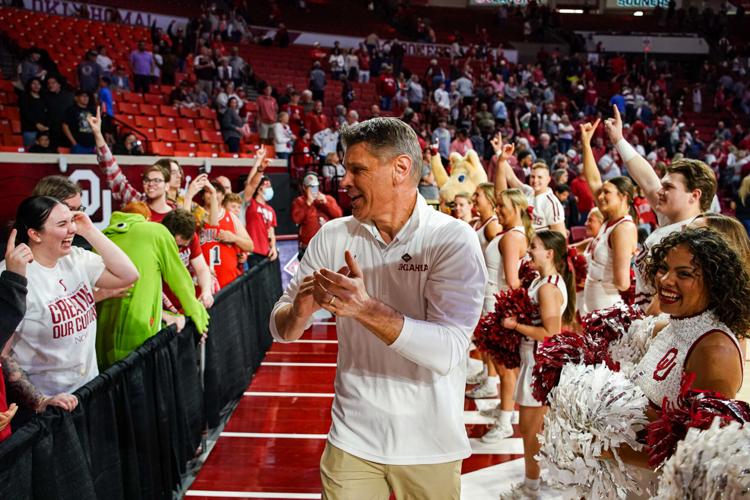
Head coach Porter Moser celebrates with fans after winning the first round of the NIT against Missouri State at Lloyd Noble Center on March 15.
Creating buy-in
A curious Moser sat on a bench inside Butler’s Hinkle Fieldhouse, staring at the banners hanging from the rafters during Loyola-Chicago’s pre-game shootaround on Feb. 14, 2012.
Gazing at the left side of the rafters, the Ramblers’ coach analyzed Butler’s championships from the 1960s. He then slid his eyes to a gap in the middle and finally over at the right, where the Bulldogs’ ceiling was flush with a new banner from their second-place finish in the 2010 NCAA championship.
“Something happened there,” Moser said to his assistant coaching staff as he pointed to the banners. “Some coaching staff came in and the whole thing started, and we have to do that for Loyola.”
A year later, after Brad Stevens left Butler for the Boston Celtics, Moser flew to Massachusetts to visit with the former Bulldogs coach about culture building for two days.
Moser learned, through Stevens’ ascension from competing in NCAA championships to an NBA job, having players and recruits who were bought into his program was the most important path to success. To start, that meant investing and building into the current system before growing outward with recruits.
“We visited for a long time there and we talked about achieving what you emphasize,” Moser said of his chat with Stevens. “As the head coach, you have to have your standards, and (have to commit) everything about getting guys and recruiting guys that are about what you want.”
Billy Clark, who played three seasons at Loyola-Chicago, was one of the main players Moser trusted with his system during his first three seasons. Like his coach, Clark was a walk-on guard, but he didn’t transfer onto the team until his sophomore year after focusing solely on academics his freshman year at Indiana.
During his official visit in 2011, Clark learned of Moser’s experience at Creighton. Moser couldn’t guarantee the guard a roster spot, but he promised he would give him a call if one opened.
Months passed and Moser accrued two more commitments to build out the roster. But finally, in the first week of August, Clark received a call from Moser to join the Ramblers. Clark was fully-prepared to continue his studies at Indiana, and he was serving in a campus-wide YMCA camp before Moser rang.
“Moser called and said ‘Hey, if you're still interested, I'd love to have you on the team,’” Clark said. “There were no separate lines for walk-on guys or scholarships. He expected the same from everybody and wanted to win a league championship there.”
Most of Moser’s players in his first season were holdovers from former coach Jim Whitesell’s tenure. They struggled to a 7-23 mark in year one, and success continued to elude Moser the next two years.
In 2012-13 and 2013-14 the Ramblers had 15-16 and 10-22 records, respectively, marking three straight seasons under .500. Then, Moser met up with Stevens and their conversation significantly altered his recruiting philosophy.
“If there's one thing about Porter, the man knows what he wants, and it's that culture that he talks about so much,” Clark said. “At Loyola, it took a little time to get that buy-in (because) he started out there with a bunch of guys that weren't his recruits.”
It was players like Clark — those who bought into the system — who Moser had to rely on for future trust. The walk-on guard earned Moser’s belief through memorizing sayings from the Ramblers’ culture wall, which Moser has recreated at OU, and quoting them in practice.
Every player was given a white binder of the sayings every season. Within were mantras like “talk, touch it, deny it,” which meant the Ramblers needed to switch the ball screen, or admonitions like “first three steps” because Moser believed the player three steps ahead on the fast break would win a possession.
Clark still uses Moser’s sayings in men’s league games at his local gym when he plays with fellow Loyola-Chicago alums like Averkamp. Now an orthopedic surgeon, Averkamp was recently reminded of the saying, “economy in motion,” while in the operating room.
The memories of Moser’s former players were once the humble beginnings to his foundation of winning with the Ramblers and beyond.
“He respected all players who were willing to buy into the culture because he understood that that culture that he's developing needs to be one that is 100% buy-in,’” Clark said. “The guys that weren't buying in it didn't make it. And, honestly, he would rather lose a game with a guy that was buying into his culture because he knew long term that was going to pay off.”
While Moser struggled in his first three seasons, Clark and Averkamp, along with Stevens’ advice, helped sustain his next generation of success. The Loyola coach hosted barbecues with the team, and they’d play games in the basement analyzing recruits to see if they fit with the foundation.
Clark even remembered the team not vibing with one of the recruits following a visit, and Moser stopped pursuing the player. Clark was also pivotal in hosting Ben Richardson’s official visit in 2014. Richardson went on to become 2017-18 Missouri Valley Conference Defensive Player of the Year and helped spur Loyola-Chicago to its first Final Four appearance since 1963.
With Oklahoma, Moser is building the same culture that he constructed at Loyola.
“I think Porter is the type of guy that's actually going to benefit from the transfer portal,” Clark said. “This new kind of climate is ideal for someone like Porter who relies on people to buy in, they're not the type that are going to leave… if you're the type of person who can stick out and put up with that and want to put up with that, he's going to love you.”

Head coach Porter Moser during the game against No. 9 Texas Tech on Feb. 9
The present
Moser has been intentional with enhancing his culture in year two. In his first year, Oklahoma finished 19-16, missing March Madness for its first time since 2017, and lost to St. Bonaventure in round two of the National Invitational Tournament.
When Moser hosted an open practice at the Lloyd Noble Center recently, he was coached through a microphone connected to the arena speakers. Standing in the paint with a play-sheet rolled in his left hand, Moser asked his players, “What is important in transition defense?”
Porter Moser is mic’d up explaining the 120 passes drill. Goal for the #Sooners is to get 120 passes in a minute: pic.twitter.com/uf79q42fHt
— Jason Batacao (@J_batacao) October 21, 2022
Each player let off memorized quotes from the Sooners’ culture wall.
Moser later addressed the media and said, “They fired off like 20 things on my culture wall. I love that.”
For Moser, that moment is a sign his plan is working. Despite massive roster turnover, he thinks he has the pieces to sustain success.
🎤 𝑴𝒐𝒔𝒆𝒓 𝑴𝒊𝒄'𝒅 𝑼𝒑 🎤@jerseymikes | #BoomerSooner pic.twitter.com/9Cp7J1aiQp
— Oklahoma Basketball (@OU_MBBall) October 27, 2022
Throughout the offseason, Moser was adamant that senior forwards Tanner Groves, Jacob Groves and Jalen Hill and sophomore guards CJ Noland and Bijan Cortes are preserving the culture he cemented in year one, and they’re helping build on top of it in season two.
“It's everything,” Moser said in October at Big 12 Media Days of his five returners. “When I got there, we were in a pandemic, so I was meeting them for the first time in June at the recruiting class. We had to sign everybody through June.
“So just the difference of when they get there, just everything from our first practice to having five guys that have a familiarity with what we do and how we do it. And not only do you have guys that did it, it was with who. Jalen Hill and Tanner are just really, really good leaders, vocally and with their work ethic.”
Like Clark, who was as a captain at Loyola-Chicago for three seasons, Moser has five players he’s relying on to instill success. Moser has also used the transfer portal to his benefit this offseason.
Moser learned from Stevens at Loyola-Chicago, new recruits Uzan and Oweh fit his system and he has a plan for them moving forward. Oweh, a versatile guard from Blair Academy in Blairstown, New Jersey, received a personal visit from Moser. According to Joe Mantegna, Oweh’s high school coach who was present for Moser’s stop, the OU coach’s foundation and vision for Oweh included him as a potential founding-father in the next iteration of Sooners basketball.
Roll the tape 📽𝐵𝑒𝑦𝑜𝑛𝑑 𝐵𝑎𝑠𝑘𝑒𝑡𝑏𝑎𝑙𝑙 featuring Otega Oweh@OtegaOweh | #BoomerSooner pic.twitter.com/LQWvprZ7wf
— Oklahoma Basketball (@OU_MBBall) October 21, 2022
“His vision for (Oweh) was that he's an extremely hard worker, and they were going to build a gym rat culture,” Mantegna said. “That's not a direct quote, but he wants a culture of guys that take their development really seriously. And then, I think Porter's just competitiveness comes through. He's a great dude, but he's a tough guy, and there's no back down and Otega’s like that himself.”
At dinner with Oweh and his parents, who are first-generation immigrants from Nigeria, Mantegna could feel the energy reverberating from Moser, and he joked about “signing himself” to Oklahoma’s roster.
In season two with Oklahoma, Moser has taken the lessons he’s learned from Arkansas-Little Rock and Loyola-Chicago and used it to weather the challenges of the transfer portal.
“Everyone is completely bought in and is completely all in here,” Moser said. “I think the newcomers who have been recruited are guys that I think really felt that fit us … Now we have a whole journey, this whole journey right now. We've got to be a program to get better. And where we are today is not gonna be where we are in January, February. But this group has been really good about being all in.”


