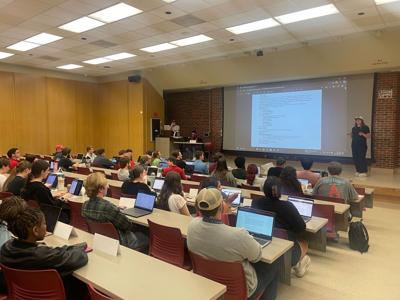

OU Undergraduate Student Congress amended the election runoff procedure and established a student survey to assess class supplies accessibility at its Tuesday meeting.
Election runoff procedure
The news: Congress established a new procedure for a tied Student Bar Association runoff election.
OU Student Government Association requires that a winner for SGA president, Student Bar Association and Campus Activities Council chair be elected by a majority vote of over 50%. If no ticket receives over 50% of the votes, the top two candidates will be placed on the ballot for a runoff election the following Thursday.
New procedures state that, in the case of a tied Student Bar Association, the Graduate Senate will choose the winner by electing one of the final two candidates through a majority vote.
What they’re saying: Associate Michael Granato, author of the bill, said this bill amends the SGA code annotated to allow the Graduate Student Senate to select a winner in the case of runoff elections.
Granato said the bill was discussed in the congressional administration committee meeting.
“We thought it’d be best for (the Graduate Student Senate) to decide because they know the people the best,” Granato said.
The vote: Congress passed this bill with a vote of 35-2-0.
Class supplies survey
The news: Congress passed a bill establishing an undergraduate student survey to assess which class-specific supplies need to be more accessible.
The survey will be conducted using OU Qualtrics from Nov. 19 to Dec. 12.
What they’re saying: Avery Pitts, pre-health sciences representative and author of the bill, said the survey is for a project that the campus outreach, safety and concerns committee is working on.
“We’re trying to get some information about what students have to buy for their classes,” Pitts said. “We’re working on a project … trying to get a physical space where students can buy some supplies. We want to know what to put in there.”
The vote: Congress unanimously passed the bill.
Congress member expulsion
The news: Congress rejected a bill that would have amended its member expulsion process to replace the special executive session with a debate period.
The bill would've ended the use of executive session for officer elections and for impeachment and expulsion hearings, forcing those proceedings to occur publicly. The bill would have allowed the public, OU Daily and the member being expelled to be present at the debate and at the no-confidence vote.
The bill would have required that a motion must receive a majority of representatives present or voting to enter a planned executive session.
Associate Marilou Bento, who authored the bill, said that OU Legal recommended Congress avoid entering executive session during former SGA President Carter Strickland’s impeachment in February, which influenced the proposed amendment.
What they’re saying: Bento and Associate Nicholas Iglehart, who co-authored the bill, said the amendment would let students be present at debates.
“These are decisions about elected and appointed officials and a public body,” Iglehart said. “Students deserve to hear both the questions and the debate that led to those decisions.”
Congress members questioned the authors for almost 30 minutes before entering the official debate session. Business Rep. Henry Christiansen expressed his concerns.
“The bill increases the stress on our chamber as a whole rather than create solutions,” Christiansen said.
Following a 10-minute debate, Bento and Iglehart addressed Congress and its hesitancy.
“We’re elected to represent the student voice,” Bento said. “If your voice is not heard, then is it really a voice?”
The vote: Congress failed to pass this amendment with a vote of 9-28-0.
This story was edited by Thomas Pablo and Ana Barboza.


