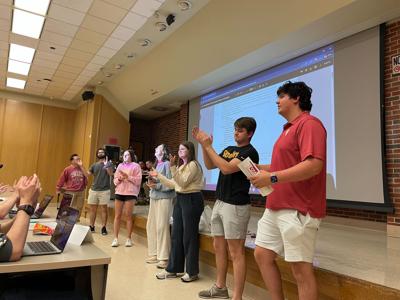

The Undergraduate Student Congress allocated auxiliary funding to registered student organizations, changed the composition of its budgetary committee and amended the Crimson Leadership Association Act at its Tuesday meeting.
Appropriating auxiliary funding
The news: Congress passed a bill appropriating $12,715.39 in auxiliary funding to various registered student organizations.
The amounts allocated and to which organizations are:
• Academic Team, $300.00
• Afghan Student Association, $500.00
• American Indian Law Review, $150.00
• Campus Activities Council, $50.00
• College Democrats, $300.00
• Criminal Law Association, $400.00
• East African Alliance, $250.00
• Graduate Music Student Association, $300.00
• Graphic Design Association, $200.00
• Horn Studio at The University of Oklahoma, $130.00
• India Student Association, $550.00
• Kidney Disease Screening and Awareness Program, $225.00
• Korean Student Association, $200.00
• Laminar, $500.00
• Latin American Law Student Association, $501.25
• Latino Medical Student Association, $435.00
• Latinos Without Borders, $1,000.00
• Law Golf Club at the University of Oklahoma, $50.00
• Model United Nations, $490.00
• Nepalese Student Association, $50.00
• Norman Students for Life, $500.00
• Omani Students Association, $800.00
• OU Women's Wrestling Club, $300.00
• Phi Alpha Delta Law Fraternity, International, $50.00
• Phi Delta Phi, $100.00
• Psychology Graduate Student Association, $175.00
• Sooner Competitive Robotics, $2,874.14
• Students for Local Action, $275.00
• The Walking Club at the University of Oklahoma College of Law, $180.00
• Venezuelan Association, $880.00
All unspent money remaining at the end of the fiscal year, which ends May 8, will return to the SGA general account.
What they’re saying: Ways and Means Committee chair Jacob Schonfield, who authored the bill, said this is the last auxiliary funding allocation bill of the year.
“We get money from what doesn’t get spent in the year previous, and then we allocate those funds to our (registered student organizations) who apply in the same order that they apply for the funds,” Schonfield said.”
Schonfield said that some of the organizations that applied did not get funding this year.
“This year, we ran out. We still had a handful of organizations who had applied but did not see any funds, because those funds were exhausted,” Schonfield said.
The vote: Congress passed this bill with a vote of 31-0-0.
Changing budgetary committee composition
The news: Congress passed a bill changing the makeup of the budgetary committee.
The amended bill states the Graduate Student Senate chair, Campus Activities Council chair, SGA president and Student Bar Association president will also serve as ex officio members on the budgetary committee.
Ex officio means the individual holds a position or membership on a board or committee automatically because they hold another, primary office.
Under the previous bill, the budgetary committee funded organizations on the basis of three categories: office expenses, capital expenses, and programs/events/activities. The amended bill adds a travel category, expanding the allocation categories from three to four.
What they’re saying: Graduate Student Senate Ways and Means Committee chair Sam Jenson, who co-authored the bill, said the purpose is to add a few individual positions to the committee.
“Essentially, what this would do is give these positions an opportunity to make contributions towards grading auxiliary and primary funding,” Jenson said.
Schonfield, who co-authored the bill, said the individuals were chosen primarily because they are leadership for other branches of student government.
“We want to make sure that everyone across SGA generally has a seat at the table when it comes to allocating funds. It makes it so that we are getting every point of view, every perspective,” Schonfield said.
Schonfield said there are no requirements for selecting a proxy, or an individual with authority to represent someone else when voting.
The vote: Congress passed this bill with a vote of 32-0-0.
Amending Crimson Leadership Association Act
The news: Congress amended a bill changing the operations of the Crimson Leadership Association.
According to the amended bill, a board consisting of the SGA vice president and the previous year’s Crimson Leadership Association co-chairs must interview applicants and consult the SGA president and legislative branch before selecting two co-chairs for the association.
Each co-chair will formally update the vice president on the association’s progress and goals at least twice a month. Before the amendments, one co-chair was required to update the vice president once a month.
The bill increases the number of office hours each co-chair must hold from a minimum of three to five hours.
What they’re saying: Crimson Leadership Association co-chair Alexandra Toyos Perez, who authored the bill, said these updates more accurately reflect the language and practices that Congress uses.
“The main change to this is our office hour requirement from three to five hours. (Crimson Leadership Association) is not paid for their office hours like other positions are, but it’s essential to connecting with our members outside of our typical Monday night meetings,” Toyos Perez said.
Toyos Perez said this might help Crimson Leadership Association members get paid for their office hours in the future.
“It’s work that we have to do, whether we get paid for it or not. I volunteered for the position in April, and I’ve been doing the five hours,” Toyos Perez said.
The vote: Congress passed this bill with a vote of 32-0-0.
This story was edited by Macey Thaxton.


