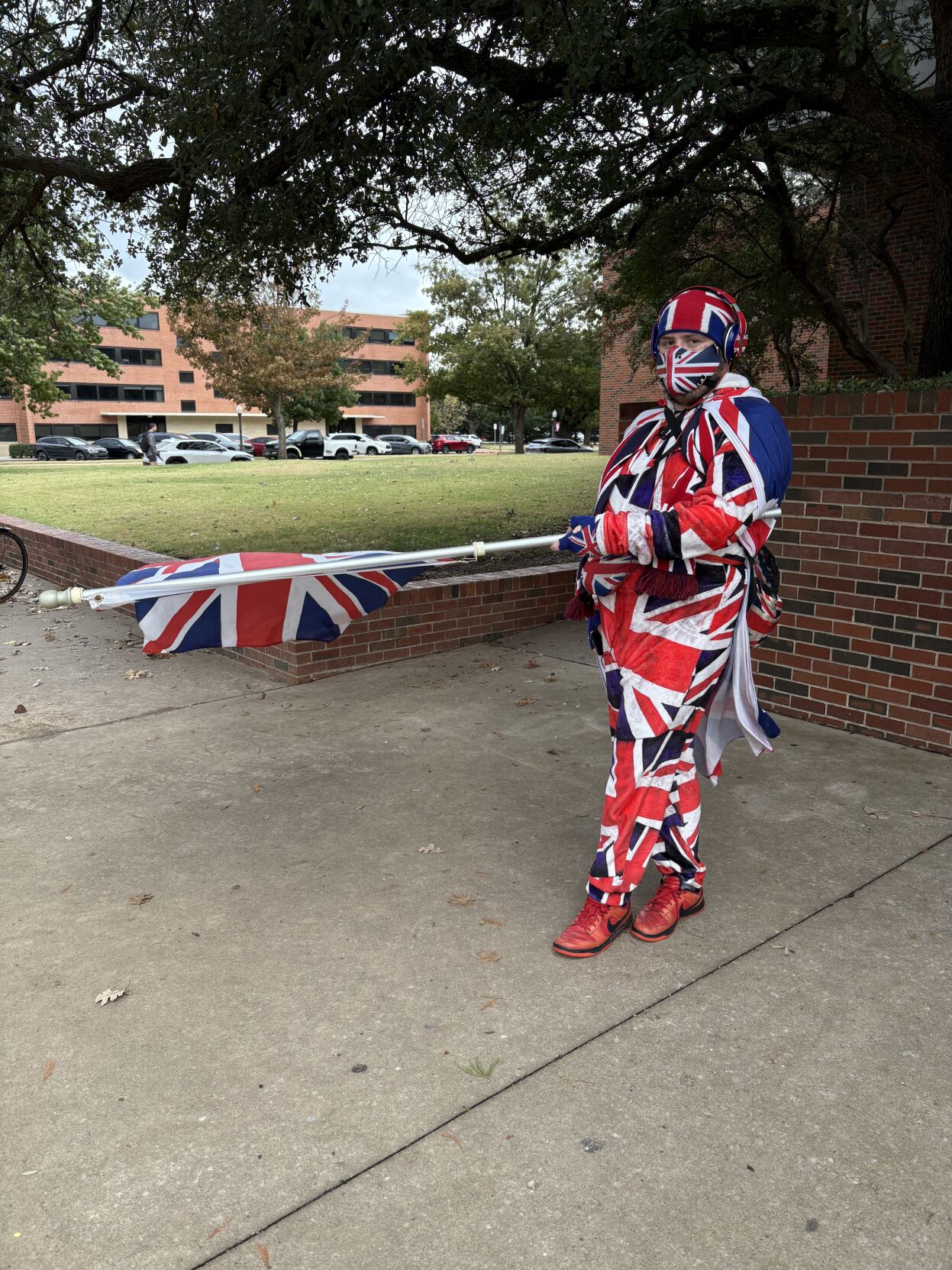

Dressed head to toe in U.K.-themed memorabilia, Holdyn Hensley’s not here just to make a statement. He’s using that outfit to raise awareness about Sooner Works and challenge assumptions about autism and disabilities.
Hensley, a junior and a student in the Sooner Works program, said he wears the outfit to brighten people’s day and act as a symbol of encouragement.
“Everybody started to eat it up; they loved it so much, …” Hensley said. “I knew that I had to bring hope to everybody around OU to make sure their spirits keep going no matter how hard the courses are.”
Hensley said he knew people going through difficult times, which inspired him to wear the outfit.
“I knew a few people (in the) last few years. They were actually facing some difficulties with grades and housing problems, and I needed to make sure to keep them going and always keep their lovely heads up … because that makes us human,” Hensley said.
Hensley said that he has autism, which he called his “lovely autism,” and spoke about the assumptions people have about autistic people.
“(People) think that we’re not actually capable of doing anything, … but I feel autism is more of a lovely power, …” Hensley said. “All of us have something very special that always makes us human — our own things that make us very special, deep down inside of our lovely hearts, all of us should keep going the way we are.”
Sooner Works — a four-year certificate program designed to support students with intellectual or developmental disabilities as they develop independent-living skills, pursue career goals and become contributing members of their community — has given Hensley opportunities to explore different career fields. He said he’s most interested in zookeeping, specifically working with African elephants, and that it would be a fulfilling career.
Hensley also said the program, founded by the Zarrow Institute on Transition and Self-Determination, has supported him through Peer Partners, which pairs Sooner Works students with other OU students.
“I have indeed (made friends), and they were very kind and lovely, …” Hensley said. “It's very nice to be part of a group though, that can understand you very well.”
A student support specialist and academic adviser for Sooner Works, Caden Geist said people with disabilities often face stereotypes.
“A lot of people think that people with Down syndrome or autism either have one emotion — I know a common misconception can be those with Down syndrome are always happy. It's not the case,” Geist said. “That’s one thing that’s been really eye-opening, is some of these students can really struggle with mental health, and that's something that I just didn't think of prior to being a part of this organization.”
Geist, a chemical biosciences and psychology major, said people should be mindful of the language they use and avoid putting people with disabilities into categories since it can negatively affect students and create barriers.
“People sometimes will refer to our students as kids when they're the same age, and slight language like that can cause an inferior feeling within our students when people don't realize it, …” Geist said. “ I think those (stereotypes) can just close doors. … It's limitation based off assumption rather than actual limitation.”
Students in Sooner Works take program-specific classes on skills like budgeting, interviewing and job readiness, as well as typical OU courses based on their interests. Students also participate in internship and practicum opportunities.
“The opportunities are ones that we could seek out that we kind of have to advocate for our students to get, and hopefully that can kind of align with their career goals,” Geist said.
Geist said one thing that sets Sooner Works apart is its level of integration.
“There (are) other programs across the country that do similar initiatives, but they’re not as integrated,” Geist said. “Their students will live in their own separate dorms away from every other student or if they want to leave campus, they have to sign in and out. Ours is a lot more about independent living and actually being integrated with all the other OU students.”
Geist said the program allows students to access opportunities they otherwise might not be offered.
“If we didn't have programs like (Sooner Works), that wouldn't happen,” Geist said. “People wouldn't give him that chance.”
Peer Partners helps build that community, pairing students based on shared interests and personalities. Students often meet up to attend events, join clubs or spend time together socially. The group also hosts social events throughout the year, including costume contests, movie nights and holiday celebrations.
Sooner Works graduates have gone on to work as teaching assistants and football coaches. Geist said it’s meaningful to see graduates live independently.
“It is pretty cool to see the students working jobs and kind of hearing about how they get to live independently, and a lot of them have roommates and are experiencing what adulthood looks like for everybody else,” Geist said. “That wouldn't have been the case if they didn't have this program. It’s really encouraging to see the wide range of jobs and experiences, and the success rate of having students live more independently after the program.”
This story was edited by Madisson Cameron. Hannah Lambert, Avery Avery and Mary Ann Livingood copy edited this story.


