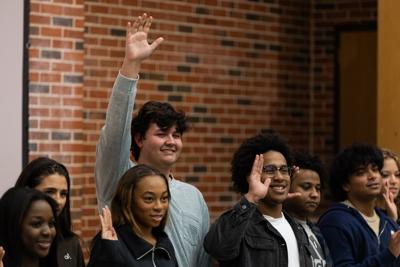

The Undergraduate Student Congress approved executive cabinet members, approved a referendum to expand congress, appointed new members and recognized Black History Month at its Tuesday meeting.
Approving executive cabinet
The news: The SGA Executive Cabinet Appointment Act of 2026 appointed the directors and cabinet positions of the Martin-Nicholson administration.
This bill was seen and passed at congress’s Jan. 27 meeting. A typographical error – the designation “Act of Procedure” rather than “Act of Legislation” – kept the bill from being officially seen by the Graduate Student Senate.
Mercer Martin and Josephine Nicholson were inaugurated as president and vice president, respectively, on Jan. 21.
The following people were appointed:
• Ava Burnett, director of external affairs
• Xander Donald, director of internal affairs
• Abby Gross, director of technology
• Jada Cannon, director of student betterment
• Reese Walsh, secretary of Speaker Series
• Kaela Theuri, secretary of liberty and representation
• Garret Brooks, registered student organization liaison
• Alaina Jawed, SGA interbranch liaison
• Stephen Pendely, press secretary
• Hannah Hamby, social media coordinator
• Jemay Leow, secretary of student services
• Nicolas Suarez-Antelo, international student liaison
What they’re saying: Nicholson, who authored the bill, said the appointees are “awesome people” and that the goal was to make a space accessible to everyone.
“The executive cabinet tends to change depending on the administration. For our administration, we've opted to expand the executive cabinet, so there's quite a few members,” Nicholson said.
This executive cabinet is nearly double that of the Strickland-Dunlap administration, which appointed seven secretaries to its executive cabinet.
Secretary Michael Wintory asked, “At what point does government become too big?” Nicholson said, “Guess we'll have to see.”
The vote: Congress unanimously approved the appointments.
Approving congress size referendum
The news: Congress passed a referendum under the Congressional Size Regulation Amendment. If approved by voters in the spring 2026 election, restrictions on the size of the Undergraduate Student Congress will be removed from the SGA Code Annotated.
Congress is currently limited to 48 members. Under the amended code, congress would have no limit on how many total seats it will have during the allocation of seats to each of 14 academic districts, which takes place every 2 years.
Code Annotated changes related to the size and district composition of congress would require a three-fourths majority vote from both the Undergraduate Student Congress and Graduate Student Senate. The size of congress would still be determined by a ratio of students in a district to representatives.
What they’re saying: Chair Caleb Robinson, who authored the bill, said that the body at its current size is not large enough to adequately represent growing student enrollment.
“When you look at our peer (Southeastern Conference) schools, also when you look at our growing size, it becomes more difficult each year to adequately represent the student body,” Robinsons said. “I think the last time I did redistricting, it was something along the lines of 600 students per representative, which is incredibly difficult for you guys, so we're hoping to expand this.”
The vote: Congress approved this referendum with a vote of 28-0-1. Vice Chair Aaron Gilson-Bond was chairing the presentation of this bill and abstained.
Appointing members
The news: The Session CXV General Application Appointment Act appointed the following representatives:
• Keiwon Landrum, Arts and Sciences representative
• Baylor Savage, Business representative
• Haripathy Pasupathy, Business representative
• De’Kyla Callahan, Business representative
• Yousra Karrar, International and Area Studies representative
• Kayla Hawley, Journalism and Mass Communications representative
Congress appointed the following associates:
• Olivia Miller
• Adriana Do
• Babilynna Wadmia
• Chis Moncayo
• Matthew Solomon
• Rhianna Bruner
• Cydney Fleeks
• Austin Blackwell
• Sofia Haddon
• Bryelle Giorgi
• Audrey Digua
• Maximilian Frehde
• Charles Duncan
• Luke Clay
• Madeleine Denton
• Jumeirah Newaz
• Benjamin Lewis
• Natalie Fernstrom
• Grace Thune
• Madison Bell
What they’re saying: Congressional Administration Committee Chair Coleman Morgan, who authored the bill, said this was a regular amendment.
“They went through the process of application, was graded by myself, Caleb (Robinson), Aaron (Gilson-Bond) and Michael (Wintory) for an application process,” Morgan said, “and then they interviewed with us – all outstanding candidates, attended orientation and they're all ready to go.”
The vote: Congress unanimously approved the appointments.
Recognizing Black History Month
The news: Congress officially recognized February as Black History Month with the approval of the Black History Month Resolution of 2026.
What they’re saying: Associate Lilith Thompson, who authored the bill, said the resolution recognizes the culture and history of African American students on OU’s campus.
“It also recognizes that there should be no hate towards these individuals, and also encourages students on OU’s campus to go to any events that will be held to educate people on these cultures in America and broadly throughout the month of February,” Thompson said.
“The University of Oklahoma Student Government Association recognizes and honors the Black/African American/Members of the African Diaspora students at The University of Oklahoma, in addition to their culture and heritage,” the resolution states. “The University of Oklahoma Student Government Association condemns any laws and policies that previously or currently suppress, or harm individuals recognized within this resolution.”
The vote: Congress unanimously approved this resolution.
Amending judge experience requirements
The news: The Judicial Branch Amendment of 2026 passed a referendum to amend the SGA Constitution to allow first-year law students to serve on the SGA Superior Court.
Students who have not completed two full-time semesters when entering office as a judge will need to receive a three-fourths supermajority in each legislative chamber for confirmation.
A clause would also be added to the constitution to grant authority to the Superior Court to set policies and procedures of the judicial branch, including the inferior courts, by a majority vote.
The referendum will appear on the ballot in the spring 2026 general election.
What they’re saying: Superior Court Chief Justice Tucker Dunn, who authored the bill, said the current language makes first-year law students who did not attend OU for their undergraduate studies ineligible to be appointed to the Superior Court.
If passed, this amendment will allow those previously ineligible students to be appointed with a three-fourths vote in each legislative chamber, which Dunn said would keep the court accountable.
“We're only going to pick people who either have been here longer or who can meet that higher vote threshold,” Dunn said. “Hopefully that creates a good balance.”
The vote: Congress approved this bill with a vote of 33-2-0. Rep. Ellie Wolthius and Gilson-Bond voted against the bill.
This story was edited by Natalie Armour and Macey Thaxton.


