
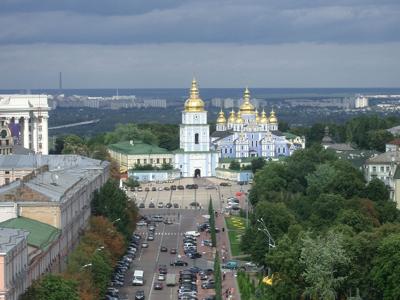
It is 9 p.m., Feb. 23 in Norman. The sky is littered with stars, ice glazes the ground and students at the University of Oklahoma are safe at home after a wintry mix closed campus earlier in the day. The night is eerily still under the hazy glow of the sky, leaving those inside with a premonition of calamity.
At the same moment, just across the Atlantic Ocean, it is 5 a.m., Feb. 24 in Kyiv, Ukraine. A tense atmosphere — grounded in a historic conflict that intensified almost eight years ago following the annexation of Crimea by the Russian Federation — is shattered with the sound of sirens. Explosions echo across the country as Russian troops close in on Ukraine’s northern, eastern and southern borders.
Associate professor of public relations and strategic communication Katerina Tsetsura, who possesses both Russian and Ukranian heritage, woke on Feb. 24 to Russia’s invasion of Ukraine, and later that day, the United States, United Kingdom and members of the European Union imposed economic sanctions on Russia. Her relatives, who live in Kyiv and Kharkiv where fighting broke out Feb. 27, are now hiding in basements and bomb shelters.
She wrote in an email that her relatives and their families, including children who range from three to 12 years old, can hear sirens and bombs and see fires in Kyiv. While she sat in her home, her child safely playing on an iPad in the other room, she watched the news unfold as her family relayed their fear and asked people in the U.S. to close the airspace over Ukraine and help get Russian soldiers off of Ukrainian land. Tsetsura told The Daily that her personal stake in this invasion made her feel “Ukrainian more than ever.”
Despite Kyiv being about 5,700 miles away, connections of heritage and family make the events in Ukraine feel incredibly close, leading some to call for local action against this “real war.”
On Feb. 24, a group of OU staff and faculty sent a letter to The OU Daily condemning Russia’s invasion of Ukraine.
The letter included OU history professor Melissa Stockdale, associate professor of Russian Emily Johnson, associate professor of international and area studies Rebecca Cruise, assistant professor of Russian Dustin Condren, College of International Studies adjunct instructor Robert Andrew, Russian instructor Rachick Virabyan and Tsetsura.
The letter read that, as scholars of Russia and Ukraine and admirers of Russian and Ukrainian achievements, they agree with the Board of Directors of the Association for Slavic, East European, and Eurasian Studies, which “condemns Russia’s military assault on Ukraine.” They wrote it was a “shocking turn of events.”
“We condemn the invasion and President Putin's use of historical distortions and lies to justify his aggression,” the letter read. “We mourn the casualties resulting from this senseless attack and wish to express our support for all the people of Ukraine and Russia who oppose this war.”

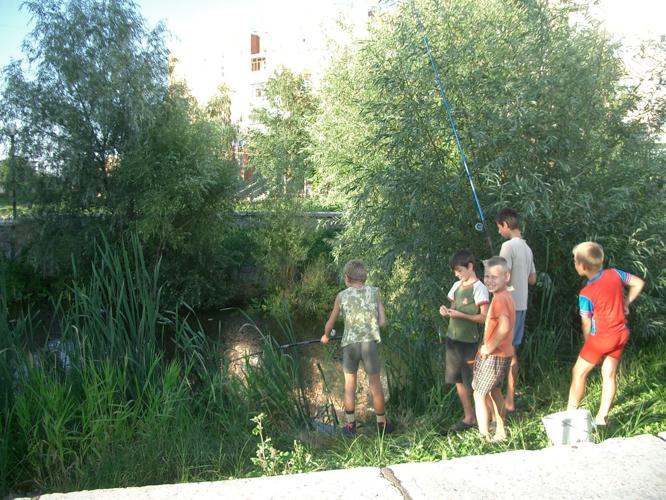
A group of Ukrainian boys fishing in central Ukraine.
Tsetsura, who lived and studied in Russia in 1998 and resided in other former Soviet Union states like Ukraine, researches Ukrainian and Russian media and strategic communication. She said Russia’s invasion of Ukraine is a global issue and concerns everyone.
Tsetsura said the world is “very hyperconnected,” and Russia’s invasion of Ukraine will “be your business” before you even know it. This is the time to understand the scale of globalization, she said, citing Pastor Martin Niemöller’s “First They Came” poem as a warning.
In the poem, the speaker references how Nazi forces came for different demographics of people, and because it did not affect them directly, some groups remained silent. Yet, once the Nazis came for their group, there was no one left to defend them.
“(People) don’t understand the scale of what’s happening,” Tsetsura said. “We are living this history, and what’s happening in front of our eyes right now is a really big historical event that will dominate the narrative of the world order and world history for many years.”
Andrew, who also contributed to the faculty letter, focuses on U.S.-Russian relations and is a former diplomat assigned to the U.S. Embassy in Moscow from 2005-07 through U.S. Foreign Service. He said, since the USSR fell in 1991, this has been a thirty-year reckoning from Russia by Putin to “reclaim its glory” from the Cold War as a respected adversary of the U.S. and China.

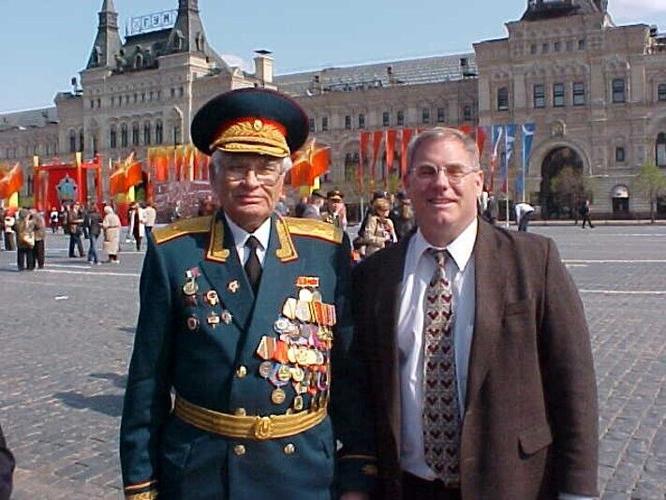
Rob Andrew with a uniformed veteran of World War II on May 9, 2007 at Red Square in Moscow, Russia. Andrew was there to watch the Victory Day parade, which is held annually to celebrate the day Germany surrendered to the Soviet Union.
“This is Russia’s war against Ukraine, (and) this is Russian aggression,” Andrew said. “This is where we find ourselves. In this new Cold War. It’s going to potentially be another long slot (of time) to deal with this issue.”
Andrew, like Tsetsura, has connections to Ukraine, as he has friends who are currently in Ukraine in danger zones.
“I couldn’t sleep. I was worried sick,” Andrew said. “These are my friends. For me, it’s not a concept of, ‘Oh, well that’s someone else’s problem.’ No, it’s all of a sudden my problem in a sense where it’s affecting me because I know these people, and I keep my fingers crossed that they’ll be okay.”
In following news regarding Russia’s invasion of Ukraine, Andrew said it is important not to trust what Putin says, but what he does. OU adjunct professor Max Kovalov said Russia has falsified humanitarian efforts to justify its occupation of and military action against Ukraine.
Kovalov was born and raised in Ukraine and received a scholarship to attend university in the U.S. in 2002, where he received his master’s in international studies at Oklahoma State University and his Ph.D. in political science at OU. He is also the Bennett director of the John Edwin Mroz Global Leadership Institute and focuses his academia on democracy, specifically in Eastern European and post-communist regions.
Kovalov said Russia’s media is state-controlled and can be “manipulated easily,” which he feels is present in the country’s justification of its actions in Ukraine.
“Russia describes it as an attempt to demilitarize and de-Nazify Ukraine,” Kovalov said. “It was supposedly uncovering mass graves (and) uncovering violations against the rights of ethnically Russian citizens. Nobody is threatening the rights of Russian citizens, and it’s absurd to call Ukraine a neo-Nazi state.”
Ukrainian President Volodymyr Zelenskyy, who refused the U.S.’s offer to evacuate him to stay and fight, instead, is Jewish and lost three great uncles during the Holocaust. To this, Kovalov asked, “How can someone who grew up in a Jewish family be described as a neo-Nazi?”
Kovalov said the invasion is a fight between democracy and autocracy at its core. He said that, if people subscribe to Putin’s narrative that Russia and Ukraine are the same people and that Ukrainians are successful at building democratic reforms, it begs the question of why Russians can’t do the same.
“Democratic reforms in Ukraine are a threat to an autocratic leadership of the Russian Federation,” Kovalov said. “That was the reason why the Russian government has been cracking down on protesters, on independent media of any kind, (and) of expressions of civil society or mobilization by civil society, because the Russian government truly believes that the threat is not necessarily coming from the outside.”
Current protests in Moscow against the invasion of Ukraine are being suppressed by authorities. Tsetsura said it is a “positive sign” that people are still protesting the invasion despite some being grabbed from the streets and detained.
Some protesters escaped imprisonment, including the parents of Russian graduate student Daniil Solovev, who wrote in an email to The Daily that they participated in city protests in St. Petersburg on Feb. 25.
Solovev wrote his family is frightened, stunned and stressed about Russian economics shrinking due to “an unwanted war.” He wrote he feels similarly shocked and helpless and couldn’t sleep when Russia invaded Ukraine because he was scrolling through his news feed.
He wrote he is currently avoiding social media and the news, as he hopes it will “all finish soon.”
“It all appeared unreal to me, like I was in a very wicked nightmare,” Solovev wrote. “If someone said ten years ago that there is going to be a war between Russia and Ukraine, this person would be called crazy, but now, it is a horrendous truth.”
Solovev wrote that, in his opinion, the invasion occured most likely because Putin is pursuing the reestablishment of the Russian Empire. Ukraine is the last piece of the big puzzle, he wrote, which is why he “acts so ruthless.”
“He wants to put Ukraine back under Russian influence, as he did with other ex-Soviet countries,” Solovev wrote. “He must be stopped. Russian people and other nations do not deserve to live another century under the Iron Curtain.”
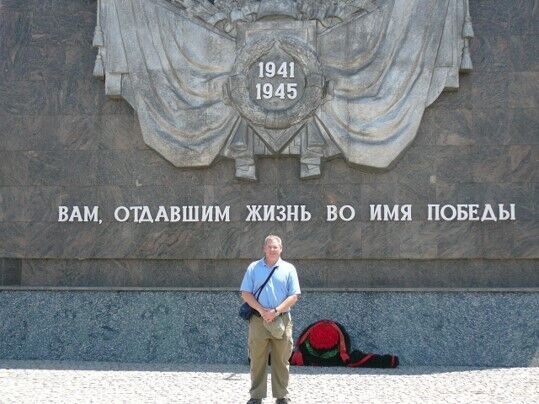
Robert Andrew outside a war memorial on July 2007 in Volgograd, Russia.
Based on reports Andrew has seen, he said Russia seeks to take Kyiv and control the border, which would make it difficult for “insurgents” to remain supplied with weapons and support. He said Ukraine is a proud country with a history of partisans, like those who fought against occupying German forces during World War II. He said, based on this history, the Russians know Ukraine won’t go down without a fight.
In Vietnam and Afghanistan, he said insurgents had safe havens across borders where they could regroup and, in the case of Americans in Vietnam, pick their battles, making it difficult to fight. Andrew said Russia is most likely trying to prevent this from happening in Ukraine.
“I think it’s a race to see how quickly Russia can subdue the population and convince them not to do that,” Andrew said. “At this point, I think the Ukrainians have shown some resilience, so let’s see where that’s going to go. (However,) it certainly could be a quagmire.”
Unlike Tsetsura, Andrew, Kovalov and Solovev, journalism junior Ben Dackiw’s connection to Ukraine is muddled by several generations, as his great grandfather is from Ukraine. He said he has always taken pride in his heritage, meaning he has a heightened awareness of Russia's invasion of Ukraine and dislikes the "World War III" jokes he sees on social media.
“It takes no effort to show compassion to the people who are not going to be sleeping, they're not going to be eating, (and) their able-bodied men are getting conscripted to fight off the Russians,” Dackiw said. “They didn’t ask for this.”
Like Dackiw, Solovev wrote he has started to notice jokes and statements directed at Russia from people at OU, and he wants to stress that these statements “blindly damage” the entire Russian community, including himself.
Starting the war was the sole decision of President Putin, he wrote, and all the protests and alternative points of view are brutally suppressed by police forces.
“I want to underline that me, my family, friends, colleagues, and the other vast majority of Russians do not want war,” Solovev wrote. “War brings only death and despair, and no Ukrainian or Russian deserves it. No one wins in war. Everyone loses.”

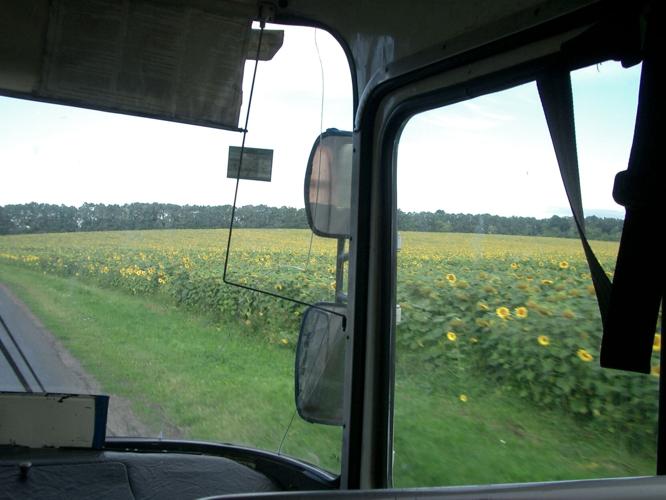
A bus trip across central Ukraine with the national flower of Ukraine, the sunflower, outside the window.
Tsetsura said the situation in Ukraine should remain at the top of people’s social media feeds, and they should continue accessing information from media outlets that have journalists on the ground, such as from the Kyiv Independent and the Ukrainian Pravda. The Nieman Lab at Harvard also put together a list of journalists and media to follow information from Ukraine.
In a follow-up email, she wrote that she was in contact with Dariya Orlova, a senior lecturer at the Mohyla School of Journalism at the National University of Kyiv-Mohyla Academy in Ukraine. Orlova agreed with Tsetsura, writing that Ukrainians have been working hard to provide coverage in English, like EuroMaidan Public Responsibility and the New Voice of Ukraine.
Orlova, who is currently near Kyiv, wrote that regular Ukrainians, like her colleague Mychailo Wynnyckyj, also deserve voices, as they’ve been active on Facebook and Twitter.
She wrote that she and her family are relatively okay and that the initial shock is over, but the first day was scary. She wrote that she can remember when her family read the news about Putin’s decision to attack Ukraine and the distant strikes in the sky which were immediately heard.
They went to pick up Orlova’s mom in Bucha, she wrote, but had to hide in the bathroom when they got there because they heard explosions overhead, which later was confirmed to be from the nearby Gostomel Military Airport.
The situation in Bucha is tense, she wrote, and she is not sure about the situation there currently.
“There were reports that Russians took it, then reports that our Army resumed their control over the airport, (and) I’m actually still not sure who controls it now,” Orlova wrote. “My mom is connected to their local Viber group — like a WhatsApp group — and her neighbors post their observations there. There were Russian tanks there already.”
Orlova is currently in a small village outside of Kyiv with her mother and other relatives. She’s in a private home, which she wrote feels safer than an apartment, and there’s a basement where they hope to hide if there is shelling or bombing.
On Feb. 25, the International Advisory Committee — an executive student body representing international students — released a statement via Instagram saying this is the time to support one another, especially those who are “deeply and directly affected” by the events in Ukraine.
“The most important thing to understand is, this is the time to act and find a way to help Ukraine any way we can (and) help those who are in dire need,” Tsetsura said. “From reading and following the news, the Ukrainians are very strong in their position right now. They do see this attack as (one) on their country. They do see it as an attack on their freedom, and they will fight and they are fighting. This is a real war.”


