
OU President Joseph Harroz took the stage before dozens of the university’s journalism students to lecture on what he called the “playbook” for weakening democracies.
His remarks Sept. 9 centered on the importance of civics education and familiarity with government functions to maintain democracies. During a period where numerous organizations have sounded the alarm on global and democratic backsliding — the international rise of governments exercising authoritarian policies like voting restrictions and discrediting or censoring the press — Harroz repeatedly emphasized the relationship of law and journalism as “first cousins” and the vital role media plays in democratic society.
“What you’re doing in media law is critical because you are the voices. You are the fourth estate,” Harroz said. “To be truly effective at it, you have to understand the law that applies to it, and you have to understand the institutions that can impact whether or not that law is upheld or run over.”
Though Harroz acknowledged the significance of the press, journalists have expressed frustration in dealing with the university. OU has drawn criticism from journalists and freedom of information advocates — ranging from the tenures of former Presidents David Boren and James Gallogly and into Harroz’s presidency — who say the institution has not upheld its legal obligation of transparency under the Oklahoma Open Records Act.
In 2019, the OU Board of Regents received the “Black Hole Award” from Freedom of Information Oklahoma, a group promoting transparent governance by supporting people and organizations who work to maintain and reinforce transparency laws such as the Freedom of Information Act. The board was recognized as the group that “has most thwarted the free flow of information” following the secretive selection of former OU President James Gallogly and the appointment of Harroz as Gallogly’s interim successor in a six-hour meeting that took place almost entirely in executive session and ended just before 2 a.m.
When Harroz was later selected as permanent president on May 9, 2020, then-OU Board of Regents Chairman Gary Pierson said the board had offered Harroz the permanent position on the night he was appointed interim.
This year, OU alumnus and editor-in-chief of NonDoc Media Tres Savage filed a lawsuit seeking reports detailing alleged sexual misconduct and misreporting of donation data under former OU President David Boren. The university has refused to produce the documents under “evidentiary privileges listed in 51 O.S. § 24A.5(1)(a)” of the open records law.
The statute reads that “records protected by a state evidentiary privilege such as the attorney-client privilege, the work product immunity from discovery and the identity of informer privileges” are not subject to open records requests.
Other media outlets have gone extensive periods with no response from OU on open records requests. The Daily published a Sept. 21 Twitter thread listing numerous unfulfilled requests, three of which were over a year old. One sought a single document, and two sought roughly a month of communications between university officials.
Responses to the thread indicated reporters from outlets including News9 and The Athletic — Storme Jones and Jason Kersey respectively, both of whom are OU alumni — experienced similar roadblocks in obtaining public records, ranging up to two full years with no records produced.
The previous struggles of the university’s open records office leaves a variety of questions: How does OU’s response time compare to other universities? How many resources are devoted to OU’s open records office? Can other universities model best practices and potential improvements? And, how could state statutes be improved for the public’s benefit?
Student media outlets at other universities — in Oklahoma and elsewhere — said their schools have often outperformed OU’s open records office. Freedom of information advocates and former Oklahoma legislators credited much of this to the strength of other states’ freedom of information laws.
‘Radio silence’
For over 20 years, South Carolina resident Frank Heindel has considered himself a “concerned citizen.”
Heindel was never a reporter and holds no public office. Still, the importance of citizens’ access to their government was never lost on him, he said, when he first began filing FOIA requests in the late ’90s. In 2019, he filed a lawsuit against the University of South Carolina regarding its open records practices, which led to systemic adjustments to the university’s open records office, including a new system for tracking requests and a new compliance position at the university.
The document Heindel requested was a log of all FOIA requests the university had received in the past 12 months, he said, to see how effectively the university was responding to requests. When the university took longer than the 10 calendar days to respond to Heindel’s request and 30 calendar days to fulfill it under South Carolina’s sunshine law, Heindel filed his lawsuit. Oklahoma currently has no defined time period in its state law.
“They had gotten back to me and said, ‘We’ve received your request and are processing it,’ and then it was radio silence for several months,” Heindel said.
Heindel said the suit was eventually dropped after the university was ordered to “create and maintain a centralized FOIA log” to document FOIA requests by a Richland County Court judge, according to court documents.
While lawsuits can help put pressure on individual institutions to uphold their legal duties to the public under FOIA laws, Heindel said states struggling with transparency issues can only fully rectify the problems in legislature.
“You can put the heat on the university, but the real guilty party is the legislature because they're the ones who could revise the law, change it to be (something like) 10 business days to get a response, and then after the response and I agree to pay you, I need the information within 30 days,” Heindel said. “That’s how (documents) here that are less than two years old are handled, and there's no reason that couldn't be the Oklahoma model as well. The legislature is letting citizens down by allowing this opaqueness to go.”
‘Prompt, reasonable access’
Stratton Taylor maintains an intimate knowledge of the Oklahoma Open Records Act. As the senate author for the bill, the Tulsa-based attorney was one of the central figures in its passage in 1985.
In an email to The Daily, Taylor wrote he also felt the lack of a specified period for public agencies to respond to requests is a flaw. Under the current statute, Taylor wrote state agencies can simply wait for individuals to lose track of their submissions.
The law currently reads only that a public body must provide “prompt, reasonable access” to records.
“That should be addressed,” Taylor wrote. “Too many agencies just try to stall out requests.”
Providing different documents inherently requires different amounts of labor and time, Taylor acknowledged, but typical requests — those that don’t seek an unusually large number of documents or records produced over an exceptional timespan — should reasonably be completed within a month.
“Having a deadline to respond would be helpful. … I don’t know about the facts (of specific requests made by The Daily), but generally speaking, 30 calendar days should be enough absent unusual circumstances,” Taylor wrote.
The inclusion of a defined period was discussed as early as 1984, when interest groups including the Oklahoma Press Association were deciding how the law would be structured and what documents would be considered subject to records requests. Mark Thomas, the current director of the OPA who was involved in preliminary discussions on the law, said no fulfillment period was included to prevent “both sides from abusing the other.”
Thomas said the inclusion of a specific time frame could potentially allow the custodian of a public record to wait out the entirety of the legally allotted time, even if the record was readily available from the start. Reports of the practice stemmed from states where a time frame had been enumerated in the law, Thomas said, though he did not remember specific states or examples from the original discussions.
While such instances can occur, Heindel said citizens in states whose law has a defined time frame are at least guaranteed a period in which they might receive their documents eventually and a concrete mechanism to hold agencies accountable.
“That can happen, but at least I'm getting it on the 29th day. Maybe 30 days isn't the magic number, but you have to have a line there where everybody knows that this is acceptable, and past this timeline, this is not acceptable,” Heindel said. “We can't hold anybody accountable. We can't really demand transparency when you’ve got that leeway.”
The vagueness of the “prompt, reasonable access” language was also intended to protect individual officials and institutions from being charged with crimes if they received a request that was unreasonable to fulfill in a given timeframe, Thomas said.
“Let’s say I want to run for county clerk. So what I do is I go into your office, and I ask you for every record you've ever created, from your predecessors and everything, and I want it in three days, or 10 days or 30 days,” Thomas said. “I want everything you've ever created, and if you don't give it to me, I will charge you with the crime, and that looks good on my brochure to run against you.”
This worry was mostly voiced by the Oklahoma Municipal League and county clerks, Thomas said.
Even in the absence of specified response times, Thomas said OU’s fulfillment of requests has been lacking. Requests for single documents, such as the contract between OU and online education consultant firm Elsmere Education to create OU Online, should be especially simple for state agencies to produce.
“Assuming that the contract has no exclusion in the law that they would apply to it, they should have had it to you by the end of the week,” Thomas said. “Those kinds of things should be much simpler to fulfill. … That certainly sounds excessive to me.”
Attempts to enact a specific response time have been seen as recently as last year. Former Senate District 17 Sen. Ron Sharp filed Senate Bill 1154 in February 2020. The bill attempted to amend the Oklahoma Open Records Act by including a 30-day fulfillment window, which could be extended another 30 days if the request was unfinished after the original period.
In a column submitted to the Journal Record highlighting the bill, Sharp wrote his time in state Legislature showed Oklahoma was “one of the weakest” states nationally in responding to records requests.
“I had asked the Oklahoma State Department of Education for some information. I was very interested in communications between the State Department of Education and Epic Charter Schools because they apparently were not in compliance with statute and administrative code and their own contract,” Sharp said in an interview with The Daily. “And of course I filed other FOIA requests (that have gone unanswered), but (the Department of Education) finally responded. … I’ve now been out of office for a year, and so it’s been at least two to four years for some of those requests that have never responded.”
Organizations outside the state have also identified a “culture of noncompliance” to the state’s sunshine law among Oklahoma agencies.
The Reporters Committee for Freedom of the Press, a national organization that provides journalists and media outlets legal information regarding press freedoms, identified Oklahoma as a state of particular need of its services, said Kathryn Gardner, an attorney with the organization.
“(In Oklahoma,) we've seen it's harder and harder to get records because the only way to challenge a denial ultimately — beyond just arguing back and forth with an agency — is taking that to court,” Gardner said. “That can be incredibly difficult. That's a really large hurdle, I think, to go from an email argument to filing a lawsuit. So because things are rarely enforced here … agencies just think, ‘Well, we haven’t been challenged in so long. … What are they going to do about it?’”
Gardner is also representing NonDoc in its lawsuit against OU to secure the release of the Jones Day investigation on Boren’s sexual misconduct allegations and misreporting of donor data. She said the lack of a specified timeline has also hurt enforcement of the law, meaning courts have never had to consider what “prompt and reasonable” access should mean.
Sharp said one motivation for his bill establishing a timeline for open records requests was also the absence of effective enforcement mechanisms for the law.
“I notice, of course, that there’s a penalty — a year in jail or $500 — but who’s going to enforce it,” Sharp said. “There’s no one there to actually enforce it … without a set timeline.”
Sharp’s time frame bill was short-lived in Legislature and never received a hearing
“It is very disappointing that (SB 1154), that would have provided the accountability and transparency to state government that legislators campaign to establish, was not even allowed a hearing,” Sharp said. “It makes you consider the distinct possibility that even legislators have something to hide in relation to state agencies after the hype of campaigning is over.”
‘The reputation you want’
At Oklahoma State, staffers at the O’Colly student media outlet said they have generally encountered fewer issues and greater responsiveness from their university administrators in Stillwater.
“I know at least on the sports side … we get those open records requests pretty quickly,” said Chris Becker, former assistant sports editor and current editor-in-chief of the O’Colly. “We got the names of people laid off in the basketball program (due to COVID-19) last semester pretty quickly, I think probably within a couple of weeks.”

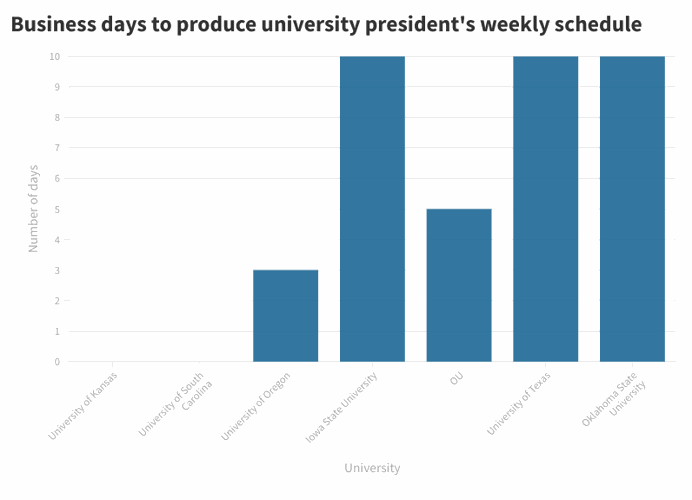
OU performed well against other universities in producing Harroz's weekly schedule. The University of Kansas declined to produce its chancellor's schedule, citing privacy exemptions in state statute, while South Carolina's president was on personal leave during the requested time frames. Other universities listed never produced records by time of publication.
In roughly three years of work at the O’Colly, Becker said the only lengthy outstanding request he has encountered is a still-unfulfilled request filed six months ago.
In Norman, OU has previously cited numerous reasons for delays in records request responses. A Sept. 8, 2020, response to a follow-up on a request submitted July 25, 2020, for a month of emails between two OU employees noted the open records office is “small … with a large volume of requests.”
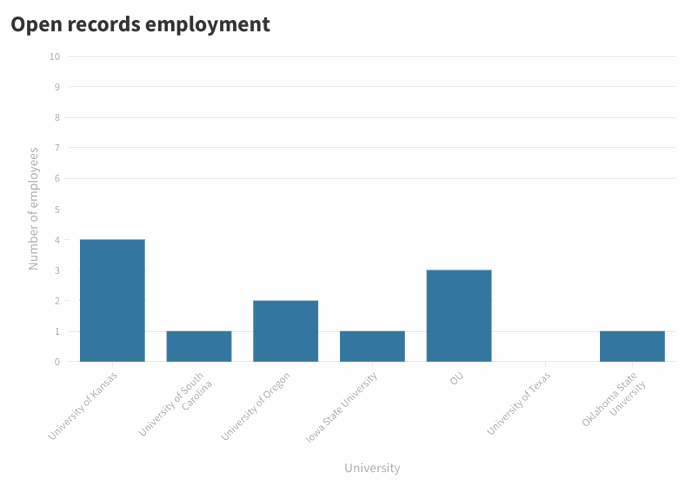
The office is made up of an executive director, a coordinator and one assistant, according to a university spokesperson. The coordinator position is vacant and being hired for.
“Currently, the office has a part-time position helping with some of the administrative functions. The Office of Legal Counsel also provides Open Records with access to additional legal resources and an outside vendor for legal review as needed,” the spokesperson wrote in an email to The Daily. “The office will also soon implement a new records management system.”
In a statement to News9, OU wrote the number of requests has risen from 708 in 2011 to 1,737 in 2020. Harroz acknowledged the office and its resources have not grown in accordance with increased demand for documents over the past decade.
“It’s something that needs to be improved. We’ve restructured it — it had been put under public affairs, it needs to be under the general counsel’s office,” Harroz told The Daily on Sept. 9. “The reality is the number of requests has grown, and we have to expand the number of positions. I think we were too slow to add more positions.”
The university wrote it is continuing to invest in the open records office in a Nov. 2 email to The Daily. Nearly 400 requests had been filled since a new open records coordinator was hired in September, the university wrote, and "additional legal resources" are now available to the office through the OU Office of Legal Counsel.
Other universities have found alternative ways to mitigate the strain on their open records offices. The University of Oregon, another flagship university with roughly 9,000 fewer students by total enrollment than OU, employs two public records office employees. It maintains an online database of frequently requested documents including university financial reports, athletics contracts and the public records office’s procedures.

OU's open records office is staffed similarly to other universities. Of those listed, only OU, Oregon, the University of Texas and the University of Kansas have dedicated open records offices. The other universities listed have single employees dedicated to coordinating FOIA requests with the departments that are in possession of relevant records for each request. These positions are typically public affairs officers or general counsel employees. The University of Texas did not respond to requests for this information.
At Iowa State University — in a state where the sunshine law stipulates a period in which agencies must respond to requests but not a deadline to produce records — the situation echoes Oklahoma State. When the Iowa State Daily, the student media outlet at ISU, submitted an open records request Sept. 2 of this year for communications between the provost’s office and university staff regarding COVID-19 policies, the university declined to fulfill the request.
“They'd come back pretty quickly and said that it was too broad and that it would cost thousands of dollars to fulfill it, so they're going to just deny it,” said Kylee Haueter, editor-in-chief of the Iowa State Daily. “We've never really had (an) instance of (that) before. We've had them come back and say, ‘Oh, this will be thousands of dollars to fulfill, but you can still do it if you want.’ We've never had them just straight out deny it like that.”
Haueter’s frustration with that request, however, was due to the unusually roundabout response and not solely the time taken to respond.
“This is the only one really that we've had issues with them taking up the maximum time. In the past, my editorial adviser had told me and I know, in my experience with getting police reports, they've usually been pretty quick about that,” Haueter said. “Obviously, it does depend on the scope of the requests, but if it is just like a report, a document or something, usually that's within a week maximum.”
While OSU operates under the same statute as OU, like Iowa State, it does not maintain a dedicated open records office or staff. All records requests are routed through OSU Brand Management to the department that would possess the relevant documents, OSU Public Information Officer Shannon Rigsby wrote in an email to The Daily
The process at Oklahoma State was under review as early as last year, however.
“We began an intense review of our open records process in 2020. I am very excited to say that our IT department has created a custom, online solution,” Rigsby wrote. “It will launch … in October. It will allow many requests to automatically go to the correct department for filling, should streamline the process and make tracking everything much easier.”
A similar review was conducted at the University of South Carolina following Heindel’s lawsuit, which also resulted in new software being purchased to coordinate open records requests.
“(Following the lawsuit) we made a few changes, but most significant was hiring a full-time FOIA coordinator who works with various campus offices,” Jeff Stensland, USC assistant vice president of media and external engagement, wrote in an email to The Daily. “We also are in the process of procuring new software that will help us process requests more efficiently.

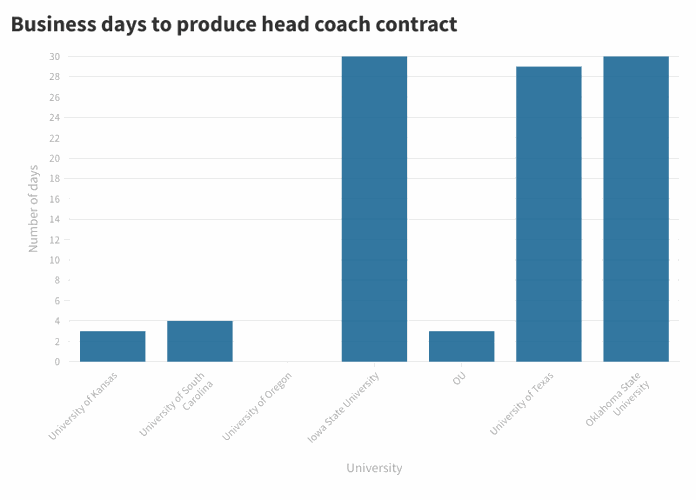
OU performed on par with other universities in producing the contract for the football team's head coach. Iowa State University and Oklahoma State University did not produce the record by time of publication. The University of Oregon's value of 0 represents the contract being readily available online.
Heindel said the university’s promptness and communication following the lawsuit was visibly improved. He submitted a records request on April 5 at 6:04 a.m., roughly two years after the lawsuit was dropped, according to an email chain provided to The Daily. The request was for all emails sent from a University of South Carolina employee to any email addresses ending in @scspa.com from Jan. 1, 2018 through March 31, 2021.
The request had been forwarded by another employee to the university’s FOIA coordinator, Shannon Beaudry, at 9:42 a.m. April 5. On April 13, Beaudry responded, informing Heindel some records within the request may be exempt under state law.
Without a second email from Heindel, Beaudry reached out on May 10 to inform Heindel the request was being processed and asked if he would be willing to give an additional five days to fulfill the request, making the new deadline under state law May 25. The request was fulfilled May 18.
“I think they realized (after the lawsuit) that they needed to put it up at the forefront,” Heindel said. “And you can see the timeliness after the lawsuit. … They know that more people are watching, and as a public university or a public agency, you don’t want to get the reputation of just stalling and not abiding by the FOIA law. That’s not the kind of reputation you want when you’re asking for (public) money every year.”
‘They’re working for us’
On Sept. 24, three days after The Daily published a Twitter thread of long-time unfulfilled open records requests, current and former staffers began receiving emails from Ferris Barger, OU director of records management. Former OU Daily editors-in-chief Nick Hazelrigg and Jordan Miller, who graduated in spring 2019 and spring 2020, respectively, were among those who received follow-ups for long-standing requests.
Since receiving these emails, several of the requests listed in the Twitter thread have been fulfilled, including requests for contracts between Course Crafters and OU, and a month of communications between Dean Mary Margaret Holt and former Director of the American Organ Institute John Schwandt.
Others have since been followed up on. On Sept. 24, The Daily confirmed it was still interested in responsive records for a request Miller submitted on Sept. 10, 2020, after receiving an email from Barger. On Oct. 15, Barger contacted The Daily to communicate the documents had been produced and were being reviewed for release.
OU has also fulfilled one of the two outstanding requests from News9, Jones confirmed in a text message, but another — originally submitted on Aug. 20, 2019 — remains unfulfilled.
During his Sept. 9 visit with media law students, Harroz told OU Daily editor-in-chief and author of this story Blake Douglas his office would be willing to look into specific requests that were outstanding for extensive periods.
“If you see a time frame that you don’t think is right or reasonable … send me a note,” Harroz said. “I’ll look into specific requests and see if we can’t move them along because it shouldn’t take that long.”
Of the five records that were brought to Harroz’s attention in a Sept. 17 email, three have been fulfilled. One has been acknowledged as in progress by Barger, while one — security recordings from Headington Hall from April 15-16 — has not been acknowledged since the email.
In an Oct. 18 email to The Daily, an OU spokesperson confirmed the Office of Open Records’ coordinator position is “in the finalist stage” of its hiring search. A new open records management system is also “tentatively scheduled” to launch on Jan. 1, 2022.
“The current system mimics a paper based system and utilizes a variety of different programs including Outlook, Excel, and Adobe. The new system will streamline processes by moving all functions to a single, digital platform,” the spokesperson wrote. “Through the new system, the Office of Open Records will receive receipts for records, be able to assign departments, and redact information in one tool. The new system will also act as the log for record requests and make interfacing with third-party vendors easier.”
On Oct. 21, Barger sent an email to OU Student Media Director Nick Jungman to reestablish "presentations/QA" sessions between the OU open records office and OU Daily staff, which had previously been held regularly but fell out of practice around 2017 or 2018, according to the email.
The continued evolution of open records offices nationwide and continued accountability from state agencies is among the most important parts of a functioning democracy, Heindel said, reflecting much of Harroz’s sentiment on the role of the press.
“They’re working for us,” Heindel said. “It’s our money that’s supporting their activities. They should want to be, ultimately I think, responsive and accountable to the people.”


