
Every morning, Mehrnoush Nourbakhsh rolls over in bed, picks up her phone and scrolls through Instagram and other social media, anxiously gathering news about her home in Iran.
Though this is not a new routine, Nourbakhsh said each day she is filled with overwhelming stress about the protests that are taking place back home.
“Especially when the protests started happening and then all other news that came up — it’s not just studying, literally, all my life kind of stopped,” Nourbakhsh said. “I wasn't motivated. I just do the minimum to survive.”
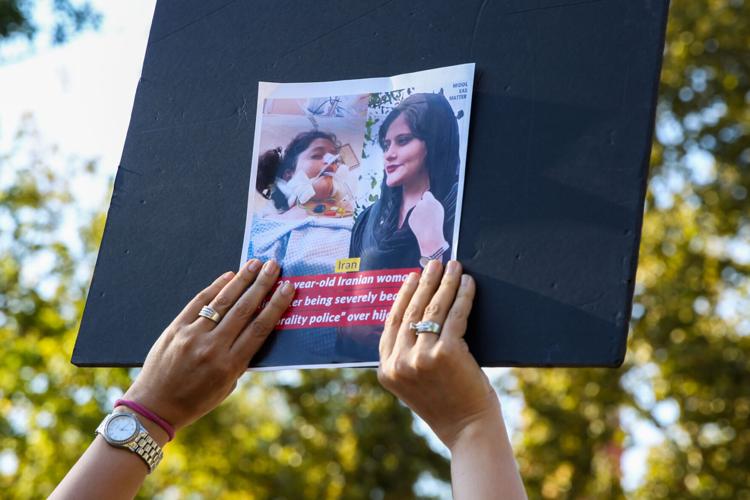
The catalyst occurred Sept. 16, when 22-year-old Mahsa Amini died in police custody after she was detained for allegedly violating the country’s hijab laws, which require women to wear the garment in public. The morality police said Amini went into heart failure, though, in an interview with BBC, Amini’s father claimed she was not in bad health. He also said the family was not allowed to view her autopsy report and witnesses told them she was beaten by police.
As protests across Iran have continued, Iran's Revolutionary Court issued the first death sentence to a person arrested for taking part in the demonstrations, according to BBC News. According to the Human Rights Activists News Agency, 341 protesters have died and 15,820 have been detained. The agency has also reported the deaths of 39 security personnel.
Since Amini’s death, mass protests have begun in multiple countries, including Iran, the United States and on OU’s campus. Nourbakhsh, since hearing about the situation, has taken a large role in speaking out about the protests to support women and families in Iran, 7,134 miles away.
Nourbakhsh, an OU neuroscience doctoral candidate and activist for women and minority groups, has lived outside of Iran for over 12 years in both France and the U.S. But having lived in Iran for most of her life, Nourbakhsh said her heart goes out to the women back home.
“Compared to 2010, the time that I left Iran, this situation has become worse and worse every single year,” Nourbakhsh said. “It’s really hard to see that even if the women in Iran are getting more and more educated and (there is) a high percentage (of women) educated in the universities (and) trying to be active in this society — at the same time, their rights are (growing) less and less.”

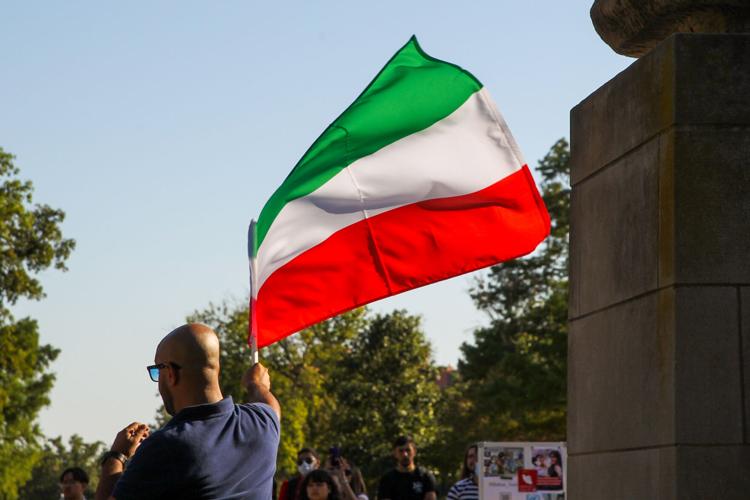
A demonstrator waves an Iranian flag during a protest against violence toward Iranian women in Norman on Sept. 22.
The protests in Iran sparked by Amini’s death are not the first demonstrations the country has seen in recent years. Nourbakhsh said when she was in her undergraduate years, she was present at a university in Iran when the Green Movement occurred in 2009.
In 2009, protesters accused leaders of election fraud, then challenged the system and the supreme leader Ali Khamenei, calling for more democratic rights. Nourbakhsh said students were directly affected when the university president allowed police on campus to shut down opposition of the election results.
“They attacked first the boys’ resident hall,” Nourbakhsh said. “I was out because I was also active in the university (during) my undergrad. I saw with my own eyes how they were beating people and how they, from the second floor, actually threw a student out of the building.”
Sara Asgari, an international Iranian student and economics doctoral candidate who came to OU in 2021, said the protests have a similar tone to those in 2009, while she was an undergraduate student.
“I feel kind of like guilty that I'm doing my normal life but the people (in Iran) are not,” Asgari said. “It’s not like they are different from us. No. It could have been any of us. It’s just like a normal university (where) people are going in and suddenly they start brutally killing them, beating them. It's like there's a high pressure that is on your chest.”
The feeling that more needs to be done is constant in Asgari and Nourbakhsh’s minds, although there have been a number of protests and rallies over the past month on OU’s campus and in Oklahoma City.
At OU, Iranian students feel the pressure and stress of the ongoing protests, said Carmen Lessani, president of the OU Iranian Student Association.
Though her immediate family is in the U.S., Lessani said when the news of Amini’s death reached her, she felt she had to constantly check her phone, which is affecting her and many other students’ ability to focus.
“Imagine if your immediate family is currently in Iran, so you're constantly thinking about them,” Lessani said. “Then there's the fact that the government has censored the people of Iran, so they cannot reach out to the international community for help. People are having trouble contacting their families because of this.”
Nourbakhsh said it has become incredibly difficult to focus on her studies. For the past month, she has not worked on her research and instead has focused on spreading news about the protests.
“Every single thing that happened in the 12 years I've been out of Iran, I totally feel it in my heart,” Nourbakhsh said. “It is even more than sympathy for me. It's like (I’m) there. … I’m trying too hard to keep up but sometimes it’s not possible.”
At the same time, Nourbakhsh is proud of the people in Iran who have educated themselves on their rights and are fighting for them.
“What is happening right now is lead by women (of) any age,” Nourbakhsh said. “You can see them, (even those) 7 years old. They are in the streets. They are chanting. I was like, ‘Oh my god, their braveness is incredible.’ So, it is both heartwarming and heartbreaking at the same time.”

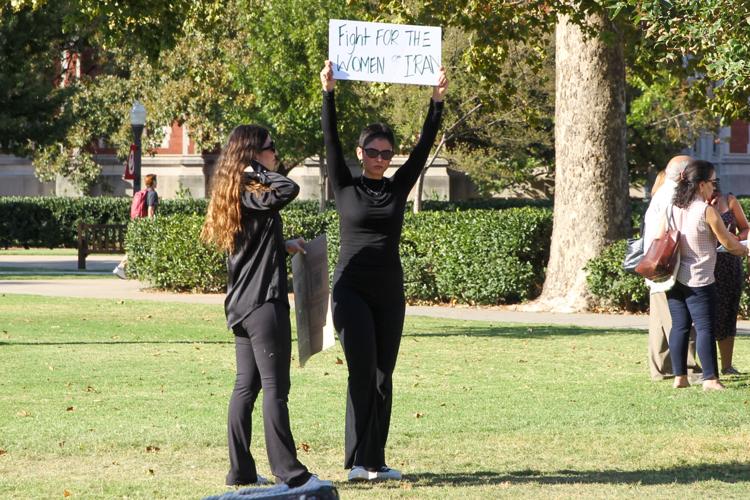
Demonstrators during a protest against violence toward Iranian women in Norman on Sept. 22.
Roksana Alavi, an OU associate professor of integrative studies, said although Iran has seen a number of protests over its long history, this one is different in how people, especially younger generations, have united over it.
Since the death of Amini, workers in the oil and gas industry have joined the strike against the Iranian regime. With Iran being the world’s third-highest producer of natural gas, Alavi said the strike has drawn a lot of attention to the movement.
“There's a lot of stuff that we've never seen in this magnitude, and people are determined,” Alavi said. “No more compromises. We tried compromising. At least they feel like they've done what they could do to make compromises, and it’s not changing.”
Alavi came to the U.S. with her parents in 1988. Family brought her to Oklahoma, where she attended OU and received a bachelor’s degree in philosophy.
Though she was young when she left Iran, Alavi said she remembers the Iranian Revolution, in which protesters overthrew a monarchy and established the Islamic Republic. Like Nourbakhsh felt during the Green Movement, Alavi said today’s protests, though concerning, give her hope for a brighter future in Iran.
“It’s really emotional for those of us who went through the 1979 revolution and watching a lot of people dying, living under curfews and then living through all these years of war,” Alavi said. “It is really difficult to watch the country go through that all over again.”
Lessani said many people and students have come to the U.S. from Iran to escape its oppressive government. As of 2021, there were 52 international Iranian students at OU. In the U.S., there were 363,090 people of Iranian descent, as of 2020.
Since the protests started, Lessani said many OU international students have lost economic support from home. Having the ability to travel home is also a concern, especially if an international student has posted something protesting the actions of the Iranian regime.
“It's exceedingly important that they have a community here, just because they can't get that back home,” Lessani said. “They're already leaving the most familiar place to come pursue an education in a country that they don't really know at first. That's why it's important to support the Iranian community.”
Despite the distance, Nourbakhsh said there are plenty of ways the OU community can get involved.
Though it can be dangerous for international Iranian students to speak about the protests in Iran in fear of government reprisal of their families, Nourbakhsh encouraged those with no ties to the country to do so. Additionally, she said to reach out to federal offices in each state and lobby for their aid in accelerating action in the international community.
Alavi, Asgari, Nourbakhsh and Lessani said the biggest thing that can be done for the Iranian student community on a university level is a statement from OU’s president about the current situation.
“When I didn't see any statement officially coming out of any office, it was disappointing,” Nourbakhsh said. “I sent an email to the office of the president, vice president (and all) administrative offices that I knew at the university. We still don't see any official statement from (OU’s) president. We had that for Black Lives Matter. We had that for Ukraine. And so, I'm asking why we don't have it for Iran.”
Although no statement has been issued by OU’s president, David Surratt, vice president of student affairs; Belinda Higgs Hyppolite, vice president of diversity, equity and inclusion; and Scott Fritzen, associate provost for global engagement and dean of the David L. Boren College of International Studies, issued a recent message of care to OU’s Iranian students on Oct. 14, according to a university spokesperson.
According to the spokesperson, the statement is not posted online, as it was sent directly to a targeted audience. OU Daily submitted an open records request to receive a copy.
“The statement acknowledged the news in Iran and that it may be impacting students’ family and friends in Iran,” the spokesperson wrote. “Students were urged to reach out to Student Affairs, the Division of DEI, or the College of International Studies if they are experiencing hardships. Students were also reminded that the University Counseling Center is available to provide support.”
The OU Faculty Senate passed a resolution issuing a statement in support of OU's Iranian students Tuesday. OU’s University Counseling Center has recognized the impact events in Iran have on students and posted a statement on Instagram about crisis counseling services. Sheena Mehta, a psychologist at the University Counseling Center, said she also facilitates a group for international students to meet and talk about their stresses called International Student Listening Space.
“For a lot of our Iranian students, they are experiencing a significant amount of stress, probably anxiety and fear for loved ones who are back home and fear about the future,” Mehta said. “That has an impact on their functioning. Whether that's impacting their social functioning (or) impacting their academic functioning, it really does have a huge impact on these individuals.”
Mehta said the International Student Listening Space meets on the first Friday of each month from 3-4 p.m. via Zoom.
Though the situation is scary for those with connections to Iran, Alavi said she can hardly contain her pride for the actions the youth have taken for their rights and their country.
“Every time I see one of the faces of these kids who are out in the street, or being beaten up or getting killed ... it's really heart-wrenching to see,” Alavi said. “God forbid, this could be my daughter. This could be me. But (Generation) Z is unstoppable in Iran right now, and I am so incredibly proud of them.”
Hannah France, KGOU reporter and producer, helped with the reporting of this article.


