
Editor's note: This story was edited at 8:02 p.m. on Feb. 24 to remove incorrect information relating to OU's Norman campus' financial situation.
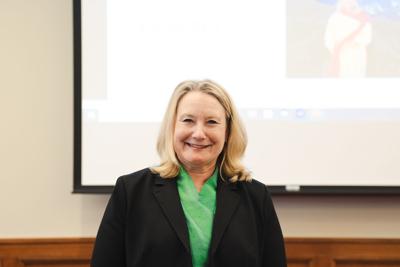
Lisa Pawloski, the first of five candidates who will interview for the Dodge Family College of Arts and Sciences dean position presented her vision for the college during a public forum with students, faculty and staff on Monday.
Pawloski currently serves as the senior associate dean for international programming, finance and administration at the University of Alabama’s College of Arts and Sciences.
Pawloski spoke about OU’s strength as a tier 1 research institution that invests in arts and sciences. She said teaching is highly valued at OU and faculty are well trained.
In order to address issues within the College of Arts and Sciences, Pawloski said she needs to first speak to faculty, students and staff by conducting what she called a “listening tour” in which she could hear what suggestions and improvements the community has.
She said, if given the position, she would meet with as many stakeholders as possible to explore what changes need to be made and what she can do to elevate the college.
“A lot of this is the idea of collaboration and identifying who are those individuals that could give input,” Pawloski said. “Who are those stakeholders and involving them.”
With over 13 years of administrative work and a career in research, Pawloski said she understands the many disciplines represented in the college and wants to immerse herself in the culture of OU.
Before her role as senior associate dean, Pawloski served as founding chair of the departments of nutrition and food studies and global and community health at George Mason University. She also served as dean of academic affairs at the George Mason University Korea campus in Incheon, South Korea.
Short term, long term goals
Pawloski said she wants to guarantee students gain knowledge and skills that are highly demanded in careers and graduate programs, including cultivating communication and language skills in students.
Pawloski said language has played a big role in her research and it is critical for students to learn other languages. She said in her time conducting research in other countries, learning languages has taught her more about culture than just words and said it helped her gain new perspectives.
“Language, it’s been a big part of my life. I think it’s critical. I would love to see every student in the U.S. learn another language,” Pawloski said. “I think you learn about culture and each other from language.

OU Provost’s Office requested in November an evaluation of the College of Arts and Sciences foreign language requirements, raising concerns from the OU community that the undergraduate language requirement would be removed.
Pawloski said in her time at the University of Alabama, she’s seen the university cut language in general education programming, but it was able to provide language education in other areas. She said she hopes OU can do the same.
“With these ideas of pivoting and trying to understand, I think it’s important to think about those other possibilities,” Pawloski said. “I think you’ve got to keep that integrity of programming in languages and understanding all of those voices.”
She said she wants to push the university to continue to grow as a research institution, which she said includes becoming a member of the Association of American Universities.
“I’ve heard again and again the idea of AAU membership, and there’s got to be ways to ramp that up and think about that as a stretch goal,” Pawloski said.
The Association of American Universities is an invitation-only organization of America’s leading research universities credited for life changing education, research and innovation. Member universities earn the majority of federal funding for research that improves public health, seeks to address national challenges and contributes to the education and training of younger generations.
A part of the “Lead On, University” strategic plan is for OU to become an institution recognized by the Association of American Universities.
If given the position, Pawloski wants to prioritize research and creative activities that positively impact the local community, Oklahoma and the global community. Citing her experience in international research, she said she has seen how research in one continent can impact another and hopes she can show students that impact too.
“It’s important to keep that global engagement in mind and see how that might help the local community,” Pawloski said.
Pawloski also emphasized the importance of transparency within the college. She said her goal is to develop plans and actions that best fit the needs of students, faculty and staff and she hopes to create a culture where constant communication and feedback is encouraged.
“We’re trying to do the best that we can for the institution, for the organization, and so it requires constant communication,” Pawloski said.
Pawloski said she wants to involve alumni, parents and the local community in research so the community understands the nature of each new initiative. She said in her current role she has helped break barriers within the local community.
“We started a speaker series so the community could learn about research that was relevant to them,” Pawloski said. “That was the key, and to sort of break some of those barriers. It’s important for parents to hear the kinds of research that we’re doing, that the students are doing.”
Pawloski said she loves OU’s close relationship with the community and state legislatures and wants to continue that trajectory if she becomes dean.
“I see great strength in terms of things being built, faculty are being hired, that’s very positive and I think important for moving forward,” Pawloski said. “I would want to go someplace where there is investment, and I’m seeing those things.”
Pawloski said she is also passionate about creating new partnerships and nurturing existing ones. She also wants to implement a support system for faculty regarding publications, books, creative activities and external funding.
Pawloski said she understands financial obstacles and wants to create a support system for faculty when unexpected challenges arise.
“Things like subvention grants, seed grants, professional development activities can be helpful in terms of supporting faculty who need to pivot,” Pawloski said.
Overcoming unexpected challenges
Pawloski said she knows colleges are anticipating growing challenges such as higher enrollment, fewer federal funding opportunities, artificial intelligence, addressing politically charged topics and preparing for a new pool of researchers from the federal government.
Pawloski spoke of times she had to overcome unexpected challenges in her career including a recent research project funded by the U.S. Embassy in Greece to explore environmental challenges specifically related to water. The research team began flushing out calls asking for anyone interested in discussing climate change.
“The call went out and asked for people who wanted to talk about climate change,” Pawloski said. “Two weeks ago, I received a letter saying, ‘you can’t talk about climate change’ … we know climate change is an issue, but we have to pivot a little bit.”
While she is still able to conduct her research about water-related natural disasters, Pawloski said scenarios like this happen frequently and issues like climate change still need to be addressed.
Pawloski said her experience with international research, working around regulations and rules in other countries, has given her the right tools to adjust when needed. She said this expertise would be instrumental to her success as dean.
“I have practiced continually being prepared for challenges,” Pawloski said. “It’s important to expect the unexpected. We’ve got to continue to do our research and read what’s happening … we have to continually be informed to be prepared.”
This story was edited by Anusha Fathepure, Ismael Lele and Ana Barboza.


