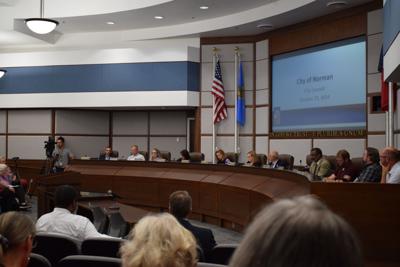

Norman City Council discussed potential solar projects for the Young Family Athletic Center and city’s line maintenance building, and the fiscal year-end 2026 Capital Improvements Program budget at its special meeting on Tuesday.
FYE 2026 Capital Improvements Program budget
The news: Council discussed the fiscal year 2026 capital improvements program budget presented by budget technician Jacob Huckabaa.
The capital improvements program budget funds long-term capital improvements projects and includes a series of funding mechanisms, such as the public safety sales tax fund, special grants fund, room tax fund, the Norman Forward sales tax fund and the University North Park tax increment finance district fund.
Guidelines listed in the presentation note capital sales tax revenue allocations: 36% is for other projects and debt service, 27% is for capital outlay, 20% is for street maintenance, 7% is for maintenance of existing facilities, 5% is for information technology, and 5% is for general contingency.
The presentation projects $17.8 million in capital sales tax revenue and lists $35.5 million in capital sales tax requests. The presentation adds $11 million is requested from general obligation bond programs and $751,000 is requested for remaining Norman Forward projects.
Overall, the capital improvements program fund proposed for recurring projects in fiscal year 2026 is listed at $15.5 million, including $2.9 million for street maintenance, $1.2 million for maintenance of existing facilities and $4.8 million for capital outlay.
According to a 2019 transportation bond timeline listed on the presentation, 11 projects are under construction and expected to be complete by 2027. The presentation notes the original schedule included 13 projects.
The presentation notes the 10-year $50 million Bridge Maintenance Bond program, which plans to replace and rehabilitate up-to 18 bridges in Norman, began initial construction last summer.
City Manager Darrel Pyle said the city intends to complete nine bridge projects by 2030, completing between two to three projects per year.
“They'll bite off two or three a year so we don't have too many traffic messes. We don't have too many contracts underway for this kind of work,” Pyle said. “We'll just be bringing them to you, prioritized based on the sense of urgency of each of those bridges in the program.”
The presentation adds the 60th Avenue NE replacement is under construction, while three projects are in a bid preparation phase – Lindsey Street rehabilitation, east Post Oak replacement and Main Street rehabilitation – and three others are in design phases – Franklin Road replacement, 24th Avenue Southwest rehabilitation and north Porter Avenue replacement.
According to the presentation, the Absentee Shawnee Tribe partnership awarded a $13.8 million construction grant for the north Porter Avenue replacement.
The actual cost for the 2012 Transportation and Stormwater Bond Program is listed at $85.4 million while $89.5 million is allocated to the bond budget. Every project from the bond program is completed except for the Tecumseh Road to Indian Hills Road project, which does not include an actual cost due to pending federal transportation grant funding, according to the presentation.
According to the presentation, an estimated -$9.2 million is available for projects in the Capital Pay-As-Go fund in FYE 2026, while -$5.5 million is projected for FYE 2027 and -$989,000 is available in FYE 2028. Huckabaa said the number is projected to increase over the three year period as revenue increases.
“That's something to really keep in mind as we go through and evaluate some of these projects, requests and possibly even the recurring project requests as well,” Huckabaa said. “As you can see in ‘27 and ‘28 as well, we're going to be negative.”
The capital projects fund includes $500,000 for recurring sidewalk projects in FYE 2026, the presentation adds.
The presentation also lists project requests from the public works, police, information technology, fire, and parks and recreation departments.
Upcoming challenges and impacts for the budget listed include the status of the capital fund, the University North Park entertainment district, the ACCESS Oklahoma turnpike plans in Norman, the Norman Public Library Central remediation and repairs, the AIM Norman master plan, the Griffin property project, “failing” stormwater infrastructure and police fleet vehicle replacements.
Council is scheduled to review the final proposed FYE 2026 capital improvements budget on May 6.
Young Family Athletic Center and line maintenance building solar projects
The news: Council heard a presentation for potential solar projects at the Young Family Athletic Center and the city’s line maintenance building presented by Tony Capucille, CEO of EightTwenty, a solar energy company from Oklahoma City.
Capucille presented a potential 592.8-kilowatt solar photovoltaic system at the YFAC, which would include 1,140 solar panels.
“The great thing about this is it's a ballast system. It's going to sit on the roof,” Capucille said. “It actually creates a thin layer of armor over the roof … These are actually more durable than most TPO or PVC systems that are rated for hail.”
Capucille said EightTwenty tried to create a concept that maximized financial benefit to the city, adding energy costs would be lowered. He said the city would not have to pay for maintenance or insurance, which would be the responsibilities of investors.
The system would create an annual production of 889,407 kilowatt-hours, offset 47% of the facility’s energy cost while offsetting $1.6 million, and reduce carbon emissions by 694 tons, according to the presentation.
“This project will reduce annual operating expenses, allowing Young Family Athletic Center to better allocate needed resources toward their long-term mission and the community they serve,” the presentation reads.
Capucille also proposed an 88-kilowatt solar photovoltaic system at the line maintenance building. According to the presentation, the system would include 176 solar panels, create an annual production of 121,136 kilowatt-hours and reduce carbon emissions by 95 tons. It would offset 81% of the building’s energy at $291,683, the presentation reads.
What they’re saying: Parks and Recreation Director Jason Olsen said solar energy was originally planned for the YFAC but was scrapped because construction costs “went crazy.” He also said EightTwenty is the city’s partner in its solar initiative.
“We think these both fit very nicely because they're both newer buildings,” Olsen said. “We have a lot of roof space out at Young Family Athletic Center, and of course, our utilities department is always trying to stay as green as possible.”
Ward 8 Councilmember Scott Dixon said he supports the solar energy proposals.
“As an oil and gas guy, I absolutely love solar. This is fantastic,” Dixon said. “Hopefully we can get it done.”
This story was edited by Ismael Lele and Ana Barboza.


