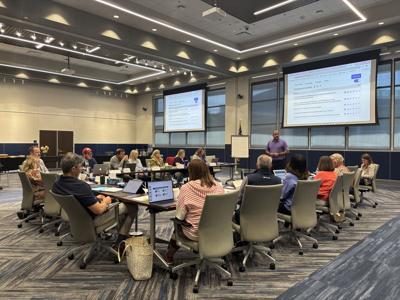


The Norman Public Schools Board of Education addressed a new cell phone policy, reviewed its school counseling plan and discussed its strategic plan at a nearly 10-hour special meeting Thursday.
Norman high schools' program study
Robert Thornell and Carri Eddy, executive consultants from TransCend4, a school district consulting firm that provides guidance and support in various areas, presented findings from a program study created to compare resources for both Norman High School and Norman North High School to ensure equity between the schools
“The question came up back in the fall … how do we make sure that our kids at both schools are receiving the same opportunities, getting the same high quality education regardless of what campus they were on,” Thornell said. “Answer is yes, they are (equal).”
According to the presentation, both high schools showed strong academic performance, surpassing the state average in academic achievement.
Eddy said both high schools excel in most academic areas, but data reports show English Language Learners, students who are learning English, are performing below state average at both high school campuses; minority student groups such as Hispanic and African-American students score below campus averages academically; and demographic representation in advanced academic courses do not mirror campus demographics.
“Both of the high schools did fall behind some of the comparable schools in four-year graduation rate, and then again, you see the English language learner proficiency,” Eddy said. “And then Norman High did fall below the other schools in chronic absenteeism, and we know if kids aren't in school, they're not going to learn.”
After conducting interviews with teachers at both schools, Thornell noticed a strong willingness to progress and improvement among teachers and said each interviewee was proud to be a part of the district.
“Your teachers and your educators are very proud of their schools here in Norman,” Thornell said. “They want to be here. They want to make a difference for their students, and they just had nothing but great things to say. Sometimes that can become a vent session. It didn't. It really didn't.”
Thornell said several teachers had the perception of an imbalance in resources between the two high schools, but he found no discrepancies between the two. He said he saw no inequity in resources or staffing, only small differences in student demographics.
“One thing that came up in the interviews was this perception that, ‘Hey, maybe one school has something that the other school doesn't,’” Thornell said. “I use the word perception because we didn't find that to be true.”
Thornell and Eddy recommended the board consider developing documents showing where all staff is used, courses offered at both schools and a universal grading policy. The pair also recommended the district evaluate its curriculum implementation, ensuring it is followed by all NPS teachers while allowing for personal autonomy in the classroom, and find specific areas for professional learning for staff, addressing how the district can help its staff improve.
Eddy said the goal of the study was to ensure both high schools are providing equal opportunity to all students, which they found to be true in most areas.
“One of our recommendations is looking to make sure that all of those sub-pops are being served based on what their needs are, and that changes, as we know, from year to year,” Eddy said. “What are the needs on the campus, how are they currently being served and using all the data that you have to inform that decision.”
Cell phone policy
On Wednesday, the Oklahoma legislature passed Senate Bill 139, which bans personal electronic devices in public schools from bell-to-bell, meaning from the start of the school day to the final bell at the end of the day. The bill requires each school district adopt a policy complying with the bill for the 2025-26 academic year.
Stephanie Williams, NPS director of student services, said the district began to work on its cell phone policy in January, and it is on its way to bringing a policy to the board. Williams said the district is taking a three-pronged approach using policy, education and enforcement to develop well-communicated expectations focusing on teaching students why personal devices can hinder their learning and enforcing the ban across all classrooms.
“We've had a lot of that conversation about, no, you can't have (cell phones), but not enough about why and connecting it,” Williams said. “We know that education has to be at the forefront of our conversations, and then enforcement. We can have the best policy on paper, but we know that that means nothing if we don't have a good plan to enforce it.”
Office 1 Board member Dirk O’Hara said educating students and parents on the harm of smartphones is vital to the enforcement of the policy, stating students will find a way around the ban if they do not understand why access to personal devices is restricted.
“That education piece, to me, is the key to this,” O’Hara said. “There’s not one study out there that shows that (smartphones) and helping kids brains … from the likes to the clicks, endorphins, addictions, we need a good education program of why elementary school kids don’t need a smartphone at all.”
Williams said the district has heard feedback in January beginning with principals at each school followed by conversations with teachers, parents and students. In April, a survey was sent to secondary students, parents and teachers of all ages. According to data shown during the meeting, there were 6,857 responses to the survey, a majority being parents and students.
According to survey data, 94% of staff respondents said cell phones are a major distraction to students and are in support of removing them from classrooms. Out of the respondents, 55% of elementary, 61% of middle school and 48% of high school staff respondents said they would prefer no cell phones from bell-to-bell, and 46% of all staff believe students should be allowed to have personal devices during passing periods, lunch and recess.
Additionally, 82% of parent respondents said cell phones are a significant disruption, but 88% believe students should be allowed to use phones during an emergency and 66% said students should be allowed to use devices during passing periods, lunch and recess.
“The common ground certainly is (cell phones) are a distraction, and they're a disruption to the learning environment. We see that on this survey, parents for all levels, would support a policy,” Williams said. “ Our feedback from our students, as I said, showed strong support for lunch and recess and passing.”
Williams said current practices in elementary, middle and high school are tiered based on age, with elementary aged students having the most restricted access to personal devices and high school students being allowed to use cell phones during passing and lunch periods.
Williams said in conversations with parents, teachers and students, most are in favor of restricting access during class periods, but allowing phone use during passing periods and lunch. Others, particularly parents and students, felt strongly about having cell phones available in case of emergencies.
“There was a lot of conversations around feeling like it needed to be developmentally appropriate and tiered,” Williams said. “We have a significant number of students, parents and staff just stress the importance of phones being available for emergencies.”
Office 3 Board member Annette Price said there needs to be a policy for parents trying to reach students during the school day. Price said she has struggled to get in contact with her daughter at school in time sensitive scenarios and believes the district’s cell phone policy should allow students to check for communication.
“If you’re going to take away this vital form of communication from kids, you need to make sure there are supports in the school building to make sure that parents can get involved with their kids,” Price said. “(Parents) want them to have cell phones in certain situations, so I think that we need to.”
Office 4 Board member Dawn Brockman said in her experience as a teacher, personal devices including cell phones and earbuds are a major distraction, and teachers spend a significant amount of class time asking students to remove them.
“From being in the classroom, it is absolutely a distraction. The amount of time you have to spend saying ‘can you take those earphones out?’ It’s not a small amount of time,” Brockman said. “I made it through the eighties in high school with my parents calling up to the school and getting information to me, it is possible to go back to that.”
NPS Superintendent Nick Migliorino said a draft of the policy will be seen at the next NPS board meeting and additional drafts will be brought to the board as the district develops the policy.
Strategic Plan
The board discussed updates and changes to its strategic plan, a five-year plan spanning from 2022 to 2027 around six categories of goals set by the district.
Teaching and learning
Gayla Mears, NPS executive director of support services, said high school graduation requirements changed to require career pathways rather than fine arts or world literature. Because of this, she believes the district should start introducing these courses before high school.
“As we get into some of those changes, we’re going to have to really frontload much earlier and get earlier exposure to that, which we have already started,” Mears said.
O’Hara said Individual Career and Academic Plans, a statewide, multi-year program that helps students explore career, academic and post-secondary opportunities, doesn’t need to be a formal program. Instead, he suggested elementary schools should have a career day or a week that every kid would fill out.
“That way, by the time they’re out of fifth grade, they’re ready for us to tee it up in middle school because you’re determining your academic path (in sixth grade),” O’Hara said. “If we’re waiting till sixth or seventh or eighth grade, or tee them up in high school, we’re already behind.”
Office 2 Board member Alex Ruggiers said he knows the legislature is pushing for public schools to implement ICAP and believes the district should be doing so, but doesn’t think it should be as early as elementary school.
Ruggiers said the best kind of education is the one that inspires love of learning and gives students the skills they need to figure it out as they go.
“There's something to be said for encouraging education, for the sake of learning, for the sake of self improvement and for the sake of owning your mind, rather than thinking about how it's going to be much in the future,” Ruggiers said.
Office 5 Board member Tori Collier asked the board if it was a requirement for high school students to have a meeting with their academic counselors to make sure they’re on track to graduate or to discuss any post-graduation plans.
Holly McKinney, NPS executive director of teaching and learning, said there weren't any requirements for a face-to-face meeting, but counselors do transcript audits to make sure students have exactly what they need to be able to graduate. Migliorino said that while planning these meetings wouldn’t be an overarching project, it could be a goal for the board.
O’Hara also suggested that all the elementary schools should have embedded art in the classroom. He suggested it may be a 20-year project, but he believes having art around the learning environment is good for the younger kids.
Williams said NPS has partnered with the Firehouse Art Center and Fred Jones Museum as the district comes up with ways to enhance art efforts.
“It helps in so many manners, …” O’Hara said. “It’s accessible, and any kid can do it at any level in any of our schools.”
Safety and security
Collier and Brockman pointed that the locked door program and the RAVE app have worked well. O’Hara also believes the district has done a great job with addressing mental health issues.
Price questioned the metal detectors and asked if there had been a formal assessment to determine whether they were necessary for those smaller events that have fewer visitors. Justin Milner, NPS associate superintendent and chief operations officer, said that while no formal assessment has been made, the reason for the metal detector implementation came from a shooting that occured at a high school football game.
“It’s one of those things that you know it’s no longer hypothetical. Now it’s a real situation, …” Milner said. “We continue to try to make sure that we are effectively in place.”
Collier suggested creating student-led support groups for students to voice their emotions and experiences with an adult working in an adviser capacity.
Ruggiers proposed to take off “add security personnel to every site” from the safety and security section of the NPS strategic plan. He said that if parents are saying they feel safe with the current school resource officers, the board could push more time and more effort into other security measures.
“I’m not trying to get anyone’s job eliminated, but I don’t think we need to keep moving toward every single site having a (student resource officer), …” Ruggiers said. “I don’t have a strong appetite for adding SROs, we’ve put money toward that, and that’s good, and then maybe we can put money to other things like counseling services.”
Brockman pointed out that if every site had an active SRO, that meant the board had accomplished the goal and it was fine to delete it.
O’Hara said he wanted to keep the item as a project because he wants the district to keep the number of SROs it currently has.
“If you take personnel and SROs off this here, a lot of principals and teachers are going to say ‘what the (hell),” O’Hara said.
The board approved deleting the item and amended another one to include the review and assignment of SROs in the district. The amended item now reads “continue safety and security audits across the district to include security personnel.”
Price also suggested adding another item to the section that would reflect on providing comprehensive counseling programs at all sites. Mears said she feels supported from the board and the most important part was to continue the district’s goal of supporting students.
“I feel 100% supported, and I know our counselors do along with our cabinet, …” Mears said. “I don’t need a project out there or in the strategic planning because I feel supported here.”
Culture and belonging
Price said she took notes of some of the teacher's concerns during a listening session in October, and said some people felt protected and others disposable, some didn’t feel valued, and others felt the district was “scared” of parents.
“Is this a perception that this is not really the way things are in the school? And even if it’s a perception, we need to get to the root of where it’s coming from,” Price said.
Price said that while the district sends a survey to teachers every year, the survey doesn’t ask how teachers feel about administration. Williams said she doesn’t want to see a division within the district and believes there’s always potential to improve.
“I will say, on a survey when we talk about whether or not staff feels heard or valued, our returning certified staff percentage was at 96%,” Williams said. “We’re going to have to find venues to dig a little deeper, because obviously people who aren’t in that percentage may have some different (opinions).”
Williams recommended to amend an item under the Culture of Belonging section of the strategic plan to “facilitate learning opportunities that empower connection and belong to all.” Collier also suggested creating non-traditional ways of community engagement for NPS families.
Maximizing the budget
Tyler Jones, NPS chief financial officer, presented updates on financial projects and goals stating the district is seeing the benefits of planning for the financial impact of COVID-19. According to Jones, NPS has not had to cut funding to any programs due to the district's preparation for the financial loss.
“We haven’t had to cut any of our programs, we’ve been able to sustain all the things that we were doing,” Jones said. “That’s just from really looking at our contracts and really utilizing our bond funds and giving those kinds of pennies just to ensure that we don’t have any interruptions.”
Jones said NPS’s Community Eligibility Provision program, a resource that provides additional free meals to students in need, has served 90,000 additional meals to meals in the past year. Currently, the program is available at ten sites, but Jones said the district will be able to expand the program to nine additional sites in the 2025 academic year.
“It looks like we’re going to be able to expand to nine additional sites,” Jones said. “That’s really the majority of our district.”
No revisions were made to strategic plan goals.
Recruiting and retaining a world-class workforce
During discussion over goals within the district, O’Hara said he wants to promote NPS’s teaching academy to identify students who are interested in teaching. O’Hara said he wants more Norman teachers to come from NPS and believes cultivating student’s passion for teaching can start as early as elementary school.
“We’ve got to continue to work on our teaching academy within the district, and I think that we’ve got to start very young, identifying kids and especially minority kids, that show an aptitude for being a teacher,” O’Hara said. “We should help develop that … We’ll always have that pipeline if we’re filling it ourselves.”
O’Hara said he wants to collaborate with Jeannine Rainbolt College of Education or other local education colleges to streamline the process of getting those students into the workforce. He said with so many students earning college credit in high school, he hopes students with teaching aspirations can start as teaching assistants right after graduating high school.
“I would cut deals with the education college somewhere, and I would say we are going to identify what these students need, and by their senior year in high school, they will be ready to go directly into the college of education,” O’Hara said. “Once they’re in (college), they’re a year and half in the college of education, a semester of teaching as a teaching assistant, and in two years they get a teaching certificate. At 20, they can start their career.”
Migliorino said the district has already begun conversations with state institutions and many are interested in participating in a program, but he said it will take time to develop.
“We have been in those conversations,” Migliorino said. “They have to get their regents to approve. There’s steps, but we do have a couple of university presidents that are interested.”
Milner said the associates degree program currently offered at NPS can help students complete general education courses and partnerships with universities can help launch students into a teaching career. He said the district needs to take time to create an environment where students can explore different career paths, including teaching.
“It does get the basics out of the way, which does allow them to just go into whatever they're studying. I think we have to back up a little bit and create the desire to go into what fields,” Milner said. “That’s where we need to spend the time, really creating that environment.”
Milner said he hopes these programs can help students avoid debt and enter the workforce sooner than if they had not gone through the program.
“Connecting them with the pathway as to how you can get there, finding ways to not create that debt as well,” Milner said.
Williams said NPS has a good relationship with OU, including many NPS students participating in OU’s ‘Find Your Future Summer Education Camp,’ a week-long summer camp that recruits high school students from underserved populations interested in becoming educators. Participants engage in various hands-on teaching experiences that allow them to explore the profession.
“We have had several of our students that have participated in (the camp), so we do have a pretty good partnership,” Williams said. “We’re always trying to follow and partner with them, but they will tell you they’re getting creative because they’re struggling to get the candidates.”
O’Hara said these partnerships can help mend the shortage in educators in Oklahoma and hopes career exploration programs can bring more qualified candidates to state institutions.
“If your demand is going down and down and down, partner with us, and we’ll give you students that will go directly into the college of education, and we can triple your demand,” O’Hara said.
No revisions were made to strategic plan goals.
Improving internal and external communication
Courtney Scott, NPS chief information officer, said she has seen improvements in transparency and two-way communication between the district and parents, but she is working on further promoting transparency. She said she is working on a policy to publish all supporting documents related to board meetings and wants to facilitate more listening sessions for community members to voice concerns and ask questions.
“We need to continue to develop transparency,” Scott said. “I have asked us to start working on a policy to allow all of the supporting board documents to be published on the website, just so people can dig through it if they want to, and they shouldn’t have to request something.”
Scott also said she wants to invite parents into conversations, recalling a parent she worked with previously who was persistent in communication with her. She said that parent’s suggestions were incredibly impactful to her and her work, and she hopes to develop those relationships in Norman.
“There was a lady who would always send me messages, and it was like, there’s this error, there’s this mistake, and at first it hurt my feelings … Then I was like, oh, she wants us to know so we can improve,” Scott said. “I want to get to a place where I know and understand Norman’s community to where I would be able to have those kinds of relationships with people.”
Collier said she experienced the impact of being invited into conversations with NPS leaders as an advocate for her son with learning differences.
“I am a product of being invited to the table, literally of having a child who had issues, I was communicating, communicating, communicating over the years,” Collier said. “I was just invited to the table or just participating in things. I think that just goes way beyond what you think, what the future of a parent could be.”
Collier said the district could implement a database system for parents interested in receiving more communication, information about listening sessions and opportunities to provide input. Scott said she agrees and wants to find additional ways for community members to join conversations.
“You have constructive feedback you can then turn around and use, and I think something that I would like to do better is have these mechanisms in place and we can receive different feedback,” Scott said. “Another thing I would start doing is recording any of those (listening sessions) that we’re having so if families can’t come, they can at least watch it back.”
O’Hara said he wants to implement a way to stay connected with NPS students after they graduate and he hopes to find a way to follow up with them years down the line.
“We’re producing a world-class product every year and we don’t have any way to connect, and it absolutely drives me crazy,” O’Hara said.
No revisions were made to strategic plan goals.
This story was edited by Anusha Fathepure and Ismael Lele.


