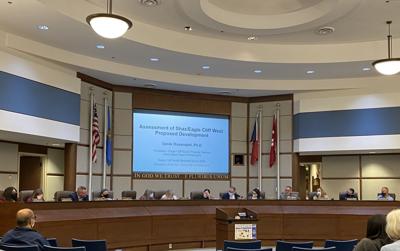

The Norman City Council voiced concerns about the effects of the planned ACCESS Oklahoma turnpike on residents’ longtime homes and the local economy, and discussed a new location for the city’s warming shelter during a Tuesday evening study session.
The Norman City Council has another study session where members will discuss turnpike plans scheduled for 5:30 p.m., March 29, which Oklahoma Turnpike Authority Deputy Director Joe Echelle will attend.
ACCESS Oklahoma turnpike in Norman
ACCESS Oklahoma, a $15 billion long-range state turnpike plan, aims to provide Oklahoma drivers alternative travel options, according to its website. Norman would be most affected by the South Extension Turnpike and the East-West Connector, according to the ACCESS Oklahoma website.
Norman Director of Public Works Shawn O'Leary said the ACCESS Oklahoma plan spans 15 years, but the two turnpike sections in Norman are a high priority, so they could be completed in less than 10 years.
Mayor Breea Clark said she learned of the proposed ACCESS Oklahoma routes days before the public did and has been concerned about its impact on Norman’s rural community. She asked why the OTA didn’t request constituent feedback before releasing its plans. She also said there’s been a lack of transparency in how the OTA settled on its final routes.
Clark told The Daily after the meeting that she’s frustrated voters weren’t able to voice their opinions on a development that will change the nature of east Norman.
“From our level of government, and apparently even our state delegation, we have no way to defend them,” Clark said. “It's like, as a parent, your kid going through something that they can only go through themselves. It's tough.”
During the meeting, O’Leary said he was similarly left in the dark on ACCESS Oklahoma plans. He said he attended a December 2021 OTA board meeting because he’d heard they’d be rolling out a long-term turnpike proposal that might affect Norman, but he left the meeting without learning any concrete plans.
O’Leary said he’s unsure why community feedback wasn’t solicited, but he’s noticed the OTA’s process for developing turnpikes looks different than what he’s seen from the Oklahoma Department of Transportation, cities or counties. He said one theory he has is that because OTA operates completely on rates instead of tax money, it isn’t required to receive public input like government agencies are.
By 5:30 p.m. last Friday, O’Leary said the OTA had received over 400 calls about turnpike plans. Every one of these was answered by a real person, and most were answered by project engineers, he said.
O’Leary’s office received a number of calls from community members, and he said he empathizes with the uncertainty of their situations. He also said, based on the Oklahoma Turnpike Authority’s experience acquiring land in the past, he knows they’ll work with every landowner affected by ACCESS Oklahoma plans. Residents are typically paid more money by the state government than they would if they sold their land to a private buyer, and relocations are paid for by the OTA, he said.
Ward 6 Councilmember Elizabeth Foreman said her mother is a 71-year-old widow who will lose her home because of turnpike construction.
“My childhood pets are there,” Foreman said. “This is the house we settled in when we moved to Oklahoma. My father passed away there, so this is very personal for me.”
Ward 7 Councilmember Stephen Holman said he was surprised by the turnpike’s proposed route, and he’s concerned about its impact on local wildlife and Lake Thunderbird, which he said is an impaired body of water. The proposed area around the turnpike isn’t commercially zoned, and the Norman City Council has historically been reluctant to approve its rezoning, he said.
Holman said he’s worried about the economic impact of traffic being diverted around Norman. Though towns like Luther and Chandler are directly on turnpikes, they haven’t seen much growth as a result, he said. He also asked why Norman is listed on the ACCESS Oklahoma website as a supporter of the turnpike, as the city hasn’t made that decision. Tulsa, Oklahoma City and Moore are listed as other supporters in the website’s FAQ section.
“I've heard nobody in my ward reach out saying they think this is a good thing,” Holman said. “Maybe there are some, but they haven't said anything. And so why, as a city, would we officially have our name on here? It says we support it. It gives our residents the impression that we've known about this, that we support it, that there's nothing they can do.”
While O’Leary said he’s unsure how routes were chosen, his office has speculated the OTA drew paths by analyzing traffic patterns on I-35 and considering community impact. He also said the routes are still tentative, according to the OTA, but he believes they’ll shift only hundreds of feet, not miles.
Ward 5 Councilmember Rarchar Tortorello said he’s gotten calls from hundreds of families across Norman, Noble and Purcell over the past few days. He said he lives a mile and a half away from the turnpike’s proposed placement, and he’s been preparing his constituents for the use of eminent domain, or the right of the government to convert private property for public use, by the state.
City Attorney Kathryn Walker said, in her understanding, OTA has the same right to eminent domain as any other government agency, and she doesn’t see a path for the city to formally stop OTA from using it. When eminent domain has been challenged in the past, it’s typically done through applications to approve revenue bonds, which often lead to court proceedings, she said.
Many families are concerned that if they sell their property to the government, they won't be able to find affordable housing elsewhere in Norman, he said. Tortorello is hosting a Ward 5 town hall to discuss the proposed turnpike, among other issues, at 7 p.m. on March 3 at CrossPointe Church, according to his Facebook.
O’Leary said he believes the turnpike presents opportunities for industrial growth at its interchanges, as goods and services congregate at these points. He said stretches of other turnpikes were initially built in rural areas, but development follows traffic viability.
“ACCESS Oklahoma will change our transportation system here significantly,” O’Leary said. “I've never seen anything like it. I've been doing this for a few years in a couple of different cities, and I've never seen anything quite the magnitude of this program at one time in one city.”
O’Leary also said he expects the state will work directly with the city of Norman to comply with its floodplain regulations and water quality protection zone, and the turnpike will likely be elevated in some places to avoid those areas.
O’Leary said he encourages community members to check the OTA website, as it’s regularly updated. Clark suggested that the city also work with OTA to create a mailing list so affected residents can get updates in real-time.
Relocation of city warming shelter
Council members also discussed relocating the city’s warming shelter from 325 E Comanche St. to a vacant building on the Griffin Memorial Hospital’s property. City Manager Darrel Pyle said he’s been in conversation with the Oklahoma State Department of Mental Health and Substance Abuse COO Durand Crosby and toured several vacant buildings on Griffin’s property.
Pyle said he believes this building is the most realistic choice, as it could likely be made habitable within a couple of weeks and for less than $10,000. The facility could fit about 39 beds as it stands, and it could potentially open more rooms for use, he said. With the $4,000 the city would save on rent with this location, he said it would have the funds to hire a third security officer.
Pyle’s contacted a number of property owners about renting their space for the warming shelter, and he hasn’t found another willing landlord, he said. He also said the city has a $5 million application with the state to build a permanent warming shelter, and this relocation would not be a permanent placement.
Tortorello said this proposed location is also near Le Monde International School, a French and Spanish immersion school with a public charter. In talks with the school’s executive director Lance Seeright and the State Department of Education, Tortorello said he’s learned having a low-barrier shelter in the vicinity could cause the school to lose its charter or force it to move, leaving its 399 students in limbo.
Tortorello also said he’s concerned that when the warming shelter closes at 7 a.m., homeless people loitering outside of it could put Le Monde’s students in danger. While he said he believes the city should provide this resource, he proposed looking into other locations that aren’t near schools.
Ward 1 Councilmember Brandi Studley said Le Monde opened in 2018, which was after Food and Shelter started operations. At this point, Food and Shelter was the city’s warming shelter, and this didn’t affect the school’s charter, she said.
Ward 4 Councilmember Lee Hall said while ideally, the city would have multiple locations to choose from, they’ve been searching for an alternative location since October 2021. The shelter’s current location was always going to be temporary, she said, as downtown businesses have been reporting some negative impacts for months. The city of Norman has an emergency solutions grant until August 2022 that it can use to help fund the shelter, which she said is another constraint.
Food and Shelter is also in the area, and Hall said she heard no complaints from Le Monde School when the organization applied for a zoning change to accommodate a food and resource center and additional parking. She said she doesn’t want to diminish the concerns of parents with children at the school, but wants more clarity on the requirements of its charter.
“I really want to understand why they feel threatened, why someone at the state department who holds their charter is suggesting that they're going to have to move,” Hall said. “That all sounds very dire.”
Allocation of ARPA funds to city incubator program
The city council also discussed a Norman Economic Development Advisory Board recommendation that the city set aside $1 million in funding from the American Rescue Plan Act of 2021 for the development of an incubator program.
Norman Economic Development Coalition president and CEO Lawrence McKinney said the program would be developed in partnership with Norman Public Schools, the Moore-Norman Technology Center and the Norman Regional Health System, and prioritize businesses owned by women, Native Americans, minorities and veterans. McKinney said the NEDC has been in need of room to expand, and this would create a partnership with the Norman City Council and the coalition. The city would make a one-time investment of ARPA funds and work with the NEDC to identify a location in a Qualified Census Tract, which the NEDC would own.
Clark asked why there isn’t a minority business coalition housed within the Norman Chamber of Commerce or the NEDC. McKinney said though he can’t speak for the Norman Chamber of Commerce, he formed the first minority business council in Athens, Georgia as the Athens Area Chamber of Commerce president 15 years ago, so he’s very comfortable with this idea.
“If we're serious about targeting these kinds of businesses, we need to show up within our organization,” Clark said.


