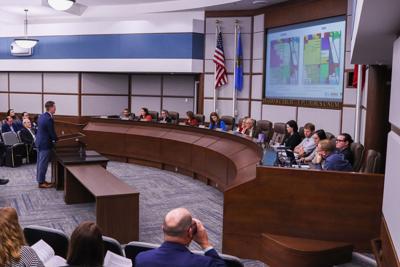

Norman City Council approved a contract with City Care Inc. to operate A Friend’s House, Norman’s emergency shelter, officially terminating its contract with Food and Shelter Tuesday evening.
According to a staff report, the termination will go into effect Jan. 15, allowing Food and Shelter to operate A Friend’s House until City Care, the new operator, can assume operations.
City Care Inc. is an Oklahoma City-based nonprofit organization, which owns Oklahoma City’s only low-barrier night shelter, according to the City Care website.
According to a presentation from last Tuesday’s study session meeting, City Care operates 112 permanent, supportive housing units.
According to a staff report, the contract term would be from the date of execution to June 30, adding operations would begin following a transition period.
The staff report lists the monthly operating budget at $62,683.36 for a total operating budget of $344,758.48 during the operating period. The report adds additional administrative and startup expenses are expected to incur prior to Jan. 15.
Staff recommends an appropriation of $25,000 for additional equipment and facility improvements, including a metal detector, defibrillators, emergency exit signage, retrofitted case management office space, fencing, camera systems, air ventilation, climate control system replacement and increased usable restrooms. The report adds such improvements can be transferred to a permanent facility, noting A Friend’s House is “not intended” as a permanent location.
The report recommends a total appropriation of $639,215.33, including for current contractual obligations to Food and Shelter. A figure in the report notes $520,190.60 would be appropriated from the general fund balance, while $119,024.73 would be appropriated from the ARPA Affordable Housing account.
The contract also requires “regular” financial and statistical reports, and “detailed reporting” on expenditures prior to payments in the monthly reimbursement schedule.
Food and Shelter first entered into a contract with the city on Oct. 11, 2022, which ended on March 9, 2023. The contract was extended to June 30, 2023, and later amended to an indefinite month-to-month approval.
In June 2024, City Auditor Shaakira Calnick issued a report accusing Food and Shelter of mismanaging $9,835.60 in facility funds from November 2022 to February 2024, with an additional $20,542 remaining unaccounted. Calnick also alleged April Doshier, executive director of Food and Shelter, received unexplained raises and bonuses.
On Sept. 19, Food and Shelter announced it would “step away” from operating A Friend’s House on Facebook, adding it could not accept the city’s new contract terms. The post stated Food and Shelter would still operate A Friend’s House until the city found a new operator.
11:20 p.m.
After several minutes of public comment the meeting has adjourned.
10:42 p.m.
Ward 7 Councilmember Stephen Tyler Holman said the city opened an initial winter shelter following demands from residents.
“I just want to reiterate that the city funding the operation of an overnight shelter is in response to public outcry that we were seeing in 2017,” Holman said. “How good does that look for our community if people are freezing to death and there are dead bodies on Main Street, it's not a very good look for business.”
Holman said government should address issues other actors will not aid, including homelessness.
“If any other entity was stepping up to do it, then the government wouldn't need it,” Holman said. “If we don't want to give out money for this, then we shouldn't give out money for anything. Private business, they can stand on their own. What do they need our help for?”
Council is motioning to terminate the contract with Food and Shelter.
Council unanimously terminated the contract with Food and Shelter.
10:11 p.m.
Council is considering terminating its contract with Food and Shelter, the city's current operater of A Friend’s House.
9:56 p.m.
“When we have a limited budget, we need to come to that rapport with that simple fact that we can't help them all,” Nash said. “Where do we draw the line?”
Ward 6 Councilmember Joshua Hinkle said there is no “silver bullet” for homelessness, adding the problem is societal. He added engaging with City Care allows the city to find progress towards homelessness.
“There is no absolute solution. The way that we would move forward is just to find progress,” Hinkle said. “If we don’t do something about this to make progress. … We’re never going to be able to stop kicking the can down the road. We owe progress to everyone.”
Ward 4 Councilmember Helen Grant asked Anthony Purinton, assistant city attorney, if the shelter would be a “green zone,” or a space where sex offenders can live beyond zones of safety.
“Norman basically doesn't have any green zones,” Purinton said. “That's one of the barriers that exist currently … we have a provider who is very knowledgeable in Oklahoma City, a place that does have green zones.”
Council is motioning to approve the contract.
Council voted 5-4 to approve the contract with City Care.
Ward 8 Councilmember Scott Dixon, Ward 5 Councilmember Michael Nash, Mayor Larry Heikkila and Ward 1 Councilmember Austin Ball voted against the contract.
9:20 p.m.
Ward 1 Councilmember Austin Ball asked City Manager Darrel Pyle if he would bet his job on his ability to find shelter for over 50 people in 45 days. Pyle said he could “absolutely” find shelter in for the “short-term.”
Ward 8 Councilmember Scott Dixon said the vote for a permanent shelter previously did not pass, adding he could not look past that.
“Here we are, trying to cleverly subvert the will of the people,” Dixon said. “I just can’t get past that.”
Ward 7 Councilmember Stephen Tyler Holman said people in central Norman voted in favor of the permanent shelter, while people outside the city did not. He said he keeps a tally at every meeting that discusses the shelter, adding more residents speak in favor of the shelter than against it “every” meeting.
“I am all for sending this to a vote of people, actually, because I think it will pass,” Holman said. “I think Norman cares about this issue.”
Holman added Oklahoma is one of the most inhospitable places to live for unhoused Americans, adding it is “boiling hot” in the summer and “freezing cold” in the winter.
“Imagine living outside in Oklahoma through all of that and thinking that people would choose to (be unhoused),” Holman said. “If you’re going to be homeless, why would you choose here? Why?
“(A Friend’s House) has saved people’s lives.”
Holman said Normanites must have empathy in considering the unhoused population in Norman.
“We're talking about people who feel inconvenienced by the sight of this, but you're not thinking about the people that are actually in that situation and what they're going through,” Holman said. “It may be bad for you, but think about how bad it is for them. They have to sit around and wonder every day if this elected body who is up for election every two years is going to decide to kick them out on the street or not.”
Holman said he will vote to approve the contract, adding the city will see increased problems without a shelter and as the population increases.
Norman Mayor Larry Heikkila said he will vote against the approval of the contract.
“That is not part of our function. It is a function of Salvation Army, of Food and Shelter, other good people trying to do different things around here,” Heikkila said. “Is this the city's responsibility, or is it society's responsibility to take care of those people? So, as we look at society, government is not society.”
Ward 5 Councilmember Michael Nash said this “wedge issue” divides residents against each other. He said residents have an “imaginary bar” of who should be allowed to be admitted into a shelter.
“We can’t even have honest discussions about this topic without being attacked,” Nash said. “Both sides want to find a solution to this problem, we’re bickering over small details.”
Nash said Ward 5 wants it closed but he believes it will pass. He said if he is wrong, he will contemplate his decision.
8:16 p.m.
Council is hearing public comments regarding the contract with City Care.
Trey Kirby, owner of Kirby Land and Cattle, said contracting City Care delays dealing with A Friend’s Place but terminating the shelter affects businesses by denying people a place to stay.
Opponents of the contract said the city should terminate the shelter and instead provide exclusivity for taxpayers. Supporters of the project said the city should treat unhoused people as residents
Stephen Ellis, an OU philosophy professor, said the city should provide City Care a six-month “trial” and approve the contract. He added he believes City Care will find working with the city of Norman more difficult than expected.
“I fear it's going to be a tougher task for City Care than they probably know because the city of Norman has a pretty incoherent approach to our unhoused neighbors,” Ellis said. “We fund a shelter, yes, but we also harass the homeless where they sleep, and we harass those who don't cooperate in that earlier harassment, mostly via code violation stuff.
Ellis said the shelter is a service Norman needs to provide.
Ben Plummer, Ward 4 resident, said the contract is meant to delay a closure of the shelter. He said further supporting services for unhoused individuals would devalue properties and decrease tax revenue.
“Right now, there’s a lot of momentum to close it. If we get a new operator who's somewhat responsible and not kind of a windy baby, and actually does the job well, our momentum to close this will evaporate,” Plummer said. “What you need to understand is that you can destroy a city with homelessness.”
Chanel Roady, a former occupant of A Friend’s House said she values shelters in society, adding unhoused individuals are residents of Norman like everyone else.
“I have experienced firsthand the vital role shelters play in our community during my stay at a friend's house. Having a stable place to sleep has been crucial for maintaining employment and planning a better future. Unfortunately, not everyone has the security of a permanent bed,” Roady said. “Please support measures that keep shelters accessible and safe for those who need them most.”
Roman Gray, 19, said they have been homeless four times in their life, including since Aug. 24.
“We all feel attacked by most anti-unhoused movements,” Gray said. “When I left my housing situation, the only place I was able to go was Food and Shelter. I ask you to seriously consider the fact that we are one of the most discriminated against minorities out here.”
Cynthia Rogers, an OU economics professor, asked the city to consider policing behaviors towards unhoused people, adding unhoused people do not have the same resources available as others.
“There’s no perfect solution,” Rogers said. “We just can’t let that be the enemy of getting people off the streets. I promise you that closing shelter and having no shelter will be (intimately) worse than a poorly operating shelter.”
Paul Wilson, Ward 1, said the city should keep A Friend’s House open. He added Norman should also prioritize affordable housing.
“You want them off the streets? Give them a bed,” Wilson said.
Russell Rice, co-owner of Norman Care-A-Vans, said the city should listen to experts and keep the shelter. At the end of his public comments, he commented on council’s rules regarding laughing during public comments.
“If you do not want us to laugh, you shouldn't have a damn circus up in here, clowns,” Rice said.
Mayor Larry Heikkila told Rice to exit city hall after his comments.
7:43 p.m.
Anthony Purinton, assistant city attorney, said the city is discussing the sale of property with Oklahoma Department of Mental Health and Substance Abuse Services for a permanent shelter, adding council allowed the city to move forward with a tax increment financing model for the property. A TIF district allocates a percentage of taxes generated within a district to projects and improvements.
Purinton said the city has agreed to a contract with City Care Inc. According to Purinton, the contract is a reimbursement contract, which means on a monthly basis, City Care will be able to submit reimbursement requests.
The contract period is divided into three parts. The first being the contract mobilization, the second being a two-week transition period from Jan. 1 to Jan. 14 and finally full operation, which will begin on Jan. 15 and run to June 1.
Purinton said no organizations have reached out to the city to provide overnight shelter. He added organizations within the city, including the Salvation Army, have expanded their operations but have not reached out.
Ward 1 Councilmember Austin Ball asked City Manager Darrel Pyle what the city would do in the event A Friend’s House required immediate closure. Pyle said the city would utilize hotel vouchers or would ask Food and Shelter to open its dining area to occupants requiring shelter.
Ball said he will vote no, adding the city should explore other avenues for homelessness. He said 45 days should provide the city with enough time to determine other options and reject the new contract.
“We have 45 days and we can't find anything to do with these people? We can't find something more compassionate than putting them in the shelter and then kicking them out in the morning?” Ball said. “Yeah, I’m voting no.”
Grant said she received a statement from Chad Vincent, Norman Police major, where he clarified several misconceptions on Norman crime data.
“The truth is that we have one of the most transparent pieces of history when it comes to publishing police data. We are finding that a variety of people and organizations are taking the raw data that we publish on our website and then completing their own analysis,” Grant said on behalf of Vincent.
In 2024, through the end of September, NPD responded to 71,196 calls for service, while 4,899, or 6.88%, of which were related to unhoused individuals, according to Vincent.
In his statement, Vincent noted NPD has arrested 511 unhoused people and charged them with 1,792 criminal charges. Grant noted these were charges, not convictions.
6:54 p.m.
Council unanimously approved the consent docket, which included a $50,000 appropriation from the room tax fund to miscellaneous services for Norman Arts Council and rezoning for a proposed nine-story apartment complex, among other items.
Council is now considering rezoning for a proposed nine-story apartment complex, among other items.
According to a staff report, the apartment complex would redevelop a two-story structure at 310 E. Boyd St., including five to seven levels of apartments and two levels of parking. The report adds the structure would include 250 multi-family units.
Trinitas Development LLC is the applicant and Rieger Sadler Joyce LLC is the legal representative for the rezoning.
Gunner Joyce, an attorney from Rieger Sadler Joyce LLC, said the complex would be located close to the Sarkeys Energy Center.
“We've got a very walkable location, which is an amenity of itself,” Joyce said. “It's only about a 10 minute walk all the way to the northern part of the football stage. It’s an extremely good location.”
Ward 4 Councilmember Helen Grant asked council to amend the structure from nine stories to seven stories in height. Council unanimously approved the amendment.
Council is motioning to approve the rezoning.
Council unanimously approved the rezoning.
6:30 p.m.
The regular meeting has started.
6:10 p.m.
The conference meeting is adjourned.
5:00 p.m.
Council is discussing the status of the 2025 capital improvements program budget and modifications to the city’s board and commissions at its conference meeting.
According to the presentation, which is available on the city’s website, the capital improvements program budget accounts for capital projects funded by capital sales tax receipts, general obligation bond issues or specific matching funds, supporting municipal services that do not have dedicated special revenues,
The presentation notes capital projects cost over $100,000, are fixed or permanent in nature, have expected lifespans of more than five years, consist of the construction of a new and improved “tangible asset,” often take more than one fiscal year to complete and may require contracted services for design, land acquisition and utility relocations.
The presentation notes projects are identified in long-range master plans reviewed by residents and adopted by the city, including Land Use, Transportation, Parks and Water.
The capital improvements program budget is funded through voter-approved general obligation bond proceeds, 0.7% of Capital Sales Tax, 0.5% of Norman Forward sales sax and public safety sales tax, University North Park TIF revenues, enterprise revenues, room tax and private funds, according to the presentation.
Funds in the capital improvements program budget include the public safety sales tax, room tax fund, Norman Forward sales tax fund and the University North Park Tax Increment Finance District fund, among others.
The presentation notes the estimated amount of funding in the capital fund “PayGo” for FYE 2026 is -$7.6 million, while the projected amounts for FYE 2027 and FYE 2028 are -$1.7 million and $4.8 million, respectively. This is a result of debt, according to Huckabaa.
“This is something that the past few years that has been negative, but not quite this much,” Huckabaa said. “This year is really getting to where it’s starting to become a concern.”
City Finance Director Anthony Francisco said council must be “careful” in pay-as-you-go expenditures from the capital projects fund. He added council should cut spending on
“You really need to be careful and you really need to stop appropriating capital fund balance as if it were available for pay-as-you-go projects because it’s really not,” Francisco said. “If you’re going to try and add any projects in this coming fiscal year. You’ve really got to take something away.”
Upcoming challenges listed in the presentation include the potential Rock Creek Entertainment District, ACCESS Oklahoma turnpike plans, Norman Public Library Central remediation and repairs, the Area and Infrastructure Master Plan update, “failing” stormwater infrastructure and fleet vehicle replacements.
Ward 2 Councilmember Matt Peacock asked Francisco where the money would come from for an up-front remediation of the Norman Public Library Central.
Francisco said the city has been reserving funds in the general fund balance for the purchase of the Griffin property, which could be used for the remediation. He added the city could also use “rainy-day” funding, which would require repayment within three years.
“Other than that, I don’t know. I really don’t," Francisco said. "When (the price) became 2 million, 5 million. … We can't do that.”
City Manager Darrel Pyle and Francisco said mold is not covered under the city’s self-insurance policy, adding it helped prompt litigation against the contractor.
“Our stop-loss does not include mold,” Pyle said. “That's why our first action is to go back against the contractor, especially since we can demonstrate the building leaks.”
This story was edited by Ismael Lele.


