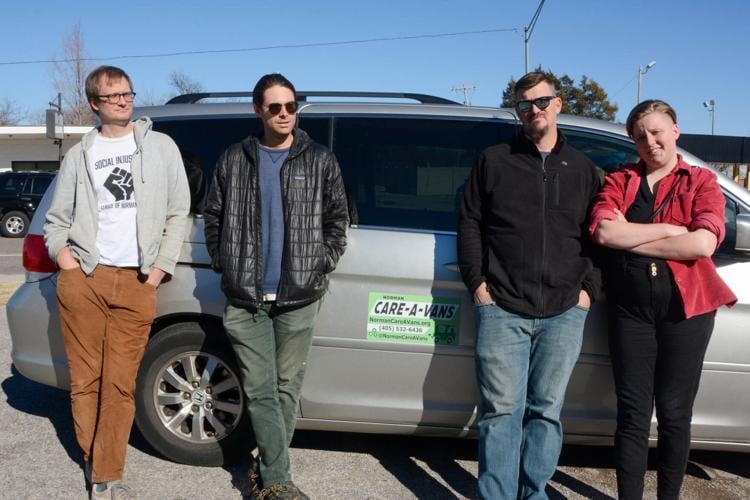


A silver Honda minivan filled with volunteers meandered through still-icy Norman roads, pushing the limits of two-wheel drive in the aftermath of a winter storm at the beginning of February.
To an observer, a minivan with over 200,000 miles on its odometer might not seem like the best choice for the weather. Yet, Norman Care-A-Vans co-founder Russell Rice said he’s lucky to have found it for $4,000 despite a struggling used-car market exacerbated by the pandemic. It’s perfect for picking up his kids from school and providing free transportation to Rice’s homeless neighbors.
For many Norman residents, getting across town can make the difference between having a steady shelter and becoming homeless. Care-A-Vans co-founder Alan Hatcher said many of the people he comes in contact with are unhoused because they haven’t given the right paperwork to institutions like the Norman Housing Authority and local tag agencies.
Numerous Norman organizations are doing valuable work, Hatcher said, but accessing their resources can present another hurdle for people working to transition out of homelessness. Rice said if homeless people can’t find transportation, they can be especially vulnerable to loitering or public nuisance charges.
In Norman, funding was originally allocated to a local mobile crisis response team that would take the place of the police in some situations, or Norman CREW. Support for this group — which would have responded to all calls indicating an overdose or potential overdose, and all domestic calls indicating a mental health crisis — grew amid conversations reconsidering local policing.
City Attorney Kathryn Walker wrote in an email that, as the presence of state mobile crisis response teams will soon be expanded in conjunction with the July launch of the federal Suicide Prevention Hotline, the money will likely be reallocated to other efforts that don’t duplicate services.
During this transition period, Care-A-Vans volunteers are working independently to fill needs highlighted in a proposal for CREW and a Cleveland County and Norman homelessness gaps analysis, which indicated that 73 percent of homeless individuals surveyed said more transportation options would be the most helpful resource to them.
Rice said his involvement with community organizations began after he injured his knee at the beginning of 2020 and had to take time off from his job as an electrician. Stuck at home for months, and with more free time than expected, Rice said he searched for involvement outside of work.
Rice saw the Social Injustice League of Norman delivering free home-cooked meals to residents without homes and said he was impressed by their group’s base of community connections. He said he joined the group and became familiar with founder Brandi Studley, who is now the Ward 1 Norman city councilmember.
Care-A-Vans began in October 2021 as an offshoot of the Social Injustice League with a focus on transportation, Rice said. He said the group’s ultimate goal is finding people permanent housing by driving them to needed offices, but they also focus on encampment support and transportation.
“Once we get them there and get them rolling on that, that changes their lives,” Rice said.
Similar programs exist across the U.S., including in Las Vegas, which recently launched a free service shuttling homeless individuals to various locations in its city limits. Cities like Olympia, Washington, and Kansas City, Missouri, offer free bus fares to all travelers, and Embark Norman fares are paid for by the city of Norman.
Michael Carter*, a homeless person who requested anonymity due to privacy concerns, said he’s been homeless for about five years and has lived out of a van in Ardmore for the past three. He’s lived in Norman since July 2021 and said, although the town has effective homelessness resources, it lacks available housing and shelter options.
He said he tries to learn as much as possible about available resources so he can tell other individuals without homes about them. He found out about Care-A-Vans through his search.
Before Care-A-Vans was created, Carter said one of the only transportation options he had was traveling to a bus stop on one of the city’s five daily routes between 7 a.m. and 10 p.m., Mondays through Fridays, or between 10 a.m. and 7 p.m. on Saturdays. The city and county gaps analysis identified transportation as a significant county issue, adding that, while routes exist to access most downtown services and shelters, transit to other areas of town is lacking.
To Carter, the most meaningful part of the program has been the relationships he has built with its staff.
“They're just wonderful people,” Carter said. “They're happy to help. I don't think I've ever seen one of them cross or angry. They're always just smiling and friendly.”

Care-A-Vans driver describing his responsibilities on Feb. 10.
Hatcher said during an ice storm in February 2021 that led to record-setting freezing weather and blackouts in the area, the Social Injustice League was looking for people to help unhoused people out of the snow and into shelters. Hatcher had a truck at the time and decided to help out, which is where he met Rice and Studley.
From the beginning, Hatcher said he knew he wanted to work with Rice. While Hatcher, Rice and third co-founder Hannah Smith filled a significant need through Care-A-Vans, Hatcher said the trio didn’t have to reinvent the wheel of public service.
“At least for me, I was kind of like, ‘All right, well, this isn’t going to happen unless we do it ourselves in whatever capacity we can in the moment and then grow instead of waiting for the city to hire people and launch this program,’” Hatcher said.
Smith said they and Rice were both involved with the proposal for Norman CREW in some capacity, and Care-A-Vans is the first local program stepping in to alleviate crisis response pressure from the police. According to the CREW proposal, almost 10 percent of the Norman Police Department’s yearly reports are categorized as mental health cases. Vagrancy, drunkenness and public disturbances could also be responded to by professionals with social work and substance use disorder training.
While 988, the federal suicide prevention hotline, is similar to CREW, the visions for the two are slightly different, Smith said.
“Nine eight eight is good. It's a step forward,” Smith said. “It includes mental health professionals. It has an emphasis on the safety of the person. It's working to not criminalize people who are having mental health crises, and these things are great, but kind of as a city, we still have a responsibility to make sure the way that it's handled is aligning with our values.”
Sarah Warmker, a former Spanish professor at OU, said she helped Care-A-Vans get its start as an organization and also helped author the CREW proposal.
Though Warmker said the city government is worried about duplicating local services with the federal crisis response program, the federal suicide hotline doesn’t exist yet, meaning a gap in resources still stands. To fill holes in Norman’s Continuum of Care, the city needs a variety of programs — like CREW, Care-A-Vans and other groups that haven’t been created yet — to address a multitude of needs, Warmker said.
Warmker said she first learned Care-A-Vans might become an independent group in conversations where she and others involved in CREW discussed what parts of the proposal they could carry out separately from the city. She said she felt Rice, Hatcher and Smith were the right people to head the group because they were already committed to the work and had long-term connections in the community.
Rice said the services Care-A-Vans provide are reliant on relationships with both local businesses and other organizations, including Food and Shelter, the Continuum of Care and the Oklahoma Department of Mental Health and Substance Abuse Services. Community members can also donate to @normancareavans on PayPal.

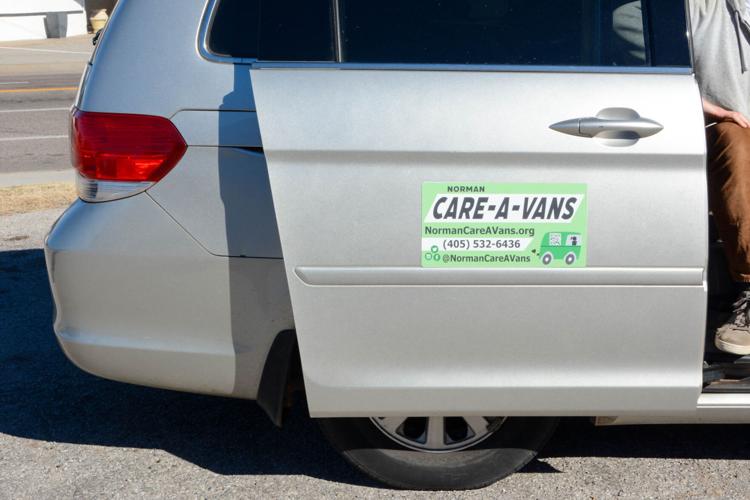
One of the Care-A-Vans vehicles used to transport those in need on Feb. 18.
As one of the group’s main drivers, he said he spends much of each day taking calls from unhoused people on the dispatch phone and checking on callers, if necessary. Staffers also help people keep track of appointments and transport them to the necessary locations.
Offering homeless people a free meal is a good way to build trust, Rice said. To do this, he said Care-A-Vans works with the Social Injustice League to feed about 40 people Mondays through Thursdays. Congregations like the Alameda Church of Christ and the Saint Anselm Canterbury Association Church, as well as the Red Dirt Collective, a social justice and mutual aid organization, also often volunteer to cook meals.
Care-A-Vans aims to help chronically homeless people in Norman, meaning unexpected issues pop up every day, Rice said. Growing up in a household with addiction and alcoholism has helped inform the decisions he makes when de-escalating situations, he said.
“I understand the craziness of it,” Rice said. “Sometimes you can't argue with people, so you just have to agree with them. And that's usually the best thing I have found to resolve this (because) a lot of the time, what they're saying is true.”
In the aftermath of the February snowstorm, Rice and Hatcher visited several homeless people who were given various shelter options across Norman.
Rice explained that many people without homes struggle with being inside for long periods, as they often haven’t had a steady indoor shelter for years. As a result, they sometimes have mental crises that require a response from Care-A-Vans. Living inside for about a week can also sometimes have positive long-term effects, he said, adding that staying in a shelter during last year’s snowstorm pushed two or three people to work harder for permanent housing afterward.
The Norman Housing Authority and other agencies are working as hard as possible to get people approved for housing, Rice said, though the city homeless coordinator Michelle Evans and two housing support employees quit at the beginning of February. Norman Chief Communications Officer Tiffany Vrska wrote in an email to The Daily that, though this is a transitional period for the city’s homeless program, all services — including the emergency shelter — will continue.
Even with housing vouchers, people without homes are still struggling to find landlords willing to rent to them, Rice said. He said, while there are some risks to having a formerly homeless person as a tenant, as some haven’t had a house in years and don’t know how to properly care for it, there has to be a middle ground.
Hatcher said, as a Care-A-Vans staff member, he’s learned that food assistance, housing and criminal justice systems are even more complex than he imagined. He added he’s doing the work of a case manager as a volunteer, which can be overwhelming, but the progress he’s seen pushes him to invest more in the organization.
The Care-A-Vans staff applied for nonprofit status with the IRS in late January, putting itself in the running for more grants and funding in the future. This meant volunteers had to familiarize themselves with yet another new set of rules. Smith, who has a master’s in public administration from OU, helped Red Dirt Collective apply for nonprofit status, and said they were asked by Rice to help with the application process one more time.
Smith said the biggest challenges were deciding on a vision and structure for the group, and they also worked for over 100 hours drafting organization bylaws. Care-A-Vans workers asked the community for donations for the first time to cover the $600 IRS application fee. Smith said they remember posting a request for the money while at a Halloween party, and by the time they left the event, the group had reached its goal.
“This is a difficult situation for anyone to be in,” Smith said. “They want to respond with empathy and kindness, as well as they want to respond in a way that keeps everyone safe and is productive for the community. … So, whenever a solution is offered, they've been just absolutely incredible at showing up for whatever we need.”
While Care-A-Vans waits for nonprofit approval, Smith said it’s preparing to assemble a board of directors and can now subsidize most costs with donations. Still, its staff continues to work without salaries.
Creating a healthy organizational structure can be difficult when all of the workers are volunteers, Warmker said, adding that she hopes becoming a nonprofit will help Care-A-Vans become more sustainable.
“People still have bills to pay, and they have limited hours in the day,” Warmker said. “Not everyone can afford to be able to do volunteer work, especially of something of that scale. … It's work that should be funded.”

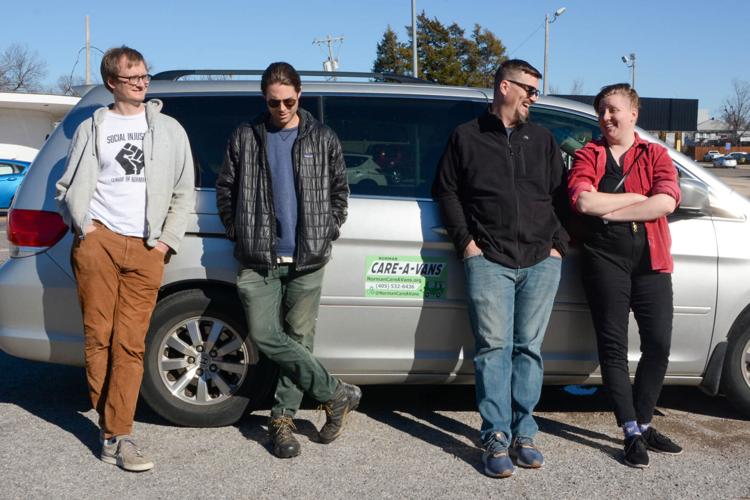
Care-A-Vans drivers in front of one of their vans used to transport those in need on Feb. 18.
Extended free labor has strained the bank accounts of everyone involved, including the Care-A-Vans founders. Smith said they’re taking a step back to find a paying job in the nonprofit sector until the group can pay its workers, but no matter their day job, they’ll continue to work with Care-A-Vans.
Hatcher said he previously worked at local music venue Opolis full time but has scaled down to a part-time job due to the pandemic, allowing him to lean more into his work with Care-A-Vans. As a 37-year-old, he said he’s had experience with mundane jobs in the past, and though he’s losing money with Care-A-Vans, he emphasized that when work feels right, sometimes sacrifice is necessary.
“With this, you never get that feeling of ‘Is this even doing anything? Is it worth anything? Or is this accomplishing anything?’ because you spend all day doing stuff that is valuable,” Hatcher said.
Rice said though he’s still on leave from his work as an electrician, he plans to return to work soon and earn his electrical journeyman’s license to build more affordable housing in Norman. He said working with Care-A-Vans continues to be a respite from his career, though.
Paying staffers will revolutionize the group’s work, making it so they can have regular schedules instead of working spontaneous hours, Rice said. As Care-A-Vans expands and adds more vehicles to its fleet, he said his minivan — and the work he’s done in it — will serve as a vision for the group.
“Whenever I got into becoming an electrician, I didn't have this in mind,” Rice said. “However … I kind of just fell in love with helping these people. Nobody else is doing it at all in the capacity that we're doing it.”
Editor's Note: This story was updated at 5 p.m. Friday to show the Care-A-Vans staff applied for nonprofit status with the IRS.


