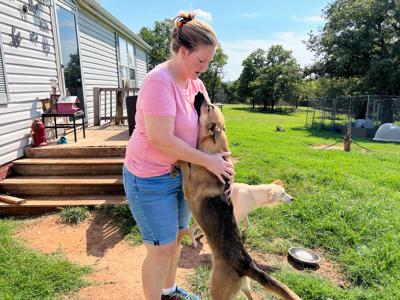

On the shore of Lake Thunderbird is just under seven acres of grassy land, home to a nurse, her roommate and 60 dogs.
Naomi Gooch, owner of Dogs Love You Forever, has been rescuing dogs and housing them on her property since 2011.
She always wanted to run a rescue, and the rural agriculture classification allowed her to have more animals than in Moore, which was limited to four. Over the years, Gooch built a community of fellow rescue owners, veterinarians and other animal care professionals. Now, the community has backed Gooch in her effort to gain a kennel license and keep her sanctuary.
On Aug. 9, Nicolette Collins, a rescue associate of Gooch’s sanctuary, appeared before the Norman City Council to plead Gooch’s case for a kenneling license and potentially expand the city’s ordinances.
Gooch is now on her third attempt at obtaining a license and is awaiting an official hearing date. According to a Facebook post, she also hopes to stop Norman’s animal welfare officers from taking her dogs.
Gooch started her rescue primarily with chihuahuas and then pitbulls after she had a pitbull mix surrendered to her. Initially, she tried to find someone to take the dog, but every shelter she called refused, telling her that pitbulls and chihuahuas are the most overbred, under-adopted and euthanized breeds in shelters.
Eventually, Gooch found a rescue willing to take the pitbull mix, but not without bad news. The rescue told her the dog would spend the rest of her life in a 10-by-6 slab because pitbull mixes typically aren’t adopted, which she found unacceptable.
At moment, everything clicked into place for her, and she knew what her sanctuary would be used for.
“(It’s) for the ones that don’t get adopted,” Gooch said. “They’re not locked in some 10-by-6 concrete slab where somebody comes in, gives them some food and water every day and that’s it. They’ll be home.”
Gooch defines her kennel as a “sanctuary” because she takes old dogs and unadoptable people- or animal-aggressive dogs long-term because, given their circumstances, they would otherwise be euthanized. The city of Norman, though, does not define sanctuary in its city ordinances.
“They have no verbiage for sanctuary,” Gooch said. “They probably just don’t see it as financially feasible for one person to do, but that's why I limit my numbers. I can't take more than what I can afford.”
With her earnings as a registered nurse, Gooch pays for microchipping, spaying, neutering and food out of her own pocket. Because she funds the rescue herself, she said she is a state-incorporated LLC, despite what the city would rather her do.
Norman, she said, wants her to register as a 501(c)(3), which allows nonprofit organizations to be exempt from federal tax income. Gooch said she hasn’t because registration only allows for tax exemptions for nonprofit organizations, which isn’t necessary for animal welfare.
Gooch said she has applied for a kenneling license three times over the past two decades and, each time, she hit a roadblock with the city.
The process involves filling out an application, sending out certified letters to everyone in a 300-foot radius of the property, making a legal publication with the Norman Transcript, getting a proof of publication and then sending all of that to the kenneling license board.
The most recent time she applied, she said an animal welfare officer went to her sanctuary and told her to get a license, but not without issuing a warning.
“I started the process again, except this time, (the) officer said, ‘Yeah, you’re not going to be allowed to keep these dogs. We’re not going to do this,’” Gooch said.
She said the situation has been a “huge ordeal,” and she has even looked into getting a United States Department of Agriculture kennel license through the state but said the city wouldn’t recognize it. Gooch said it would be easier to register as a zoo than as a sanctuary, which she said has no description in the city ordinances.
“If I was federally licensed as a zoo, I could open one,” Gooch said. “But it’s dogs and cats, (so the animal welfare officers) are threatening — after it’s been okay for years — to take the sanctuary dogs who are just here to live out their lives.”
Brenda Hall, Norman City Clerk, said it’s not that the city of Norman doesn’t recognize a USDA license, but for her to be able to keep a large number of dogs on her property, the city would need her to have a private, commercial or foster license with the city.
Tara Sharp, owner and director of Safe Haven Animal Birth Control Clinic said she’s worked with Gooch for years, and Gooch is what she calls a “gold standard client.” Norman, she said, is lucky to have someone like Gooch doing the service she does.
“To be giving her a hard time about a kennel licensing for the amount of animals, which we consider small in the grand scheme of things, is mind-boggling to me,” Sharp said. “(How could) they not be welcoming and supportive of an individual in the community that’s spending their own funding to provide housing and care for animals?”
She said as someone who works for animal welfare, municipalities are typically complaint-driven regarding animal issues, especially since animal welfare has low staffing in Norman right now.
Sharp said she was shocked when she first saw Gooch’s Facebook post about her struggle but is ready to come to her aid if needed.
“I can vouch on her behalf that she’s a very good caretaker of these animals,” Sharp said. “It’s just very concerning Norman has decided to give her such a hard time. It would be different if she was a backyard breeder, a puppy mill or in a situation where these animals will not be cared for, but she’s not. That’s not the issue at all.”
Collins wrote in a message to the OU Daily that Gooch is knowledgeable about how to properly care for fosters and is a capable caretaker.
“(Gooch) is a Godsend,” Collins wrote. “She takes those that aren’t cute enough to be adopted, those old and won’t be adopted and those that have a physical disability. These animals in a shelter are the first to be euthanized even if they have more life left or they are fighters to overcome their problems.”
From her perspective, Collins wrote she couldn’t imagine any reason why anyone would be confronting Gooch about how many dogs she had in her care. Collins wrote that Gooch’s sanctuary has been in service for over 15 years, and it feels “wrong” to question her on her licensing situation seemingly out of nowhere.
“(Gooch) is helping the shelters who are overcrowded,” Collins wrote. “Naomi lives far enough from the city and on a large acreage where her dogs don’t bother her neighbors. She uses her own money to feed, house and provide medical care for these dogs. She isn’t hurting anyone.”
Gooch said her ultimate objective is to educate and to encourage the city council and kenneling board to recognize sanctuaries and the need for long-term care for animals.
“My goal is to get them to recognize sanctuary by changing some verbiage or adding some verbiage to the city ordinances,” Gooch said. “Even if they say I can’t take in any more dogs, (I at least want them) to let these ones that are here — that are happy, healthy and safe — stay. … They just want to live their lives out.”


