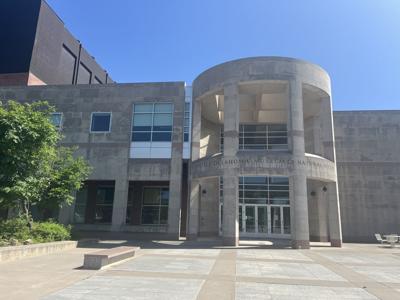

Revisions to the Native American Graves Protection and Repatriation Act, or NAGPRA, require institutions like the Sam Noble Museum of Natural History to consult with tribes, though funding and organizational challenges make it difficult.
In December, the U.S. Department of the Interior announced it was revising regulations in NAGPRA, an act passed in 1990 to establish rules and protections for Native American human remains and funerary objects. One revision in particular requires institutions to obtain prior consent from tribes in order to display, access or research human remains or funerary objects.
Marc Levine, the NAGPRA director at the Sam Noble Oklahoma Museum of Natural History, said the revisions to the act were designed to address areas that had not been clear about the display of human remains and funerary objects.
Levine said the regulations focused on ensuring all NAGPRA-related items were taken care of by institutions in culturally sensitive ways, requiring more direct consultation with tribes.
The revisions also made it more necessary for institutions holding Native American remains or funerary objects to take more active roles in the repatriation process, Farina King, the interim chair of the department of Native American Studies, said.
King, a Navajo Nation citizen, said their ancestors had long been violated and dehumanized by institutions that were researching and studying their remains and sacred objects.
“For so long, our very bodies, everything that belongs to us, they've been stolen,” King said. “These kinds of issues is another form of violence. Even our dead cannot rest in peace.”
Levine said the updates to the regulations did not radically change NAGPRA compliance at Sam Noble and were primarily aimed at institutions that have been out of compliance. Sam Noble had already been working with tribes directly before the revisions, Levine said.
Deanna Byrd, the former NAGPRA coordinator for the Choctaw Nation, said all of their ancestors and funerary items at Sam Noble have already been returned.
Levine said in recent years, the museum relied on NAGPRA grants to fund repatriation efforts, receiving six since he came to the museum in 2013. When the COVID-19 pandemic began, Sam Noble fell behind in its efforts toward repatriation and was unable to apply for additional grants.
This past fiscal year, though, the museum was granted funding from the university designated specifically for NAGPRA-related efforts. Levine said this is the first time since 2013 that the museum have received NAGPRA funding from OU, which he said is not typical of other museums connected to universities.
OU Daily reached out to the university, asking for confirmation the funding was given as well as context for why the university had not been providing NAGPRA funding previously.
“The University allocated funding to the Sam Noble Museum for NAGPRA compliance efforts this past fiscal year,” an OU representative wrote in an email to the Daily. “These funds are designated for use over the next two years to support related initiatives.”
While the money from OU makes up for the loss of the NAGPRA grants, the grants themselves were never enough to fully fund repatriation efforts at Sam Noble, Levine said.
Despite these funding challenges, Byrd said working with Sam Noble and Levine over the years has been pleasant. She also said that over 95% of the institutions she has worked with have been helpful and cooperative.
The main challenge, Byrd said, is ensuring that all tribes are able to come to the table. However, Levine also said that a major difficulty can be a tribe or nation’s bandwidth. While institutions may be reaching out to several tribes at a time, a tribe may have dozens of institutions contacting them all at once, Levine said.
Byrd said one way to mitigate this is through organizations like the Southeastern Tribal Alliance for Repatriation and Reburial, or STARR. The alliance allows for tribes to work together and help ensure everyone is able to get consultations with institutions holding their ancestors and funerary objects.
The forced removal of Indigenous peoples from their lands in the United States made it so many tribes and nations lose the ability to protect their burial sites according to their beliefs and cultures, Byrd said. Later, when people began looting those locations, people often sold the items to institutions, Levine said.
Those institutions studied the remains of Native American ancestors and the sacred objects buried with them, often without any consultation with the descendants of the people they were studying, King said.
“They worked on them like they were specimens,” King said.
Many of the Native American remains and items in the collections of institutions also lacked adequate organization prior to NAGPRA’s passing, Levine said. It is also difficult to accurately identify which remains and items belong to whom, as even collections that were organized well often contain ancestors and sacred objects from areas where tribes overlapped throughout time.
Because of the complicated nature of collections, Levine said the repatriation process can take a lot of time, ranging from a few months to several years. While the work can be slow, however, Levine said the tribes in Oklahoma have been very patient with Sam Noble over the years.
“I’m very thankful all of the time for that,” Levine said.
However, Levine said the revisions to NAGPRA do bring to light an important question. In the late 1990s, Sam Noble consulted with local tribes to develop exhibits for the museum and many of the objects selected remain on display. However, many of them have not been updated since the 2000s.
“It opens up the question, ‘Is the consent that was (provided) in the '90s for perpetuity? Is it forever, or is it something that needs to be updated?’” Levine said.
Levine said opinions surrounding NAGPRA and repatriation have already been changing in the last several years. As he has taught classes at OU, Levine said he sees his students become more and more accepting of the idea that repatriation is necessary. Byrd said that has worked with many young people that are determined to ensure all ancestors are returned to their people.
Levine said his priority at Sam Noble is to continue to build and foster collaborative relationships with tribes and indigenous peoples, even if that means making changes to what the museum displays.
“I would much rather take something off exhibit than lose that collaborative relationship,” Levine said.
King said repatriation is just as much about the process as it is about the final act. It is important that institutions work with tribes and are culturally sensitive to the individual and unique needs to each group.
“We really need all hands on deck of people working together and, most importantly, working with Native nations, not just as a checkbox or trying to rush things, but building trust,” King said. “Rebuilding trust, and earning that trust.”
This story was edited by Anusha Fathepure, Ismael Lele and Peggy Dodd. Avery Avery copy edited this story.


