
The University of Oklahoma and the University of Texas will be joining the Southeastern Conference after the schools’ Boards of Regents voted unanimously on July 30 to accept the invitation to join the conference. The shakeup between two of the Power Five conferences — considered the elite of collegiate football — could manifest a boost in funding to academics and an increase in academic standards.

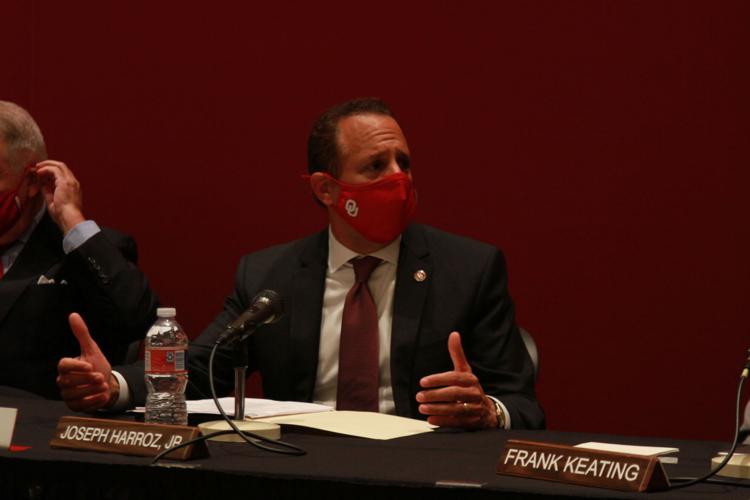
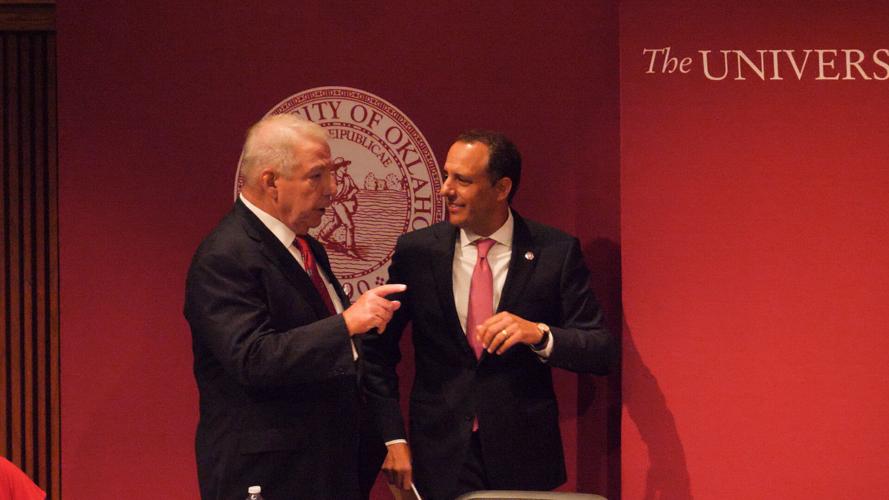
OU Regent Michael Cawley and OU President Joe Harroz at the OU Board of Regents meeting for the Sooners' move to the SEC on July 30.
According to a Feb. 21 press release from SEC Conference Commissioner Greg Sankey, the SEC divided $657.7 million of total revenue among its 14 universities for the 2019-20 fiscal year that ended on August 31, 2020. Each university received an average amount of slightly over $45.5 million, excluding bowl money retained by participants.
With the potential for an influx of new money, OU academics could also stand to benefit from the switch, like how the University of Kentucky athletics department contributed $65 million toward building a new science building, which opened in 2016.
Michael T. Benson, president of Coastal Carolina University and a veteran administrator of higher education, spoke to The Daily about the impact of OU joining the SEC on the university’s admissions and academic standards. He argued football conferences should put a higher premium on academic performances and “institutional fit” when selecting new members.
“Simply defined, institutional fit means how a proposed member institution might mesh with other universities within a conference,” Benson said. “Do they have comparable student body populations? Are there endowments similar in size? Are they large land-grant institutions or flagship universities within their respective states? What are their alumni bases like? Are those alumni bases congregated in cities within the conference footprint? Does an institution have a teaching hospital or medical school or other professional schools that are similar to other institutions? All these factors, and many more, figure into the calculus of ‘institutional fit.’”
‘Our aspiration to become an AAU-caliber institution’
OU President Joseph Harroz said in his speech during the Board of Regents meeting on July 30 that the university’s conference shift is “a significant decision in the 130-year history” of OU, as it will impact not only athletics, but also the “broader university.”

OU President Joseph Harroz speaks during a Board of Regents meeting.
Harroz said OU shifting to the SEC has two primary focuses that are “imperative” for its intercollegiate athletic programs: to remain a premier national caliber athletics program and to continue having an athletic budget not subsidized by the state.
“We have to ask the question: ‘Are we putting ourselves on a path to be worthy of a legacy?’ We have to advance it over time,” Harroz said. “We look at those things that are absolute because it impacts so much.”
According to the College Athletics Financial Information database from the Knight Commission on Intercollegiate Athletics, UT ranks first in the Big 12 athletic revenue rankings with a total of $223,879,781, followed by OU, whose total athletic revenue was $163,126,695 in 2019.
In a July 30 email from Harroz to the OU community, he said joining the SEC is the best option to preserve OU’s athletic reputation.
“It's our obligation as stewards of our institution to ensure that OU has a conference home that will best position us to honor, preserve and continue our tradition of athletic excellence for decades to come,” Harroz said in the email.
Academically, Harroz said OU’s conference shift will advance the university’s purpose of fulfilling its Strategic Plan in order for OU to become a member of the Association of American Universities in the future.

“Much of our plan speaks to our aspiration to become an AAU-caliber institution, with benchmarks based on the criteria by which AAU institutions are judged,” Harroz said in the email. “A move into a conference with more AAU institutions provides us the chance to align OU further and more closely to the standards we will need to meet to reach our goal.”
Benson said the AAU, which he considers to be the real “power conference,” is the most “prestigious” and “exclusive” university association in the U.S. According to the AAU membership policies, the organization has two phases of requirements to evaluate the possibility of a university’s membership, with phase I divided into four criteria: competitively funded research support, membership in national academies, faculty awards, and fellowships and research citations.
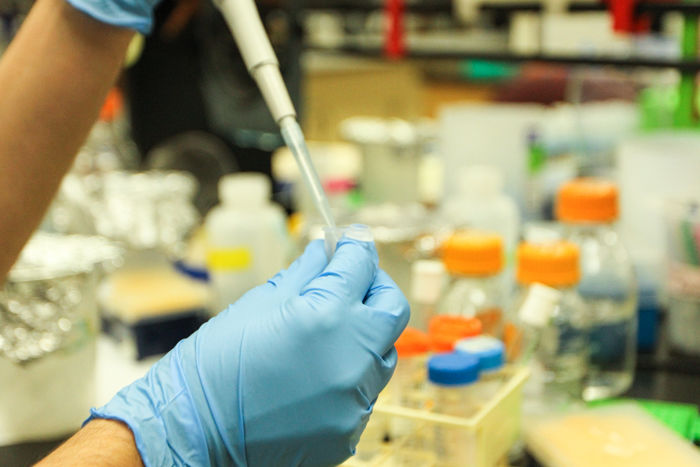
Student pipetting a solution into a centrifuge in a lab.
Although Benson said the institutional fit is “paramount” for any football conference considering possible members, he said he is unsure whether the SEC considers membership in the AAU to select future members.
“How much sponsored research a university engages in annually or members of the faculty in learned societies or faculty citations in prestigious journals are all factors for AAU membership,” Benson said in a follow-up email. “But I’m not sure these factor into the equation as much as brand and program recognition and athletic success might weigh in the balance for presidents, chancellors and directors of athletics.”
Once UT joins the SEC, it will become the fifth AAU university in the conference alongside Vanderbilt, Mizzou, Texas A&M and Florida, bringing the AAU membership in the SEC to over 20 percent.
‘Big disparity in terms of sponsored research’
According to the National Science Foundation, UT is ranked 35th at $652,187,000 annually by total research and development expenditures as of 2017, and OU is ranked 84th at $272,239,000 annually. According to OU’s research metrics for fiscal year 2020, the Norman campus spent $188,090,700 on research and sponsored programs.
“That’s a pretty big disparity in terms of sponsored research,” Benson said.
Benson said although college athletics are a hot commodity in the U.S., universities must not lose sight of their main purpose to teach and develop new knowledge.
“Sports are an important part of our kind of cultural identity as a country — a big business in many ways. Whether it's athletics, student life, (greek) life or dining halls, these things are ancillary,” Benson said. “Now, what happens in the classroom, that relationship between faculty and students — particularly those that go on to develop new knowledge — that's what universities are about.”
Benson said he expects OU to boast more scholarship opportunities after it joins the SEC since it will count on a larger athletic budget. According to the NCAA finances ranking, the university’s total revenue — which reflects the latest 2018-2019 fiscal year — is $163,127,000. UT leads with a total revenue of $223,879,781 from the same year.
Although Benson said in his article that he is aware of the “multi-billion dollar industry” that college athletics represent, he also recognizes the importance of the universities’ research aspects and their impact on societies.
“I'll be in here, in our (Coastal Carolina University stadium) in two weeks for a football game, and I'll be cheering alongside all of our other fans,” Benson said. “But at the end of the day, institutions are about educating citizens to improve themselves, but also to improve the lives (we) live every single day that are positively impacted by products that have come out of research universities.”


